
What this will do for you
Someone tells you God elected who would be saved before the world began, and hands you the doctrine. Election. It is in your Bible, they say, and it means what Calvin said it means: the act by which God selected which individuals would be saved. That is what I mean by Calvinist election in the title, and that is the thing I went looking for. What is left to say?
The word is left to say. The noun itself.
“Election” appears seven times in the Greek New Testament. “Elect,” the adjective, twenty-three. The God Chose Judas essay read the verb, every named man God chose, forty of them, and found every one chosen to a task. Judas was the verb. This is the doctrine. This essay reads the noun the confessions built their article on, the adjective that names the people, the three groups Scripture gives the title to, what the text says election is for, and where “to salvation” got attached. Behind it sits a count of every occurrence of the whole family in Hebrew, Septuagint, and Greek, two hundred forty-seven, on the audit page.
By the end you will know what election means when the Bible uses the word, where the confessions got the meaning they gave it instead, and why you can say “election” without flinching. The doctrine is yours. It was always yours. This essay is the word across the whole Bible. Its companion, The Address of Election, is the one letter they lead with, Ephesians, and what that letter says about how a person comes to be in Christ. Read this one first.
One rule, before we start
Read every occurrence, and count. Not what a verse could mean. What the Book says the word is, every time it says it.
Exhibit one: the word “election,” seven times
Start with the noun, because it is the word in the title. Any concordance lists its seven uses. What I have not seen done is reading the seven for what each one governs, and that is the count that matters.
Ekloge (G1589), “election,” appears seven times in the New Testament. Acts 9:15. Romans 9:11, 11:5, 11:7, 11:28. 1 Thessalonians 1:4. 2 Peter 1:10. That is all of them. It does not appear in the Greek Old Testament at all. Not once in the Law, the Prophets, or the Writings. The word the doctrine is named for arrives in Paul with no scriptural history behind it.
Now read what the seven do. In none of them does the noun say what anyone is elected to. No “election to salvation.” No “election unto life.” No “election to” anything. Three times it is an “according to” phrase describing some other word, the way “according to plan” describes the plan. In Romans 9:11 the other word is purpose: election is how the purpose stands, not a place the purpose is headed. In 11:5 the other word is remnant. In 11:28 it stands beside “as concerning the gospel,” two ways of looking at one people. Once it describes a vessel, Acts 9:15, a “chosen vessel,” and the “to bear my name” that follows is what the vessel is for, not what the choosing is for. Once it is the one doing something, Romans 11:7, “the election hath obtained it,” a people getting what Israel sought. And twice it is the thing a man does something to: knowing it, 1 Thessalonians 1:4, and making it sure, 2 Peter 1:10.
Dort's article is titled election and its sentence is “God chose in Christ to salvation a definite number,” a verb with a goal attached. The noun the article is named for has no “to” in any of its seven verses. It names a people's standing, a purpose's ground, a remnant's character, and a thing a man knows and secures. It never names a destination. In Greek the test is simple: the family is never followed by eis soterian, unto salvation, or by any form of sozo, to save, as its purpose. The one place eis soterian follows a verb of choosing is 2 Thessalonians 2:13, and the verb there is haireo.
Exhibit two: who the Bible calls elect
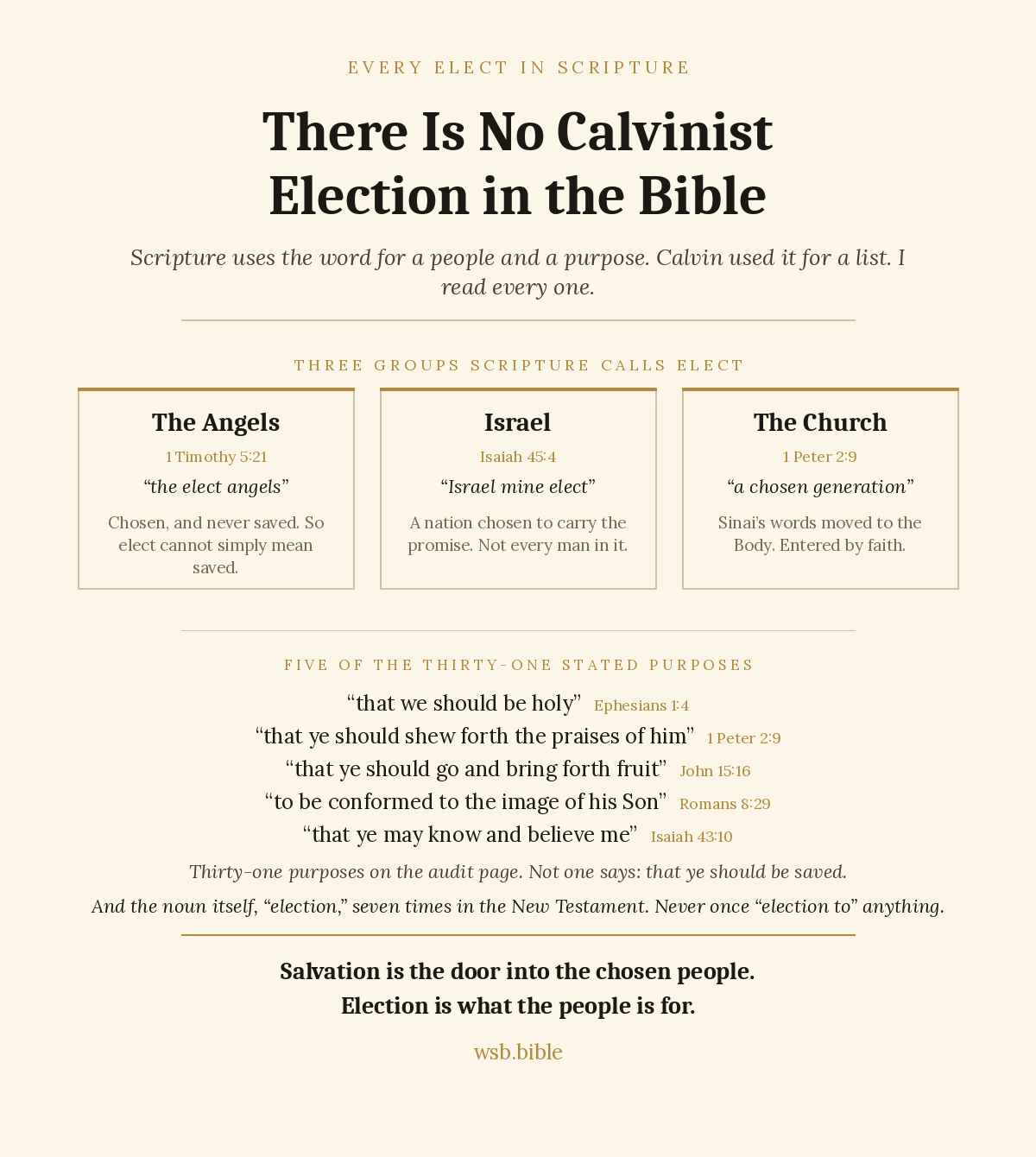
The adjective, eklektos (G1588), twenty-three times, and the King James renders it both “elect” and “chosen”: “God's elect” at Romans 8:33 and “a chosen generation” at 1 Peter 2:9 are the same word. Read who carries it.
Scripture calls three groups elect. It also calls Christ elect, and it names forty men God chose by name, every one to a task; the God Chose Judas audit lists them. The groups are three.
The angels. “I charge thee before God, and the Lord Jesus Christ, and the elect angels.” (1 Timothy 5:21) Angels are not saved. “For verily he took not on him the nature of angels.” (Hebrews 2:16) No incarnation for them, no atonement, no gospel. The fallen ones are reserved in chains (Jude 6) with no door back. So here is the one group in Scripture where salvation is impossible, and the word elect is applied to them anyway. If elect always meant saved, it could not be said of angels. It is said of angels. So whatever the word means, it does not mean saved by definition, and the other side's own reading of this verse has to make the angels an analogical use. The count says the angels are a real use, not a footnote. And Westminster III.3, “some men and angels are predestinated unto everlasting life,” cites this verse, 1 Timothy 5:21, as its text for the angels.
Israel. “For Jacob my servant's sake, and Israel mine elect.” (Isaiah 45:4) A nation chosen to carry the promise, and inside it, men cut off. “the LORD shall blot out his name from under heaven. And the LORD shall separate him unto evil out of all the tribes of Israel.” (Deuteronomy 29:20-21) Separated out of the very tribes the choosing made. The election of the people stood. The standing of the man did not.
The Church. “But ye are a chosen generation, a royal priesthood, an holy nation, a peculiar people.” (1 Peter 2:9) Peter is quoting Exodus 19:6, the words spoken to Israel at Sinai, and giving them to the Body. The same corporate identity, moved from the nation to the Church. You are in the third the same way the first two work: a people called to a purpose, and standing inside it is not automatic.
Three groups, one adjective, and the first group cannot be saved. That is the word's range. It names a people set apart, and it names them for something.
Exhibit three: what election is for
Now the purpose clauses, because that is where the doctrine's content is. When Scripture names someone elect or chosen and then says why, what does it say?
“he hath chosen us in him before the foundation of the world, that we should be holy and without blame before him in love.” (Ephesians 1:4) Holiness.
“ye are a chosen generation... that ye should shew forth the praises of him who hath called you.” (1 Peter 2:9) Praise.
“I have chosen you, and ordained you, that ye should go and bring forth fruit.” (John 15:16) Fruit.
“Elect according to the foreknowledge of God the Father, through sanctification of the Spirit, unto obedience and sprinkling of the blood of Jesus Christ.” (1 Peter 1:2) Obedience. The one place “elect” is followed by an “unto,” and the “unto” is obedience.
“whom he did foreknow, he also did predestinate to be conformed to the image of his Son.” (Romans 8:29) Conformity, and I mark this one: it is the destination of people the verse before has already named, and the other side reads it as glory. It is on the list because it is a stated purpose. It does not by itself prove the purposes ignore salvation.
“Ye are my witnesses, saith the LORD, and my servant whom I have chosen: that ye may know and believe me.” (Isaiah 43:10) Witness.
“he is a chosen vessel unto me, to bear my name before the Gentiles.” (Acts 9:15) A name to carry.
I gathered every stated purpose of a divine choosing in the Bible, verb, noun, and adjective. Thirty-one of them. A place to put his name. A special people unto himself. To be my priest, to offer, to burn incense, to wear an ephod. To be king. To carry the ark. To build an house. As a signet. To stand in the breach. To bring forth judgment to the Gentiles. To be holy. Unto obedience. To shew forth praise. To bring forth fruit. To be conformed to the image of his Son. To bear my name. To confound the wise. That no flesh should glory. That the purpose of God might stand.
Thirty-one purposes, in the text's own words. Not one of them is “to be saved.”
That is the finding, and everything else in this essay is the count behind it. Election in Scripture is a people chosen for a purpose. Salvation is how a person comes into the people, and the elect Church is saved people; the word stands beside salvation constantly. What the word never does, in any row, is name the sorting.
And the verb behind the noun agrees. In the Old Testament God chooses a hundred times, and nearly half of those, forty-nine, the thing chosen is a place; thirty are persons chosen to offices; twenty-one are a nation. In the Greek Old Testament the adjective is ordinary, Pharaoh's fat cows and Assyria's picked soldiers, and the corner stone of Isaiah 28:16 is eklekton, the verse Peter quotes when he calls Christ “elect, precious.” The word means picked out, for something. The full tables are on the audit page, and the forty named men are on the Judas page.
Exhibit four: election known, made sure, obtained
If election names a people and not a list, the Book will use the word of the people in ways that only make sense if they came in by answering. It does, four times, with the word itself.
“Knowing, brethren beloved, your election of God. For our gospel came not unto you in word only, but also in power... And ye became followers of us... having received the word.” (1 Thessalonians 1:4-6) Paul knows their election. How? The next word is “for,” and “for” gives the reason. Because the gospel came, because they received it, because they turned from idols. Election here is known by what they did with the gospel.
“Wherefore the rather, brethren, give diligence to make your calling and election sure.” (2 Peter 1:10) Make it sure. A command to the man, about his election, with “if ye do these things” attached. The other side reads both of these verses as election known by its fruit and confirmed in assurance: the man active in diligence, passive in the decree. That is their reading and it is coherent. I refuse the split, because Paul does not write “knowing the fruit of your election” and Peter does not write “make your assurance of it sure.” Both name the election itself as the thing known and the thing made sure, and neither adds a decree behind it. That is a reading, and I am naming it as one.
“Hath not God chosen the poor of this world rich in faith, and heirs of the kingdom?” (James 2:5) Chosen, and described by the faith they hold.
“the election hath obtained it, and the rest were blinded.” (Romans 11:7) And read what the rest were blinded for and whether it holds: “because of unbelief they were broken off” (11:20), and “if they abide not still in unbelief, shall be graffed in” (11:23). The election obtains; the rest refuse; the refusal is reversible.
How a person comes into Christ, heard, believed, sealed, by the gospel, is the Address of Election essay, from Ephesians. This exhibit is narrower: the election word itself, used of people already in, known by their reception, secured by their diligence, described by their faith, and set against a “rest” whose blindness has a cause and a cure. Salvation is the door. The word names what is on the other side of it.
The word beside it: beloved
They will say the election is grounded in a distinguishing love, God's love for the elect and not for the rest, and they will point to “elect” and “beloved” standing side by side: “the elect of God, holy and beloved” (Colossians 3:12), “brethren beloved of the Lord... chosen you” (2 Thessalonians 2:13), “brethren beloved... your election” (1 Thessalonians 1:4), “as touching the election, they are beloved” (Romans 11:28). Four places, and in all four the two words are titles standing together, never one sorting the other, and the fourth calls the same people enemies in the same sentence.
So I counted the love too. Every place God or Christ is the one loving, sixty-five in Hebrew and Greek, with the stated object of the love in each. The objects: the world, mankind, sinners, a nation, the church, the disciples, Christ, named persons, the stranger. In one row salvation is the stated purpose of the love, and it is the one everyone knows: “For God so loved the world, that he gave his only begotten Son, that whosoever believeth in him should not perish.” (John 3:16) The object is the world. The condition is whosoever believeth. “God commendeth his love toward us, in that, while we were yet sinners, Christ died for us.” (Romans 5:8) The object is sinners, fixed at the moment of loving. “and loveth the stranger, in giving him food and raiment.” (Deuteronomy 10:18) And one man settles it alone: “Then Jesus beholding him loved him” (Mark 10:21), and the next verse, “And he was sad at that saying, and went away grieved” (10:22). Divine love, stated, whose object walked off.
Three rows make the love answering: “the Father himself loveth you, because ye have loved me, and have believed that I came out from God.” (John 16:27) Because ye have loved. God's love is never once said to be for the salvation of a sorted set with no wider object in the passage. The full table is on the audit page. Distinguishing love is not in the count. Love for the world, for sinners, for the stranger, and for the man who walked away is.
Exhibit five: the position, in plain words
So you know what you are reading, this is what I hold.
God chooses. He chooses a people, and He chooses persons to offices inside that people, and He says what He chooses them for. The Church is that people now, chosen in His Son before the world. A person enters the Church as an individual, by faith, in time. Once he is in it, everything said of the chosen is said of him.
You are allowed to say elect. You are allowed to say chosen. You are allowed to say election. The words were never the other side's. They were the Book's, and the Book uses them for what a people is for. Rob Congdon put it in one sentence: three groups in the Bible are called elect, and in all three it refers to a group serving God. William Klein, Roger Forster and Paul Marston argued the corporate reading before I was reading. This essay adds the count. How a person comes into that people, in the letter they lead with, is the Address of Election essay, and it picks up where this one stops.
The verses they will bring
This stretch is for the day someone tells you the count is sloppy. Their best texts, in their strength, and where each one lands.
Romans 8:33. “Who shall lay any thing to the charge of God's elect?” There is the word, they will say, at the end of the golden chain, and the chain's first link, “whom he did foreknow,” means fore-loved, not foreseen, so the elect are individuals loved before they did anything. Read where the chain starts. 8:29 opens “whom,” and “whom” has to point back to someone already named, and 8:28 has just named them twice: “them that love God,” “the called according to his purpose.” Whatever foreknow means, its object is the people 8:28 has already described. And twenty verses back the chapter defined its sons the same way, with an if: “if ye through the Spirit do mortify the deeds of the body, ye shall live. For as many as are led by the Spirit of God, they are the sons of God” (8:13-14). The chain's terminus is not rescue but resemblance, “conformed to the image of his Son.” And “elect” appears in Romans 8 exactly once, at 8:33, after the chain is finished, inside a courtroom question about who can accuse them. Salvation is unmistakably in Romans 8; the chain ends at glorified. But the word arrives after, as a title for people already named, in a sentence about their security. It does not do the sorting.
Romans 9:11 and 11:5. “The purpose of God according to election.” “A remnant according to the election of grace.” There is the list inside the people, they will say, and 9:11 says “not of works.” Not of works I hold; faith is not a work, Paul says so at 4:5. 9:11 is Jacob before Esau, and 9:12 quotes Genesis 25:23, “Two nations are in thy womb,” and 9:13 quotes Malachi, whose next line is about Edom's mountains. A line, and two nations. The Grammar of Romans essay walks it with Malachi beside it. And 11:5's remnant comes with its own explanation two paragraphs up: broken off for unbelief, grafted in on its ceasing. They will say the graftable “they” of 11:23 is Israel after the flesh, national branches, not the remnant of 9:11, and that is their reading and it is on the page. Mine is that Paul uses one figure, the olive tree, for both the breaking and the grafting, and gives one cause, unbelief, and one condition, its ceasing. And 11:28 says the same people are “enemies” as concerning the gospel and “beloved” as touching the election, in one verse. Only a people can be both at once.
2 Thessalonians 2:13. “God hath from the beginning chosen you to salvation through sanctification of the Spirit and belief of the truth.” Chosen to salvation, in English, and this is where the confessions' phrase comes from. The verb is heileto, from haireo (G138), an ordinary word for choosing that is not the family this essay counts, which is why the verse is on this page and not in the table. Now read the sentence to its end and the verses around it. The means are in the same breath: through the Spirit's sanctifying, and belief of the truth. Three verses earlier, the perishing are named: they “received not the love of the truth, that they might be saved” (2:10), and “believed not the truth” (2:12). One verse later: “Whereunto he called you by our gospel” (2:14). The passage draws its own line between the saved and the lost, and the line is belief of the truth against refusal of it. The “you” chosen to salvation is a church, and it is chosen through the very belief the perishing withheld, and two verses on it is commanded: “Therefore, brethren, stand fast, and hold the traditions” (2:15). “From the beginning” I hold. What the verse does not say is that God chose who would believe. It says the chosen are the believers, and it says who the others are.
Acts 13:48. “as many as were ordained to eternal life believed.” Read the sermon it closes. Nine verses earlier Paul offers it to everyone: “by him all that believe are justified from all things” (13:39), and before that, “to you is the word of this salvation sent” (13:26). Then the warning to despisers (13:40-41), then the refusal (13:46), then 13:48. The verb is tasso (G5021), not the family, and a different verb from the potter's katartizo. What the two share is the grammar. The word means “having been set” or “having set themselves,” and the sentence never says who did the setting. They read it as God, setting men to eternal life before they believed. That is a possible reading, not a proven one, because in Greek “they were set” and “they set themselves” are spelled exactly the same way here, the same as the potter's “fitted” in Romans 9:22, so the word alone cannot tell you which. And the same verb two books on from Acts is men who “addicted themselves to the ministry” (1 Corinthians 16:15): they did the setting, and they did it to themselves. The word carries that sense in Paul. And the verse before it has the Jews who “put it from you, and judge yourselves unworthy of everlasting life” (13:46). The refusers dispose themselves first. Then the disposed believe.
2 Timothy 2:10. “I endure all things for the elect's sakes, that they may also obtain the salvation which is in Christ Jesus.” This is the closest the Bible comes to putting the word beside salvation as a goal, and the other side reads it as their proof: Paul suffers for people already elect and not yet saved, so election comes before salvation and apart from it. That is their reading, and it belongs on this page. Now read the chapter around it. The means is in the verse before: “the word of God is not bound” (2:9). The people Paul calls elect are named by the Lord's knowledge and by their own conduct in one verse: “The Lord knoweth them that are his. And, Let every one that nameth the name of Christ depart from iniquity” (2:19). And the word “elect” is fenced on every side by conditions on the same people: “if we deny him, he also will deny us” (2:12), “If a man therefore purge himself” (2:21), “if God peradventure will give them repentance... that they may recover themselves” (2:25-26). Paul does not know who the elect are. He endures so that the unbound word reaches whoever they will be, and the chapter says how they are known: by the Lord, and by departing from iniquity. Elect before saved, yes. Elect apart from response, the chapter never says, and it says “if” five times. They will also bring 1:9, twenty verses back: “Who hath saved us, and called us with an holy calling, not according to our works, but according to his own purpose and grace, which was given us in Christ Jesus before the world began.” Not according to works, and I hold it. Read where the grace was given: in Christ Jesus. The location again, and “saved us, and called us” is said of people already there.
Matthew 22:14. “many are called, but few are chosen.” Read the parable, and the two before it. Three parables of refusal in a row, the two sons, the husbandmen, the wedding: and in this one, “they would not come” (22:3), and “they made light of it” (22:5). The same “would not” Christ says over Jerusalem a chapter later. I read the parable it closes as a sequence: the hall filled with everyone found, one man without a garment cast out, then the line, so the chosen are those left in the hall. They read the garment as given and the line as decree, not timeline. That is a reading against a reading, and I am naming mine as mine.
Romans 8:30, the chain, and John 6:37-39. Called, justified, glorified with no link missing; and “all that the Father giveth me shall come to me... and I will raise him up at the last day.” Neither uses the election family, and both are the other side's strongest texts for a fixed number. The chain's first link is a described people at 8:28, as above. On John 6, read the whole discourse. It opens with “This is the work of God, that ye believe on him whom he hath sent” (6:29), and it says of the crowd, “ye also have seen me, and believe not” (6:36). They will bring 6:65, “no man can come unto me, except it were given unto him of my Father.” True, and nobody comes unaided. Then read what Jesus says the Father's giving looks like, in the same speech. “And this is the will of him that sent me, that every one which seeth the Son, and believeth on him, may have everlasting life” (6:40). “Every man therefore that hath heard, and hath learned of the Father, cometh unto me” (6:45). Jesus explains the giving Himself, and His explanation is seeing, believing, hearing, learning. Two things done first, hearing and learning, and then a man comes. That is the Father's drawing in Jesus's own words, and it is a teaching, not a transfer. John 6 deserves its own essay, and it will get one. But it is not unanswered here.
Ephesians 1:4-5 as one sentence. Chosen in him, and predestinated unto adoption, in one breath. The other side reads the sentence as one act with one object. Read the two purpose clauses: chosen “that we should be holy,” predestinated “unto the adoption of children.” Two purposes, holiness and sonship, and neither is the act of being saved. The Address of Election essay walks the sentence.
Deuteronomy 7:6-8. The classic unconditional text. “The LORD did not set his love upon you, nor choose you, because ye were more in number than any people... But because the LORD loved you.” (7:7-8) The object is a nation. The purpose is a status, “a special people unto himself.” The basis is love and the oath to the fathers. It does not say who will be saved. And read the next two verses: “the faithful God, which keepeth covenant and mercy with them that love him and keep his commandments” (7:9), and “repayeth them that hate him to their face” (7:10). The chosen nation is put under conditions before the paragraph ends: “if ye hearken to these judgments” (7:12). And twenty verses on, a perish warning on the same nation: “if thou do at all forget the LORD thy God... ye shall surely perish... because ye would not be obedient” (8:19-20). Would not. The same book says the man inside the nation can be cut out of it.
Isaiah 43:10 is the strongest verse against me in the Old Testament, and I will say so. “My servant whom I have chosen: that ye may know and believe me.” Bacharti in the Hebrew, the verb bachar, and the Septuagint renders it with eklegomai, the verb of Ephesians 1:4; one verse, all three texts. That is a stated purpose with “believe” in it. Read the whole verse: “Ye are my witnesses” comes first, the scene is a courtroom where Israel is called to testify, and the knowing is what a witness needs. A task with a knowledge requirement. It is the nearest approach in two hundred forty-seven occurrences, and it names the task before the knowing. They will bring 43:1 with it, “I have redeemed thee, I have called thee by thy name.” Redeemed, called, chosen as witness. And twelve verses later the same chosen witness is rebuked: “But thou hast not called upon me, O Jacob... thou hast wearied me with thine iniquities” (43:22, 43:24). The chosen people, redeemed and named, did not call, and the chapter says so.
None of this finishes the count. It says their texts were not left off the table.
Exhibit six: where “to salvation” was attached
John Calvin, defining the doctrine, in his own words: “By predestination we mean the eternal decree of God, by which he determined with himself whatever he wished to happen with regard to every man. All are not created on equal terms, but some are preordained to eternal life, others to eternal damnation.” With regard to every man. Some, others. That is a distribution over individuals. That is the list.
The Canons of Dort say God “chose in Christ to salvation a definite number of particular people.” Westminster says God “hath chosen, in Christ, unto everlasting glory.” Both attach “to salvation” or “unto glory” as the object of the verb.
So I traced where they got it. Westminster's election article cites its proof texts, and two of them contain the word family. Ephesians 1:4, whose stated purpose is “that we should be holy.” Romans 9:11, whose stated purpose is “that the purpose of God might stand.” The rest do not contain the word. The article that says “some men and angels are predestinated unto everlasting life” cites 1 Timothy 5:21 for the angels, an oath formula in which the elect angels witness a charge. The article on a number that “cannot be increased or diminished” cites John 13:18, the one verse where the word's reach visibly shifts, Judas inside the choosing at 6:70 and outside it at 13:18. And the article on reprobation, the one that consigns the rest of mankind to wrath, cites six verses and not one of them contains “elect” or “choose.”
“To salvation” comes from two verses outside the word family, 2 Thessalonians 2:13 and Acts 13:48. One shares its verb with Moses and Paul making choices. The other names no agent. The word's own hundred and fifty-nine uses with God as the chooser supply a place, a people, and an office.
That is where “to salvation” was attached. Not from the word. From two verses that do not use it, attached to a noun that in seven uses never governs a destination, and to a verb whose stated purposes are thirty-one and none of them salvation.
Where that leaves election
Election is a people chosen for a purpose. A person comes into that people by faith.
That is where two hundred forty-seven occurrences leave it. The noun never names a destination. The adjective names three groups, one of which cannot be saved. The purpose clauses say what the chosen are for, thirty-one times, and not one says “to be saved.” The word is used of people known by their response, told to make it sure, and set against a “rest” whose blindness has a cause and a cure.
Salvation is how a person comes into the chosen people: heard, believed, sealed, by the gospel. Election is what the people is for once they are in. Scripture keeps the two apart, in every row I found. The confessions join them, and I have shown where.
I do not claim the word never appears near salvation. It does, constantly, because the elect Church is saved people. I claim the word never names the sorting. That is a count, not a reading, and the table is on the page.
The verdict
Elect angels, and no angel is saved.
Elect Israel, and men cut out of its tribes.
Elect Church, known by its response and told to make its election sure.
Election, seven times, and never once with a “to.”
Chosen for a purpose, thirty-one times the text says why. Not once for a list.
Say elect. Say chosen. Say election. The Book gave you all three, and it told you what they are for.
“ye are a chosen generation, a royal priesthood, an holy nation, a peculiar people; that ye should shew forth the praises of him who hath called you out of darkness into his marvellous light.”
Chosen. Called. And the choosing is for the praise.
Every count in this essay comes from the complete census, published in full at Every Election: 247 occurrences of the word family in two languages, three texts, 159 of them with God as the one choosing, every row classified and every stated purpose quoted.
Scripture quoted from the King James Version. Greek and Hebrew forms verified against the tagged Greek New Testament and the Masoretic text (STEPBible TAGNT and TAHOT, CC BY 4.0) and Swete's Septuagint. Greek New Testament claims run on the Textus Receptus, the text underlying the King James. Calvin quoted from the Beveridge translation; the Canons of Dort from the Christian Reformed Church text; the Westminster Confession from the Orthodox Presbyterian Church text, with its Scripture proofs from the Westminster Seminary and Blue Letter Bible editions.
This essay is original to The Whosoever Study Bible. The word counts, the grammatical readings, and the Seven Threads reading are original scholarship. All rights reserved. Platform use under Revelation 22:17, free to all who come.