
What this will do for you
You have probably been in this argument. Someone says God chooses who gets saved, and points to Romans 9. The potter. The clay. The vessels. And the argument stops there, because it is their chapter, and you are fighting on their ground.
I am going to hand you the whole letter.
By the end of this, Romans 9 will not be the chapter that stops you. You will know what it is actually about. And you will be able to move the argument off the one chapter it always gets stuck on, and onto the fifteen chapters nobody quotes.
If someone handed you one verse and you came here for that verse, go straight to it. Romans 8:30 is at Read the chain from the top. Romans 9:16 and 9:18 are at The two verses they lead with. Romans 9:21 is at Their best picture: the potter. Romans 9:22 is at Paul defined these words before he used them. Then come back and read the whole thing, because the whole thing is the point.
The rule my father-in-law gave me
First, one tool. It runs through everything below.
My wife's father, Pastor Frank, taught me how to read the Bible. He is with the Lord now. But the rule he gave me is in every chapter I open.
He called it 20/20 vision. Never read a verse by itself. Read the verses around it. And when the argument is big, read the whole book.
Romans 9 is what happens when people forget that rule. Someone reads one verse about a potter. They build a whole system on it. And they never look at the verses around it, or the letter it sits in.
So that is what I am going to do. I am going to put Romans 9 back in the room it was speaking in.
Exhibit one: the word that is missing
Start where they never start.
Romans has sixteen chapters. The first five explain how a guilty person gets made right with God. That is the most important question in the whole book. How am I saved?
So go read those five chapters. Read them looking for the word “election.” Read them looking for “predestination.”
The words are not there.
Not in chapter 1. Not in chapter 2. Not in chapter 3, where Paul explains how we are justified. Not in chapter 4. Not in chapter 5.
Five chapters on how to be saved.
Zero mentions of election.
Zero mentions of predestination.
Think about what that means.
If God secretly chooses who gets saved, and that choosing is the main event, then the five chapters about getting saved are a strange place to leave it out completely. You would expect it in chapter 3. You would expect it in chapter 4, where Paul argues about who gets counted righteous. You would expect it at the start of chapter 5, where he sums the whole thing up.
It is not there.
Paul had the word. He uses it four times in this letter, and all four are in chapters 9 and 11. He just does not use it here, in the one place it would matter most.
Exhibit two: the word he uses instead
So what does Paul reach for, in those five chapters?
Three times, he sums up how a person is made right with God. Three times, and every one of them starts with the same word. Therefore.
“Therefore we conclude that a man is justified by faith without the deeds of the law.”
“Therefore it is of faith, that it might be by grace...”
“Therefore being justified by faith, we have peace with God through our Lord Jesus Christ.”
Three therefores. And every one lands on faith.
That is his answer to the most important question in the book. No secret list and no hidden decree. Faith.
Exhibit one and two together say one thing. The book everyone calls the election letter leaves election out of the part about getting saved. That is not my opinion. That is what is on the page. Open the first five chapters yourself and look for the word election. It is not there.
The best answer they have
Someone will answer this a particular way, and it is the best answer they have, so let me put it on the table.
They will say faith is itself a gift. Ephesians 2:8, “For by grace are ye saved through faith; and that not of yourselves: it is the gift of God.” So my count of faith words counts for His sovereignty, not against it. Every time Paul says believe, that is God's giving.
That argument rests on one verse in another letter.
But notice what has happened. To answer a question about where Paul put his words in Romans, they had to leave Romans.
And they did not need to. Romans answers it without leaving Romans. “So then faith cometh by hearing, and hearing by the word of God.” (Romans 10:17) Faith comes by hearing preaching. It is produced by a message, and the message goes out to whoever will hear it.
I am asking one thing. Paul spent five chapters explaining how a guilty man gets right with God, and he never used the word. Not once. That question does not get answered from another letter. It gets answered from this one.
Exhibit three: watch the grammar change
Now I want to show you something in how Paul writes. This is the part nobody taught me.
For the first four chapters, sin is a thing you did. “All have sinned.” Sin is the action of a person.
Then at chapter 5, verse 12, something changes. “Sin entered into the world.” Now sin is not a thing you did. Now sin is the thing doing.
Watch it act. Sin entered. Sin reigned. Sin worked in me. Sin deceived me. Over the next few chapters, Paul makes sin the actor again and again.
Then you reach chapter 8, and sin stops acting. It goes quiet. And a new character floods the chapter. The word Spirit shows up twenty-one times in that one chapter, after barely appearing in the whole letter before it.
Why does this matter? Because it proves there are two different problems in Romans, not one.
Problem one is the sins you committed. Things you did. Paul answers that with the cross and with faith. That is chapters 1 through 5.
Problem two is deeper. Sin is not just what you did. It is a power living inside you. And Paul does not solve that problem the same way.
He does not solve it with faith. Faith almost disappears in chapters 6 through 8. The word appears once in those three chapters, after thirty-six times in the five before. He solves it with union. You were buried with Christ. You were crucified with Him. It already happened to you. Then two commands: count it true, and give yourself to God.
Keep that in your pocket. Two problems, two solutions. It matters when we get to the map.
Read the chain from the top
Before we get to chapter 9, there is one passage in chapter 8 they lead with, and it deserves its own stop.
Romans 8:29 and 30. Foreknew, predestinated, called, justified, glorified. The Reformed confessions call it the golden chain. Five links, no leakage. Everyone foreknown finishes glorified.
I agree with the no-leakage part. Everyone in that chain finishes. The question is where the chain starts and what it is toward.
Most people start quoting at verse 30. Read verse 29 first.
“For whom he did foreknow, he also did predestinate to be conformed to the image of his Son, that he might be the firstborn among many brethren.”
Two things in that verse. Foreknowing comes before predestinating. And the predestinating has a stated destination. Conformed to the image of his Son. Paul says what the predestined are predestined to. He does not say predestined to believe. He says predestined to become like Christ. The destination is on the page. The entry is not.
Now read verse 28, because the sentence does not start at 29 either.
“And we know that all things work together for good to them that love God, to them who are the called according to his purpose.”
Paul names the group before he chains them. Them that love God. That is the “whom” of verse 29. He identifies the foreknown by their love before he says one word about foreknowing.
They will answer that the loving is itself produced by God, and 1 John 4:19 says we love him because he first loved us. Fair. I am not claiming the love proves they moved first. I am claiming Paul identifies them by what they do, not by a decree, and that the chain never says predestinated to believe.
Now the confessions. The Canons of Dort quote Romans 8:30 in the article that defines election, and call it the golden chain. The Westminster Confession cites Romans 8:30 in its chapter on God's decree and again in its chapter on effectual calling. Neither one cites verse 29. Check their proof texts. Both begin the chain one link late, at the verse that names no destination, and both skip the verse that does.
Read the chain from the top and it says what the predestined are for. Read it from the middle and you can make it say what they are.
Now their best chapter: Romans 9
Everything so far has walked us here. And Romans 9 reads completely differently once you know where it sits.
One thing to know before a single hard verse.
The chapter numbers in your Bible are not Paul's. They were added more than a thousand years after he wrote. And sometimes they land in a strange place. This is one of those places.
Chapter 8 ends on the highest note in the letter. Nothing can separate us from the love of God. Then chapter 9 opens with Paul in anguish over his people, the Israelites. We see the chapter break and think a new subject started.
It did not.
Paul goes straight from nothing being able to separate us, to what about Israel, in one breath. And that tells you what chapter 9 is doing before you read a word of it. It is not a new topic. It is the question the love of God in chapter 8 raises: if that love holds us and never lets go, did it fail Israel?
Let me be fair about one thing here, because the other side is right about it. This chapter is about salvation. Paul is not grieving over Israel's lost national role. He is grieving, in 9:3, over kinsmen who are perishing. Anyone who tells you Romans 9 is not about who gets saved has not read the first three verses. So the question is not whether salvation is in view. It is.
The question is how God saves. Does He pick individuals, one by one, before they exist, and pass over the rest? Or does He choose a people in Christ, and let anyone in who believes? That is the whole fight, and Paul answers it in this chapter. Keep watching for which one he says.
And Paul tells you what the section is about himself. Three times. Once at the top of each chapter.
At the top of 9, he lists what belongs to Israel: the adoption, the glory, the covenants, the law, the promises. Every one belongs to a nation.
At the top of 10: “my heart's desire and prayer to God for Israel is, that they might be saved.”
At the top of 11: “Hath God cast away his people?”
That is the question of the whole section, in Paul's own words. Did God keep His word to a people He chose? And before we look at how he answers, hold one fact in your hand, because it governs every use of the word “chosen” from here on. Jesus said, “Have not I chosen you twelve, and one of you is a devil?” (John 6:70) He chose Judas. Judas was lost. When Jesus said “chosen” of Judas, it meant appointed. Every time the word appears below, ask: chosen for what?
Paul wrote the divine side down
One more thing before the hard verses, because it is the move they make against every argument in this essay, and I want it on the table first.
When you show them Paul saying the hardness is the man's, they will say that is the human side. When you show them Paul saying Israel missed it by unbelief, they will say that is the human side. The divine side is the decree behind it. Both are true. No contradiction.
I understand the frame. It is not stupid. And it has one weakness. It only works if Paul never wrote the divine side down.
He did. Seven times in this letter Paul attaches a purpose clause to a hardening, a blinding, or a vessel of wrath. Seven times he says what God was doing it for. Read where every one of them lands.
Romans 2:4. God's longsuffering “leadeth thee to repentance.”
Romans 9:22 and 23. God endured the vessels of wrath “that he might make known the riches of his glory on the vessels of mercy.”
Romans 11:11. “Have they stumbled that they should fall? God forbid: but rather through their fall salvation is come unto the Gentiles.” Paul denies that the fall was the purpose.
Romans 11:15. “The casting away of them” is “the reconciling of the world.”
Romans 11:23. “And they also, if they abide not still in unbelief, shall be graffed in.” Reversible, on a condition.
Romans 11:25. “Blindness in part is happened to Israel, until the fulness of the Gentiles be come in.” Until. Temporal.
Romans 11:32. “God hath concluded them all in unbelief, that he might have mercy upon all.”
Seven purpose clauses. Seven times Paul tells you what God was doing when He hardened. Repentance. Mercy. Salvation to the Gentiles. Reconciling the world. Grafting back in. Until. Mercy upon all.
Not one of them lands on destruction as the aim. Not one says He hardened them so that they would perish.
So when they say the divine side is a decree of destruction behind the human refusal, the answer is short. Paul wrote the divine side down. He wrote it seven times. It says mercy every time.
Hold that as we go into the hard verses. It is the answer to all of them.
Exhibit four: two Israels, and Paul defines them
The first hard verse is 9:6: “they are not all Israel, which are of Israel.” The other side reads this as God secretly picking some Israelites and not others.
Read two verses further. Paul defines his own terms: “they which are the children of the flesh, these are not the children of God: but the children of the promise are counted for the seed.” (9:8)
Two Israels. One by blood. One by promise. The true Israel was never the bloodline. It was always the people of promise, and everywhere else Paul writes, the people of promise are the people of faith. That is not God sorting individuals inside Israel. That is God telling you what Israel always was.
Exhibit five: he answers it about nations
Count what is in these three chapters.
Israel by name, twelve times, and Israelites twice more. Gentiles as a people, seven times. Jacob, Esau, Pharaoh, Abraham, Isaac, Moses, Elias, David, the remnant, the fathers, an olive tree. Forty-three named markers of peoples and nations in ninety verses.
The election words show up four times.
And the two Old Testament passages Paul quotes about Jacob and Esau are both about nations. The first one, before the twins are even born, says “two nations are in thy womb.” Four times in that one verse it says nations and peoples. And this is the fact that ends the individual reading. Esau the man never served Jacob the man. Between the two men it ran the other way. When they met again in Genesis 33, Jacob “bowed himself to the ground seven times” before Esau, called himself “thy servant,” and called Esau “my lord” five times in one conversation. The younger bowed to the elder. It was the nation Edom that served Israel, under David. The prophecy only came true at the level of nations. It cannot be about the two individuals, because at the individual level it never happened.
The second, “Jacob have I loved, but Esau have I hated,” is from Malachi. And Malachi says in the very next verse that he means Edom. A whole nation. Addressed centuries after the man Esau was dead.
Notice what kind of choosing this is. God chose Abram to be the father of a nation. He chose Jacob to be the head of a people. When the Bible shows God choosing a man, it is choosing a head, and the people come from him. That is exactly what Ephesians says about us: “chosen us IN HIM.” Christ is the head. The people are chosen in Him. You join the people the way every verse says you join it: you believe.
Then there is the verse I keep coming back to.
“As concerning the gospel, they are enemies for your sakes: but as touching the election, they are beloved for the fathers' sakes.” (Romans 11:28)
Read it slowly. Same people. Same sentence. Enemies of the gospel, and beloved by election, at the same moment.
Now try reading “election” there as a decree that saves individuals. You end up with God's elect standing as enemies of the gospel while they are elect. It does not work.
Read it as a people, chosen for the fathers' sakes, and there is nothing left to explain.
The two verses they lead with
Here are the two verses that press hardest. I will give each one its best shot.
Romans 9:16. “It is not of him that willeth, nor of him that runneth, but of God that sheweth mercy.”
The strong version of their argument: willing is ruled out by name, and faith is an act of the will, so faith cannot be the ground of mercy.
That verse is answering the question Paul asked two verses earlier: is God unfair? And the answer is that nobody is owed mercy. No man's willing puts God in His debt. That is not the same as saying no man believes.
Now go where the quote came from, because the verse before 9:16 is a quote. “I will have mercy on whom I will have mercy.” That is Exodus 33:19. And that verse carries real weight on the other side. John Piper gives it a chapter of its own in The Justification of God, his book-length defense of the Calvinist reading of Romans 9. Anyone who owns the book can check that.
So read what is around it in Exodus. Chapter 32: Israel has just made the golden calf. God says He will destroy them. Moses pleads. God relents. Then, in 33:19, God says He is free to be gracious to whom He will. The freedom He is declaring is the freedom to PARDON a nation that had just earned destruction. It is not the freedom to pick the damned. And the very next thing He says about Himself, 34:6, is “merciful and gracious, longsuffering.” The sentence “I will be gracious to whom I will be gracious” is a way of saying “and I will not explain myself.” It declines to give reasons. It does not say there are none. So the verse doing that much work in the argument is a verse about God pardoning people who had earned destruction.
And Paul answers the what-decides-it question himself, sixteen verses later, in his own words. Why did Israel miss it? “Because they sought it not by faith, but as it were by the works of the law.” (Romans 9:32)
He asks his own question, and gives his own answer. And the answer is works of the law, not faith. If 9:16 ruled out faith, Paul contradicted himself sixteen verses later and never noticed.
Romans 9:17-18. “For the scripture saith unto Pharaoh, Even for this same purpose have I raised thee up... Therefore hath he mercy on whom he will have mercy, and whom he will he hardeneth.”
They read “raised thee up” as “God made Pharaoh in order to destroy him.” That reading does not survive the Hebrew, and I can show you in two languages, three texts.
So go to the verse Paul is quoting and read it in the languages it was written in.
Exodus 9:16. “For this cause have I raised thee up.”
The Hebrew is he'emadtikha. It is the Hiphil of amad, and amad means to stand. Hiphil is the causative stem. So the sentence reads: I have caused thee to stand.
Not made, and not formed for this. Kept standing.
Now read the same verse in the Septuagint, the Greek Old Testament that was in use before Paul wrote a word. The verb there is dieterethes. You were preserved. Passive. Something was done to keep Pharaoh in place.
Two languages, one picture. God kept a man standing who should have fallen, and the plagues in front of that verse tell you why he should have fallen.
Now the hard part, and I will say it before anyone says it to me.
Paul did not quote that Greek. He changed it. Where the Septuagint has the passive “you were preserved,” Paul writes exegeira se, “I raised thee up,” active, with God as the one doing it.
Someone will say Paul strengthened the verse toward divine agency on purpose. I think that is exactly what he did, and I hold it. God is the actor here. That was never the question.
The question is what He is the actor of. So look at the verb Paul reached for.
Exegeiro. It appears exactly twice in the New Testament. Here, and in 1 Corinthians 6:14, where it is God raising the dead.
Paul had every word in Greek available to him. He did not reach for a word that means made, or formed, or created for a purpose. He reached for the word he would later use for God raising the dead.
He made God the agent and still did not say what the system needs him to have said.
Now read the verse before and the verse after, because that is the rule. Exodus 9:15: “I will stretch out my hand, that I may smite thee... and thou shalt be cut off from the earth.” Then 9:16: “for this cause have I kept thee standing.” God is saying, I could have destroyed you already. I have kept you alive. Then 9:17, the next verse: “As yet exaltest thou THYSELF against my people.” Pharaoh exalting himself. And 9:20-21, in the same passage: some of Pharaoh's own servants “feared the word of the LORD” and brought their cattle in, and others “regarded not the word of the LORD” and left them out. Inside the hardening story, Egyptians hear the same warning and choose differently.
And the hardening itself, in order. Pharaoh hardens his own heart at 8:15 and 8:32, before God is ever said to harden it. He does it again at 9:34. God's hardening confirms a defiance the man had already chosen, over and over.
The Hebrew uses two different verbs for those two things, and it is worth knowing that the Greek translators kept them apart.
When Pharaoh hardens his own heart, the Hebrew is kavad, to make heavy. When God hardens Pharaoh's heart, the Hebrew is chazaq, to strengthen, to make firm. Two words, two subjects, all the way through the plagues. The Septuagint, the Greek Old Testament Paul read, saw the difference and used two Greek words for it. Pharaoh's kavad became baruno, to weigh down. God's chazaq became skleruno, to harden.
Paul's word in Romans 9:18 is skleruno. It is the Septuagint's word for what God did, the strengthening of a resolve Pharaoh had already set. It is not the word for what Pharaoh did to himself. In English both came out as “hardened” and the difference vanished. In the Hebrew and the Greek it was there the whole time.
Their best picture: the potter
Romans 9:20-21. “Shall the thing formed say to him that formed it, Why hast thou made me thus? Hath not the potter power over the clay?”
This is the image they lean on hardest. God shapes some vessels for honor and some for dishonor, and the clay has no say. So let me ask the question the rule requires. Where did Paul get the potter?
From the Old Testament. So go read the potters Paul had in front of him.
Start with the one Paul actually quotes. The phrase in 9:20, “shall the thing formed say to him that formed it,” is lifted word for word from the Greek of Isaiah 29:16. Not Isaiah 45. Isaiah 29. So read Isaiah 29.
Verse 13: “this people draw near me with their mouth, and with their lips do honour me, but have removed their heart far from me.” Verse 15: “Woe unto them that seek deep to hide their counsel from the LORD, and their works are in the dark, and they say, Who seeth us? and who knoweth us?” Then verse 16, the clay's error: “shall the work say of him that made it, He made me not? or shall the thing framed say of him that framed it, He had no understanding?”
The clay in Isaiah 29 is not asking why it was made. It is denying that it answers to its maker at all. He made me not. He does not see. That is the man Paul is rebuking at 9:19, the one who says if God hardens then why am I to blame. Paul answers him with the words Isaiah used against people who pretended God could not see what they were doing. The potter's rebuke is aimed at the man who uses God's sovereignty to escape his own responsibility.
Jeremiah 18. The potter is working a vessel. It is marred in his hand. So he turns and makes it again another vessel. Then God explains the picture Himself: “If that nation, against whom I have pronounced, TURN from their evil, I will repent of the evil that I thought to do unto them.” (Jeremiah 18:8) The clay responds. The potter reshapes the vessel depending on whether the nation turns. Judgment announced can be reversed by repentance. That is the fullest potter passage in the Bible, and it is a summons to turn, not a sentence already passed.
Isaiah 45:9, “shall the clay say to him that fashioneth it?” Read the chapter. God is announcing that He will use Cyrus, a pagan Persian king, to deliver Israel. Israel objects. God says, who are you to question the potter? The potter in Isaiah 45 is God's freedom to use the outsider, the Gentile, in His plan. Which is exactly what Paul is defending in Romans 9 through 11.
Isaiah 64:8. “But now, O LORD, thou art our father; we are the clay, and thou our potter.” And the next verse: “Be not wroth very sore, O LORD.” The clay speaks to the potter. It calls Him Father. It asks for mercy. The whole objection assumes the clay cannot address the potter. In Isaiah it does, as a child to a father.
And Paul's own other potter, in his own letter to Timothy. “In a great house there are... vessels... some to honour, and some to dishonour. If a man therefore PURGE HIMSELF from these, he shall be a vessel unto honour.” (2 Timothy 2:20-21) Same author. Same vessels. And a man moves from dishonour to honour by his own response.
There is no Calvinist potter in the Bible. Not in Isaiah 29, the one Paul quotes, where the clay's sin is pretending its maker cannot see. Not in Jeremiah 18, where the potter relents when the clay turns. Not in Jeremiah 19, where the vessel is broken because they “hardened their necks, that they might not hear my words.” Not in Psalm 2, where the vessel dashed in pieces belongs to the heathen who “rage” in the first verse. Not in Isaiah 45, where the potter uses a Gentile. Not in Isaiah 64, where the clay calls the potter Father. Not in Paul's own second letter to Timothy, where a vessel changes by purging itself. To read Romans 9:21 as fixed shaping, you have to cut it off from every other potter in Scripture, including Paul's.
One more thing about the vessels, because the grammar shows it. In 9:22, the vessels of wrath are “fitted to destruction,” and the Greek form does not name who did the fitting; it is a form where “were fitted” and “fitted themselves” look identical. In 9:23, the vessels of mercy are the ones God “had afore prepared,” and there the verb is active, and God is the subject. Paul had the active verb in his hand. He used it for mercy. On the wrath side, the only thing God is said to do is “endure with much longsuffering.” Longsuffering is a waiting word. You do not wait patiently for something you built to destroy.
Paul defined these words before he used them
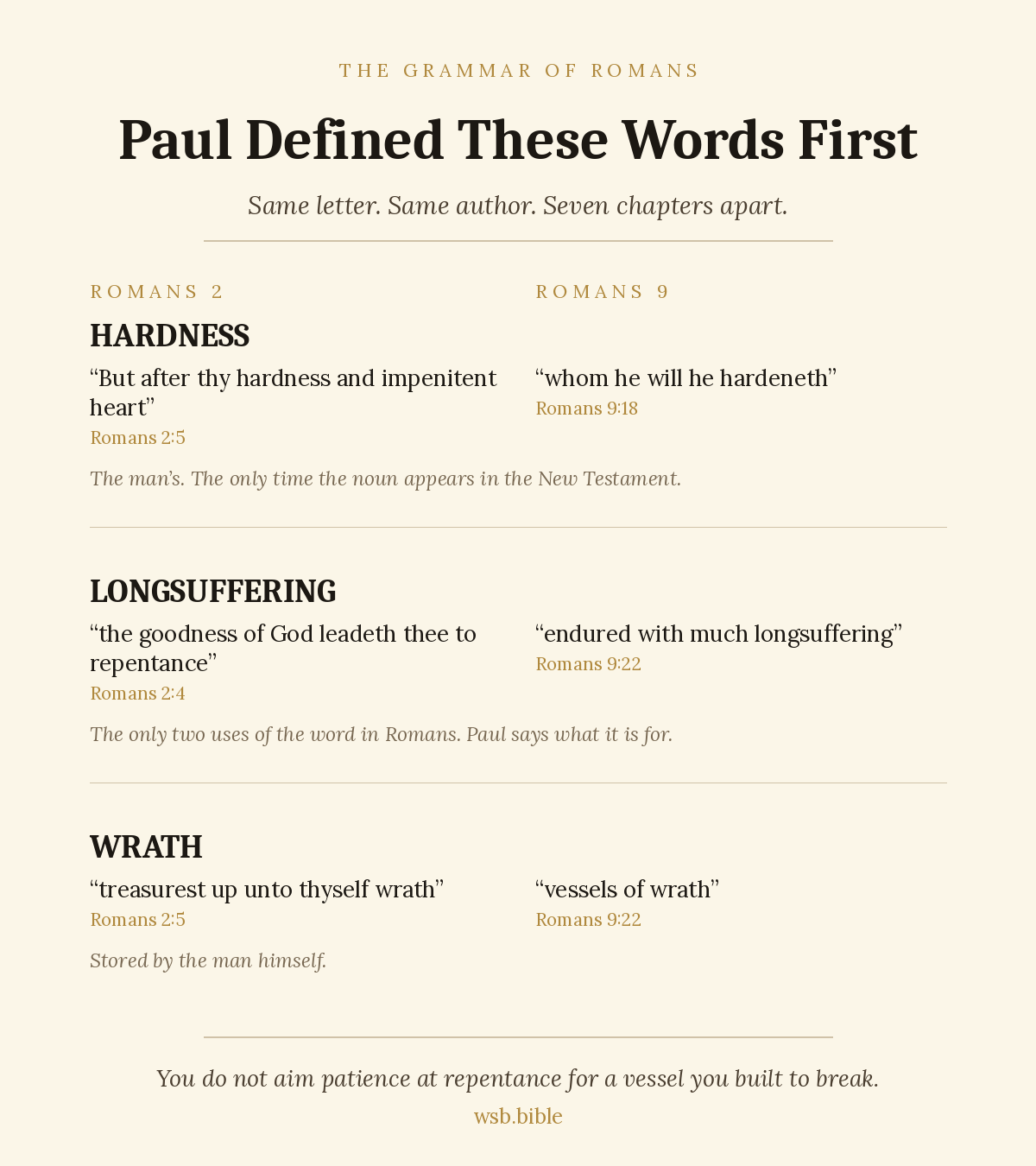
Everything in Romans 9:18 through 22 turns on three words. Hardens. Longsuffering. Wrath.
Paul used all three together once before in this letter. Seven chapters earlier, in Romans 2, talking to a man who thinks he is better than the people he judges.
Read the two verses.
“Or despisest thou the riches of his goodness and forbearance and longsuffering; not knowing that the goodness of God leadeth thee to repentance?”
“But after thy hardness and impenitent heart treasurest up unto thyself wrath against the day of wrath and revelation of the righteous judgment of God;”
Now look at who does what.
The hardness is his. “Thy hardness.” Not something done to him. The Greek noun there, sklerotes, appears exactly once in the whole New Testament, and this is it, and it belongs to the man.
The wrath is stored by him. “Treasurest up unto thyself wrath.” He is filling his own vessel.
And the longsuffering has a stated purpose. God's patience “leadeth thee to repentance.” Paul says what it is for.
Hold that beside chapter 9. Hardeneth, wrath, longsuffering, the same three words. And longsuffering is the only other time Paul uses it in this letter.
So by the time a reader reaches Romans 9, Paul has already told him whose the hardness is, who fills the vessel, and what the patience is aimed at. He did not change his vocabulary between chapter 2 and chapter 9. He defined it, and then he used it.
There is one more link. Paul addresses the man in chapter 2 as “O man.” Twice, at 2:1 and 2:3. He addresses the objector in chapter 9 the same way. “Nay but, O man, who art thou that repliest against God?” Those are the only three places in Romans he speaks to someone that way. The man storing up his own wrath in chapter 2 and the man talking back to God in chapter 9 are the same figure.
The other side will answer that chapter 2 is the human side and chapter 9 is the divine side of one event. Fair enough as a frame. But then take Paul's own account of the divine side. He says the longsuffering leads to repentance. You do not aim patience at repentance for a vessel you fitted for the fire. Either Paul changed what longsuffering meant between two chapters, or the vessels of wrath were being waited on to turn.
Paul glossed his own verse. He did it seven chapters early, and he did it in words anyone can check in a minute.
Where that leaves the chapter
Right where Paul left it. Inside the Israel section. Doing the job he told you three times it was doing.
I am not asking you to skip Romans 9. I am not asking you to soften it. It says what it says, and I live with all of it, the potter and the hardening included. The text outranks every system, including mine.
What I am telling you is that the chapter is not the letter.
And that brings me to the last thing. The thing I actually wanted to give you.
The whole letter, in four moves
Let me walk you through the book the way Paul built it. Once you see it, you have Romans for good.
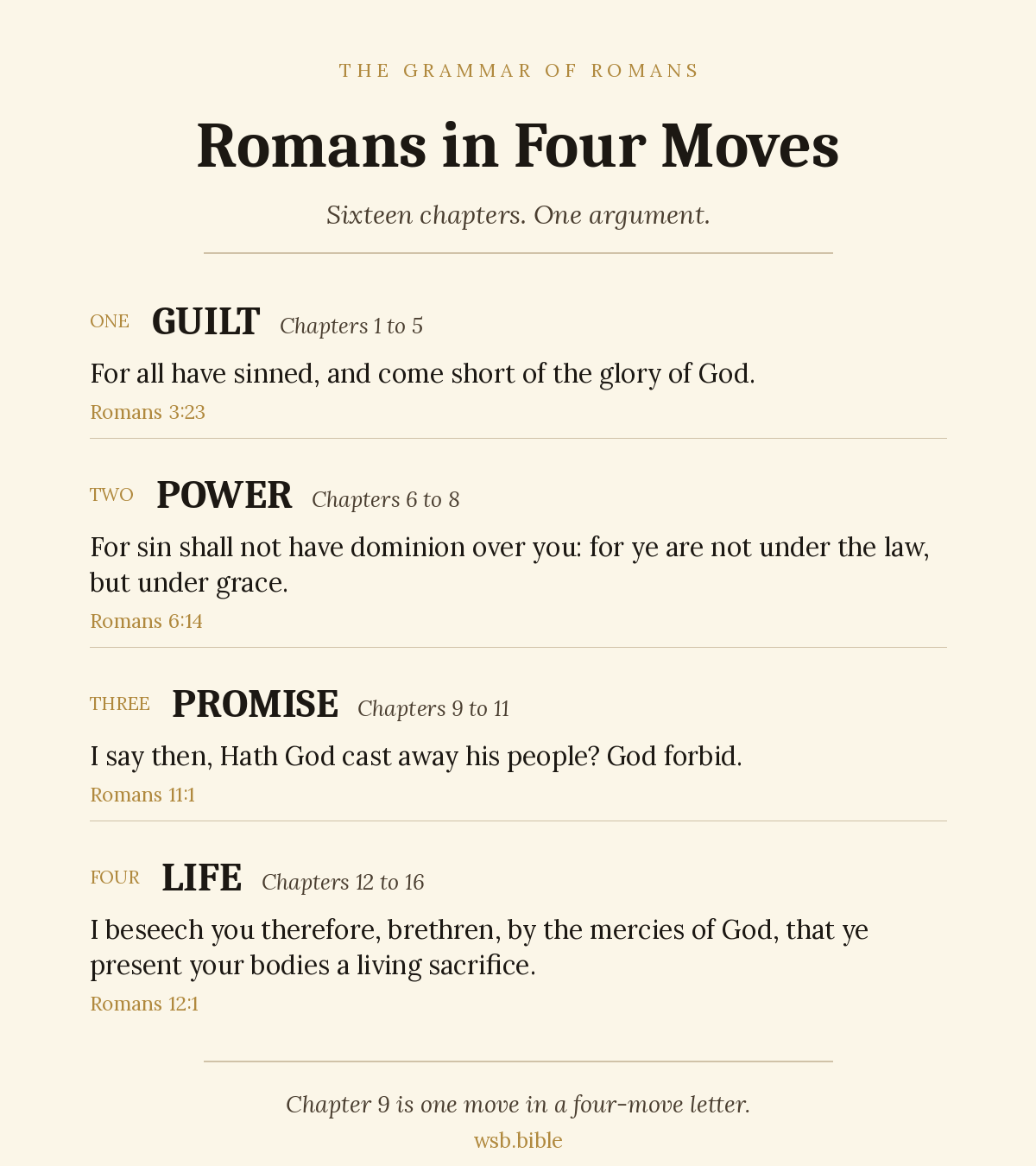
Guilt. Chapters 1 through 5.
Everyone is guilty. Paul spends three chapters proving it, until he can say “there is none righteous, no, not one.” Then the best two words in the letter. A righteousness from God, apart from the law, for anyone who believes. Three times he lands on faith. And not one word about election in the whole stretch.
But now.
You do not clean yourself up first. You come in guilty and believing, and God counts you righteous. The door is open.
Power. Chapters 6 through 8.
A different problem. Sin as a power in you, rather than the sins you did. And Paul breaks it with union rather than faith. You were buried with Christ. Crucified with Him. Then the Spirit floods chapter 8, and sin stops acting.
You are not white-knuckling your way to holiness. You are joined to Christ. When sin feels like it owns you, the answer is not “try harder.” It is “you died with him, now count it true.”
Promise. Chapters 9 through 11.
Did God keep His word to Israel? Yes. And this is not God sorting individuals into saved and lost before they exist. It is God keeping faith with a people He chose in Christ, and leaving the way in open. Paul draws you a picture you cannot forget. An olive tree. Branches broken off by unbelief. Wild branches grafted in by faith. And the door left open: if they do not stay in unbelief, they can be grafted back.
Branches broken off by unbelief.
Wild branches grafted in by faith.
God keeps His promises. And no one is a lost cause. The branch cut off can be grafted back the moment it believes.
Life. Chapters 12 through 16.
Then Paul says “therefore.” Now live it. Give your body to God. Love without pretending. Bless people who hurt you. The doctrine becomes a life.
The truth was never meant to sit in your head. It was always headed for your feet.
The verdict
Put the four moves together and you have the whole letter, and you have why Paul wrote it.
He wrote it to walk a person from guilty, to forgiven, to joined-to-Christ, to sure that God keeps His word, and then out into a real life.
Guilt, power, promise, life.
Romans 9 is real. But now you can see where it sits. It is one move in a four-move letter. Its job is to show that God kept His promise. It was never the whole thing. It just got treated that way.
So the next time you are standing in Romans 9, remember this.
You do not have to win the chapter. You can show them the letter.
Paul wrote sixteen chapters. Now you have all of them.
Scripture quoted from the King James Version. Greek and Hebrew forms verified against the tagged Greek New Testament, including the Textus Receptus, and the Masoretic text (STEPBible TAGNT and TAHOT, CC BY 4.0) and Swete's Septuagint.
This essay is original to The Whosoever Study Bible. The word counts, the grammatical readings, and the Seven Threads reading are original scholarship. All rights reserved. Platform use under Revelation 22:17, free to all who come.