What this will do for you
Someone shows you Romans 9. The potter. The clay. The vessels of wrath. And it lands like a door closing, because the picture itself seems to settle it. The potter shapes the pot. The pot has no say. If God is the potter and you are the clay, what is left to argue?
I am going to hand you every other potter in the Bible.
But when they show you that verse, they let it do all the work alone. Paul did not make up the potter. He was quoting. The potter and the clay is an Old Testament picture, and it appears again and again, and Paul's readers knew every place it appears. So the honest question is not “what could the potter mean.” It is “what did it mean everywhere else Paul's Bible used it.”
So I read them. Every potter in Scripture. And by the end you will know something most people who quote Romans 9 have never checked: there is no Calvinist potter in the Bible. Not one. Not even Paul's.
One rule, before we start
One rule runs through all of it. Never read a verse alone. When a writer quotes an image, go read the image where he got it. That is the whole method here, and it is the method Paul assumes, because he is quoting a picture he expects you to already know.
The verse Paul actually quoted
Start with the quotation itself, because this is where most readings go wrong on the first step.
Romans 9:20. “Shall the thing formed say to him that formed it, Why hast thou made me thus?”
People treat that as Paul's own line. It is not. It is a quotation, and I can show you the exact source. The opening of Romans 9:20 is six words lifted straight out of the Greek of Isaiah 29:16: mē erei to plasma tō plasanti (μὴ ἐρεῖ τὸ πλάσμα τῷ πλάσαντι), the thing formed and the one who formed it. Then Paul recasts the clay's question. Isaiah's clay says “he made me not.” Paul's says “why hast thou made me thus?” He took a text about men hiding from God and turned its line into the exact objection he was answering at 9:19. That is not sloppiness. That is design. And those are Isaiah 29's words. They are not the words of Isaiah 45, which people often assume is the source. Isaiah 45 says clay and potter. Paul says thing-formed and former, which is Isaiah 29.
They will say Paul can borrow an image without importing its context. He can. But this is not an image borrowed. It is a line quoted at the word level, and the man Paul aims it at, the one saying “why doth he yet find fault,” is the same kind of man Isaiah aimed it at, one using God to escape his own blame. That is not shared vocabulary. That is the same target.
Their real reply is stronger than that, and I want it on the page. They will say Paul uses the potter to establish the Creator's right over the clay, whatever Isaiah meant by it, and that the passive in verse 22 is a divine passive, God the agent left unnamed. Granted on the right. Verse 21 asserts it. On the divine passive, that is a possible reading of a form that cannot tell middle from passive, not a demonstrated one. And the man who wrote it had the active verb in his hand. He used it one verse later, for the vessels of mercy, with God as the named subject. He did not use it for the fitting. The right is asserted. The exercise is what the grammar withholds, and the asymmetry is Paul's own choice.
Now let me argue against myself for a moment, because a careful reader will push here. Some scholars note that Isaiah 45:9 is a potter verse too, and a few think Paul may have had it partly in mind. Fine. Grant it for the sake of argument. Say Paul was thinking of Isaiah 45 as well as Isaiah 29.
It does not help the other side. It makes my case twice.
Because Isaiah 45 is the Cyrus chapter. “Thus saith the LORD to his anointed, to Cyrus” (Isaiah 45:1). God is raising up a pagan Persian king, an outsider, to deliver Israel, and Israel is objecting to God using a Gentile for the job. That is when the potter line appears: who are you, clay, to tell the potter he cannot use whom he wills? The potter in Isaiah 45 is God's freedom to bring an outsider into His plan.
And that is exactly what Paul is defending in Romans 9 through 11. Gentiles grafted in. Israel stumbling. The outsider brought near. So if Paul had Isaiah 45 in mind, the potter is God's freedom to save Gentiles over Jewish objection, which is Romans 9's whole argument, not a decree about who goes to hell.
So take your pick. Isaiah 29, and the clay is a man denying that God sees him. Isaiah 45, and the potter is God's freedom to use a Gentile for rescue. Both are the majority scholarly readings of the source. Neither one is a potter who shapes a man for the fire. There is no third Isaiah where the potter does what they need him to do.
That matters more than any other single fact in this essay, so hold it. The chapter that governs what Romans 9:20 means is Isaiah 29. So go read Isaiah 29.
And watch what the clay is doing there. It is not asking why it was shaped. Read the verses around it.
“Woe unto them that seek deep to hide their counsel from the LORD, and their works are in the dark, and they say, Who seeth us? and who knoweth us?”
Then the potter line, “shall the work say of him that made it, He made me not? or shall the thing framed say of him that framed it, He had no understanding?” (Isaiah 29:16)
Read it slowly. The clay's sin in Isaiah 29 is not “why did you make me this way.” It is “he made me not” and “he had no understanding.” The clay is denying that its maker made it, and denying that God sees. These are men, verse 15, hiding their works in the dark and saying “who seeth us.”
Now go back to Romans and read who Paul is answering. “Thou wilt say then unto me, Why doth he yet find fault? For who hath resisted his will?” (Romans 9:19)
That is a man using God's sovereignty to escape his own guilt. If God is in control, how can he blame me? And Paul answers him with the exact words Isaiah used against men who pretended God could not see what they were doing.
The potter passage is not God explaining why He damns people. It is God rebuking a man who is hiding behind God's power to escape accountability. Paul picked that quotation on purpose, because that is exactly the man he is answering.
Now read every potter he could have quoted
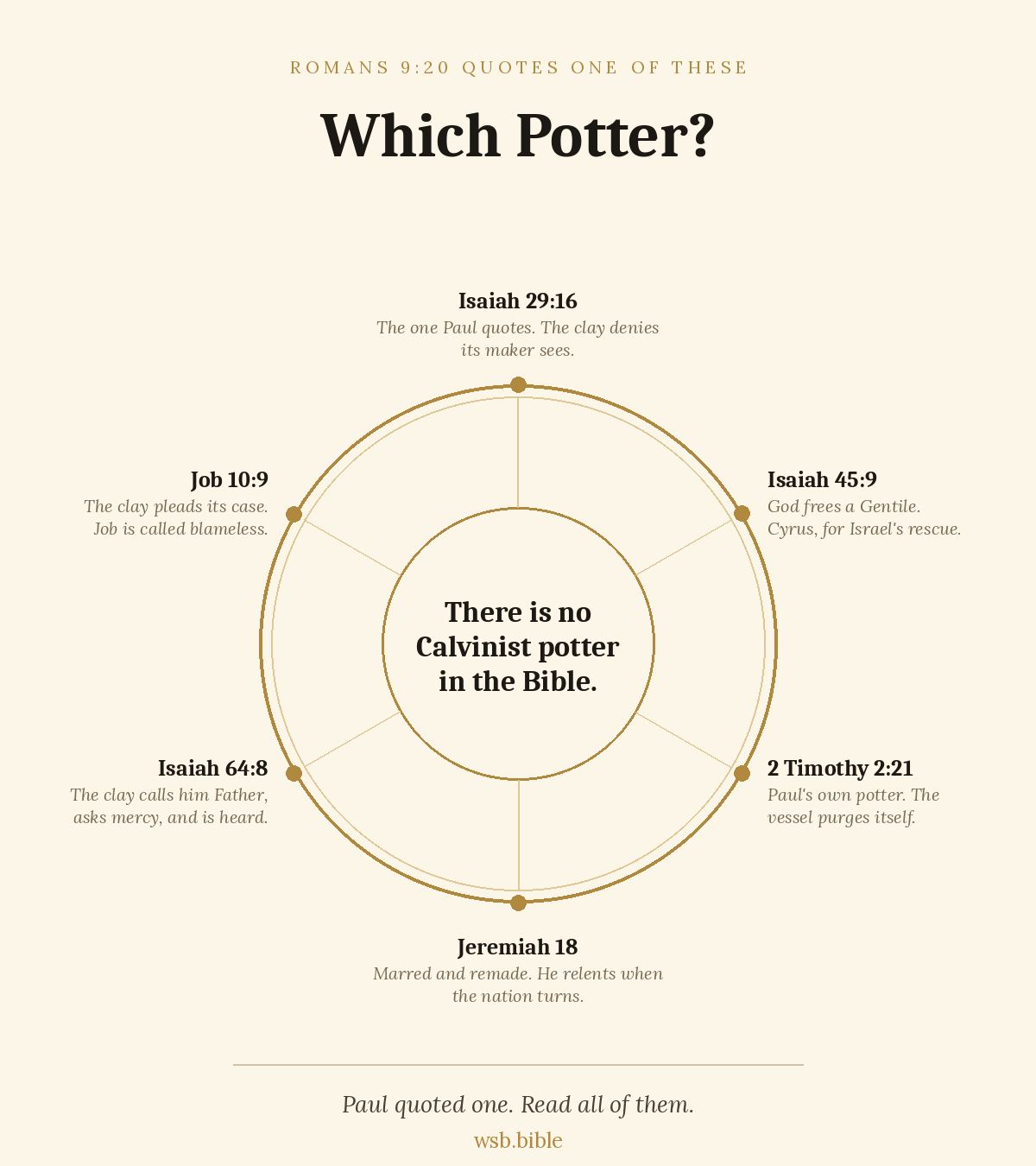
Paul's Bible had potters all through it. Go read them, and watch what the potter does in each.
Jeremiah 18. This is the fullest potter passage in the whole Bible, and God interprets it Himself, so you do not have to guess.
“the vessel that he made of clay was marred in the hand of the potter: so he made it again another vessel.” (Jeremiah 18:4) The vessel is marred, and the potter remakes it. He does not throw it out. He reshapes it. And read where the marring happens: “in the hand of the potter.” Not before it reached him. While he was working it. The vessel goes wrong in process, and the potter answers. That is not a decree from before time. That is a potter responding to what the clay did on the wheel.
Then God says what the picture means, in His own words, and it is conditional in both directions.
“At what instant I shall speak concerning a nation... to destroy it; If that nation... turn from their evil, I will repent of the evil that I thought to do unto them.”
And the other direction. “And at what instant I shall speak concerning a nation... to build and to plant it; If it do evil in my sight... then I will repent of the good.” (Jeremiah 18:9-10)
The potter reshapes the vessel depending on whether the nation turns. Judgment announced can be reversed by repentance. Blessing announced can be forfeited by evil. God says this. It is not my reading of the potter. It is God's own reading of the potter.
And then, at the end, a summons. “return ye now every one from his evil way” (Jeremiah 18:11). And the people refuse it. “There is no hope: but we will walk after our own devices.” (Jeremiah 18:12)
The fullest potter passage in Scripture is a call to repent, and the outcome hangs on the answer. That is the opposite of fixed shaping.
Isaiah 45:9. “Woe unto him that striveth with his Maker... Shall the clay say to him that fashioneth it, What makest thou?”
They will say this one proves the clay has no right to question.
Now, that verse does rebuke striving, and I will not pretend it does not. But read the very next potter and watch the clay do the thing Isaiah 45 seems to forbid.
Isaiah 64:8. “But now, O LORD, thou art our father; we are the clay, and thou our potter; and we all are the work of thy hand.” And the next verse, “Be not wroth very sore, O LORD, neither remember iniquity for ever.” (Isaiah 64:9)
The clay speaks to the potter. It calls Him Father. It asks for mercy. And it is not rebuked. So Isaiah 45 is not a rule that the clay may never address the potter. It is a rebuke of the posture of striving. The clay that comes as a child asking mercy is welcomed. Isaiah shows you both, in the same book.
And Job, long before either, and not a text Paul is quoting, but the oldest clay speech in the Bible. “thou hast made me as the clay; and wilt thou bring me into dust again?” (Job 10:9) Job appeals to the potter, reminds Him he is clay, and asks to be spared. The clay talks back, and Job is called blameless.
Paul's own potter, in his own letter
Now Paul himself, in his own words, about the same vessels.
“But in a great house there are not only vessels of gold and of silver, but also of wood and of earth; and some to honour, and some to dishonour. If a man therefore purge himself from these, he shall be a vessel unto honour, sanctified, and meet for the master's use.”
Same author as Romans 9. Same image, vessels to honour and to dishonour. And how does a vessel become a vessel of honour? “If a man purge himself.” The Greek is a man cleansing himself, his own act, and the vessel moves from dishonour to honour by response.
Now, someone will say this is about sanctification, not election, and that is fair. It is. But it is Paul's own potter, and in Paul's own potter the vessel's honour is decided by what the man does, not by a shaping fixed before he existed. When the man who wrote Romans 9 draws the vessel picture in his own words, the vessel is not passive. It purges itself.
Their hardest verse, read exactly
Now the one they lean on hardest inside Romans 9 itself.
“What if God, willing to shew his wrath, and to make his power known, endured with much longsuffering the vessels of wrath fitted to destruction: And that he might make known the riches of his glory on the vessels of mercy, which he had afore prepared unto glory.”
Read the two verses together and watch the grammar, because Paul does something deliberate.
On the mercy side, verse 23, the vessels of mercy are the ones God “had afore prepared.” That verb is active, and God is the subject. Paul names God as the one who prepared the mercy vessels.
On the wrath side, verse 22, the vessels of wrath are “fitted to destruction.” And that verb names no one. Paul does not say God fitted them. The standard reading of the Greek form is passive, and I will be square with you about that: it is tagged passive, not middle. But the form itself cannot tell you who did the fitting, because in Greek the middle and the passive of that verb look exactly the same. What the verse does not do, in any reading, is name an agent. There is no “by God” in it.
So here is what Paul actually wrote. He named God as the preparer of the mercy vessels. He did not name anyone as the fitter of the wrath vessels. That asymmetry is his, and it is on the page. He had the active verb in his hand. He used it for mercy. He did not use it for wrath.
And one more word, in the same verse. He “endured with much longsuffering” the vessels of wrath. Longsuffering is a waiting word. You do not wait patiently, for a long time, on a thing you built to break. The verse that supposedly shows God manufacturing vessels for destruction shows God being patient with them, which is the last thing you are with something you made to smash.
I will give the other side its due. They will say that verse 21 grants the potter the right to make a vessel to dishonour, and verse 22 shows Him using it. That is a real inference and I am not going to call it silly. But read the next verse. “Even us, whom he hath called, not of the Jews only, but also of the Gentiles.” (Romans 9:24) Paul names who the vessels of mercy are: us, called from Jews and Gentiles. Peoples entering by calling, not a sorted list of individuals fixed before time. Paul tells you who the vessels are, and it is a body men are called into.
They will say Jeremiah is about nations and Romans 9 is about individuals and eternity. But read what Paul has been doing all chapter. Esau is Edom. Pharaoh is Egypt. Israel is Israel. The chapter runs on national types, and then names the vessels of mercy as called peoples. The move from a potter of nations to a potter of unborn individuals is their inference. Paul never announces the subject changed.
Where that leaves the potter
Put every potter together.
Jeremiah's potter remakes the marred vessel and relents when the nation turns. God says so Himself.
Isaiah 45's potter uses a pagan king for Israel's rescue.
Isaiah 64's clay calls the potter Father and asks mercy, and is not rebuked.
Job's clay talks back and is called blameless.
Paul's own potter, in Second Timothy, has the vessel purge itself into honour.
And the potter Paul actually quotes, Isaiah 29, is rebuking a man who hid his works in the dark and said God could not see.
There is no Calvinist potter in the Bible. Not in Jeremiah. Not in Isaiah 45. Not in Isaiah 64. Not in Job. Not in Paul's own second letter to Timothy. To read Romans 9:21 as a potter who shapes vessels for the fire and gives the clay no say, you have to cut that verse off from every other potter in Scripture, including the one Paul wrote himself.
The verdict
The potter was never the argument they think it is.
It is not God explaining why He damns. It is God's answer to a man hiding his own guilt behind God's power. It is a picture of a potter who relents, reshapes, uses outsiders, welcomes the clay that asks mercy, and honours the vessel that cleans itself.
They gave you one verse and told you the picture settles it. The picture does settle it. Just not their way.
Go read the potters. All of them. Then read Romans 9 again, and you will see a God who was never holding a wheel to shape you for the fire. He was answering a man who would not stop hiding.
“we are the clay, and thou our potter.” (Isaiah 64:8) Said by clay that came asking mercy, and got it.
A note on one potter not in this essay. Wisdom of Solomon 15:7 has a potter working one lump into vessels for clean use and for the contrary, and some scholars set it near Romans 9:21. It is not in the Bible, so it is not in the count. And on its own terms it does not help the other side: its potter is a human artisan making household ware and idols, with nothing said about a decree.
Scripture quoted from the King James Version. Greek and Hebrew forms verified against the tagged Greek New Testament and the Masoretic text (STEPBible TAGNT and TAHOT, CC BY 4.0) and Swete's Septuagint.
This essay is original to The Whosoever Study Bible. The word counts, the grammatical readings, and the Seven Threads reading are original scholarship. All rights reserved. Platform use under Revelation 22:17, free to all who come.