Knowing Isn’t Writing
The glance that doesn’t flatten.
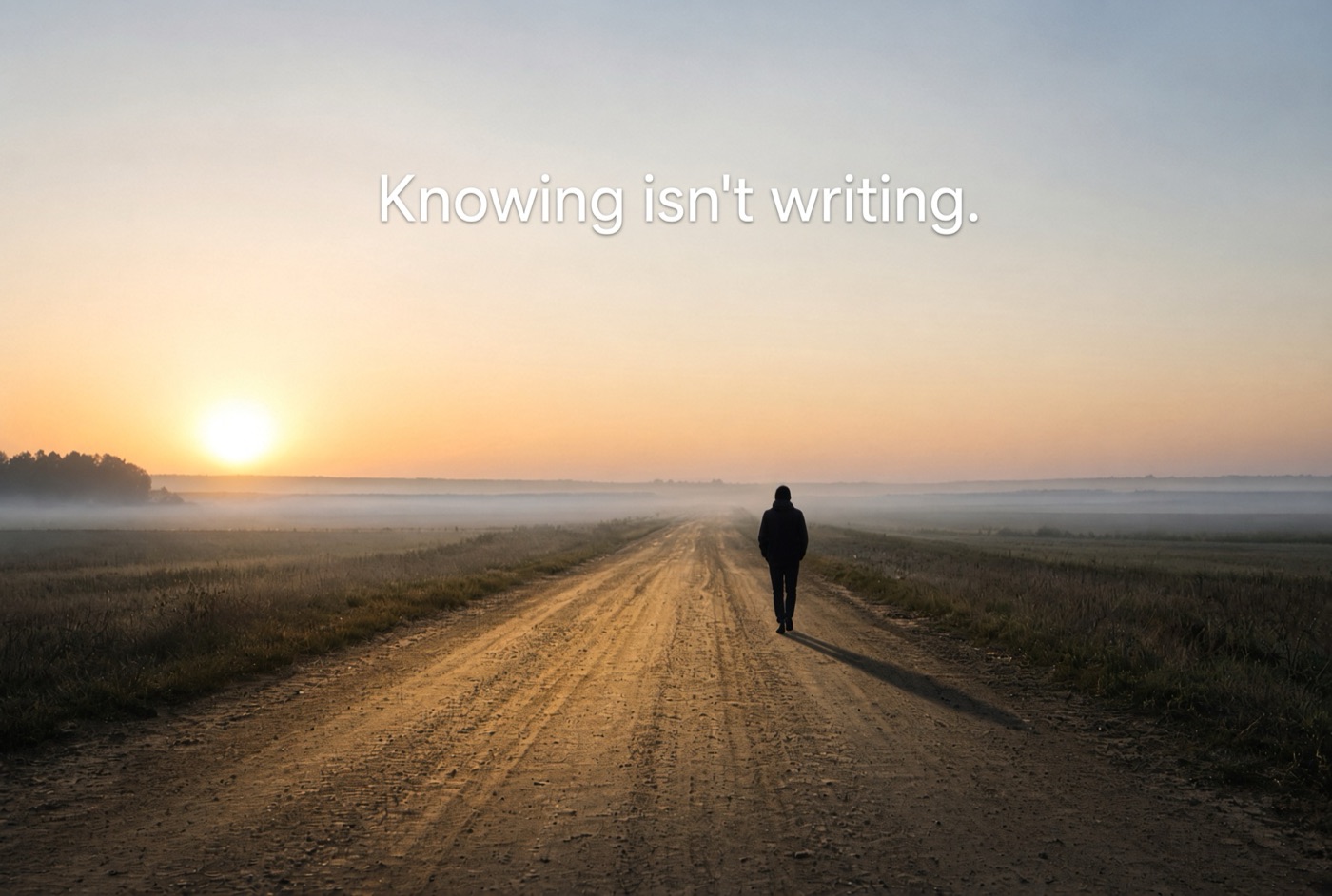
Some men will only give you two boxes. Either God wrote the sin, or God finds out later. Scripture never says either how. It says he knows, and it says the man did it. Fifteen centuries ago Boethius put those together without flattening the walk into the sunrise. That is the view I hold.
Two boxes, and an older room
The first box is the decree: God knows the future because he ordained it. Westminster puts it in confessional form: “Although God knows whatsoever may or can come to pass upon all supposed conditions, yet hath he not decreed anything because he foresaw it as future” (III.2). The second box is open theism: God does not know a free act until it is done, because until then there is nothing to know. The two boxes argue with each other as if the room had no other door. It does. Boethius wrote the Consolation of Philosophy in a prison cell around 524, and in its last pages he answered the question both boxes think they own. That is not Molina, who comes a thousand years later. It is not a modern escape hatch. It is older than either fight I am in.
What Scripture says, and what it leaves unsaid
Scripture asserts that God knows the future, and not in one place. “Declaring the end from the beginning, and from ancient times the things that are not yet done” (Isaiah 46:10). “For there is not a word in my tongue, but, lo, O LORD, thou knowest it altogether” (Psalm 139:4). “God is greater than our heart, and knoweth all things” (1 John 3:20). He knows the ifs as well. David asked whether Keilah would hand him over and whether Saul would come down, and the LORD answered both: “He will come down” and “They will deliver thee up” (1 Samuel 23:11-12). David left, and neither happened. Jesus said Tyre and Sidon “would have repented long ago in sackcloth and ashes” had they seen what Chorazin saw (Matthew 11:21). God knows what would follow on a choice that was never made.
What Scripture never states is how. Not because he decreed it. Not because he stands outside time. Read Acts 2:23: “Him, being delivered by the determinate counsel and foreknowledge of God, ye have taken, and by wicked hands have crucified and slain”. Two nouns, counsel and foreknowledge, joined by and. If foreknowledge were only counsel under another name, Luke would have said it once. He said it twice, and left the join between them unexplained. Everyone who explains it is doing philosophy. I am about to. So is the man with the decree. The difference is that I will say so.
Two verbs
The New Testament has a word for knowing beforehand, proginosko, and a word for marking out beforehand, proorizo. They are not the same word, and the writers never confuse them. Romans 8:29 uses both in one clause: “For whom he did foreknow, he also did predestinate to be conformed to the image of his Son”. Foreknew, and, predestinated. Two verbs with an also between them. The one place the King James renders the know-verb as “foreordained” is 1 Peter 1:20, of Christ, “[w]ho verily was foreordained before the foundation of the world”; the Greek there is the same word as “foreknow” in Romans. Say that once and move on. Lexically, foreknow is not foreordain. Whether God’s knowing was in fact a choosing is a reading brought to the verb, not a meaning found in it.
One page of Boethius
Here is the page. Eternity, he says, “is the possession of endless life whole and perfect at a single moment.” God does not wait for Tuesday to know Tuesday. And his knowledge is not something the world hands him: “this ever-present comprehension and survey of all things God has received, not from the issue of future events, but from the simplicity of His own nature.” So when the objection is put to him that my choosing would change what God knows, the answer is two words: “Surely not.”
Then the image. Stand at dawn “at one and the same time ye see a man walking on the earth and the sun rising in the sky”, and you “distinguish between the two, though one glance embraces both, and judge the former voluntary, the latter necessary action”. One look, two kinds of thing, and the look does not turn the walk into a sunrise. “[S]o also the Divine vision in its universal range of view does in no wise confuse the characters of the things which are present to its regard, though future in respect of time.” And his knowing the free act is not a guess: “its apprehension is not opinion, but rather knowledge based on truth.”
Then the distinction that does the work. There are two necessities, “one simple, as that men are necessarily mortal; the other conditioned, as that, if you know that someone is walking, he must necessarily be walking.” If it is known that he walks, then he is walking; that much is necessary. But “[n]o necessity compels one who is voluntarily walking to go forward, although it is necessary for him to go forward at the moment of walking.” Foreknowledge gives the second necessity and never the first. The free things God sees “desist not from the absolute freedom naturally theirs”, and “before they happened it was really possible that they might not have come to pass.” Some things, he says, “come from the necessity of things, others from the power of the agent.”
From the power of the agent. That is the whole of what I claim.
Knowing is not causing
The oldest objection is that if the act settles what God knows, then the creature is making God’s knowledge, and God is a learner. Aquinas quotes Origen on Romans 8 answering it: “A thing will happen not because God knows it as future; but because it is future, it is on that account known by God, before it exists.” And Aquinas, who is nobody’s Provisionist, keeps the distinction. God’s knowledge is a cause of things, he says, only “in so far as His will is joined to it.” When he asks how God knows a contingent act with certainty, he does not say by having made the nature that produces it. He says the opposite: “whoever knows a contingent effect in its cause only, has merely a conjectural knowledge of it.” Certainty comes from presence: “God knows all contingent things not only as they are in their causes, but also as each one of them is actually in itself.” His picture is Boethius’s, a road seen from above: “he who sees the whole road from a height, sees at once all travelling by the way.” The road does not cause the seeing. It is what is seen. What the knowledge is of, and what causes the knowing, are two relations, not one.
Free is not autonomous
When someone says I am smuggling in autonomy, I want the word defined. Autonomy is self-law, answerable to no one. The freedom I hold is a creature’s. God set the man in a garden and said, “Of every tree of the garden thou mayest freely eat: But of the tree of the knowledge of good and evil, thou shalt not eat of it” (Genesis 2:16-17). That is a free man under a command, with a penalty, sustained every moment by the one who spoke. Moses set the same shape before Israel: “I have set before you life and death, blessing and cursing: therefore choose life” (Deuteronomy 30:19). If you want the Reformed tradition’s own words, Westminster has them. God “hath endued the will of man with that natural liberty, that it is neither forced, nor, by any absolute necessity of nature, determined to good, or evil” (IX.1). Not forced. Not determined by nature. That is not Sartre. It is a will that can answer or refuse, and is judged for which. What the fall did to that will is another essay. This one is about knowing.
What Boethius does not answer
Say the limit first. Boethius answers three things: that foreknowledge makes the act necessary, that God’s knowing is received from the event, and that seeing all at once flattens free into fixed. He does not answer the decree. He never engages the claim that God knows because he ordained. If a man brings that as his premise, Boethius has not refuted it, and I will not say he has. What I will say is that the premise is a premise. Westminster asserts that God did “ordain whatsoever comes to pass” and in the same sentence that “the liberty or contingency of second causes” is not “taken away, but rather established” (III.1). It does not say how both are true. Their how is also a how. I confess a mystery at the mechanism of eternal vision. They carry a mystery at the mechanism of a decree that establishes what it fixes. Neither of us has a verse for the join. Only one of us has been calling the other’s silence a defect.
He is not surprised
So here is where it rests. God is not on your clock. “For a thousand years in thy sight are but as yesterday when it is past” (Psalm 90:4). He is “the high and lofty One that inhabiteth eternity” (Isaiah 57:15). He knows the road, all of it, from a height, and he did not chain your feet to walk it. Foreknown is not forced. Knowing what you will choose is not choosing it for you before you were born. He saw the sunrise and he saw you walking, in one look, and he did not mistake the one for the other. He is not surprised by anything you did. And you still did it. The glance does not flatten the walk.
Scripture quoted from the King James Version. Boethius from the Consolation of Philosophy, Book V, prose 6, in the translation of H. R. James. Aquinas from Summa Theologiae I, question 14, articles 8 and 13. Westminster from the Orthodox Presbyterian Church text. The full census behind this essay, every verse, every quotation, and what each does not prove, is published in the foreknowledge audit.
This essay is original to Whosoever Will (2026). The census, the readings of Boethius and Aquinas, and the Seven Threads reading are original scholarship. All rights reserved. Platform use under Revelation 22:17, free to all who come.