Flavius Josephus
Antiquities, Wars, Against Apion and the Life, entire, in the Whiston translation. 2,225 numbered sections, and fourteen places where he and the New Testament describe the same thing.
About Josephus
Josephus was born Joseph ben Mattathias in Jerusalem, of a priestly family. He commanded Jewish forces in Galilee during the revolt against Rome (AD 66–70), was captured by Vespasian, and eventually became an eyewitness to the siege and destruction of Jerusalem under Titus in AD 70. His works were preserved almost entirely by the Christian church, which recognized their immense value for understanding the world of the New Testament.
His two major works, Antiquities of the Jews and The Wars of the Jews: together cover the history of the Jewish people from Creation to the fall of Jerusalem. Antiquities alone spans 20 books, running from Genesis through the reign of Nero. Wars of the Jews is the most detailed contemporary account of the destruction of Jerusalem and the temple: the event Jesus predicted in Matthew 24, Luke 21, and which forms the immediate historical background of the book of Revelation.
Josephus provides independent historical confirmation of figures mentioned in the New Testament, including John the Baptist, James the brother of Jesus, the high priests Annas and Caiaphas, Herod the Great, Pontius Pilate, and Felix and Festus. His account of the Pharisees, Sadducees, and Essenes remains the primary historical source for understanding the Jewish sects of Jesus's day.
Josephus commentary is now available inside the wsb.bible reader. When you open a book of the Bible that Josephus covers, Genesis through Acts, his relevant passage appears in the commentary panel alongside Whosoever Will, Chuck Smith, Matthew Henry, and others. Select “Josephus, Antiquities & Wars” from the commentary source picker to read his account alongside the biblical text.
OPEN BIBLE READER →His Works
Twenty books from the creation account to the eve of the revolt against Rome, written for a Greek and Roman readership that did not know the Hebrew scriptures.
Seven books on the revolt of AD 66 to 73 and the destruction of Jerusalem and the temple, written by a commander who changed sides and then watched the siege from the Roman camp.
Two books answering the charge that the Jewish nation was recent and without record, and arguing from the antiquity of its own writings.
His own account of his descent, his training, his command in Galilee and his surrender, written late and in answer to a rival historian.
Where Josephus and the New Testament meet
Fourteen places where the same person, office or event appears in both. The King James text sits beside the passage from Josephus, with the citation, so the two can be read against each other rather than summarised.
Also available elsewhere: the Chicago text and a complete-works PDF.
The Works of Flavius Josephus, translated by William Whiston (1737). Public domain. Hosted online by the University of Chicago and other institutions.
What Josephus saw, and what it settles
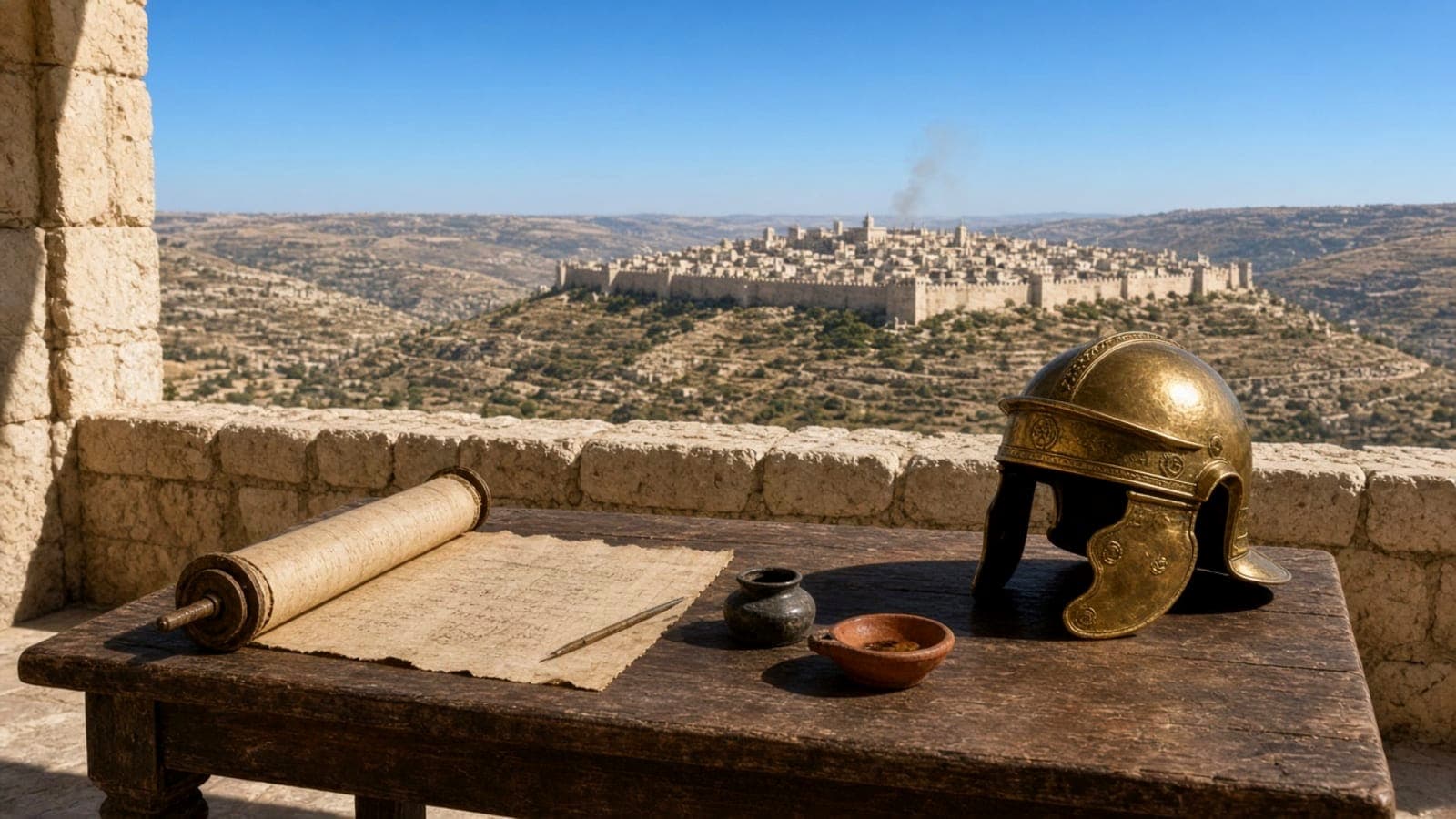
Josephus stood outside Jerusalem with Titus in the summer of AD 70 and watched the temple burn. His account in Wars 5 and 6 is the most detailed record of any siege in the ancient world: the famine, the factions inside the walls, the Roman earthworks, the fire that took the sanctuary on the ninth of Ab. Forty years earlier, Jesus had stood on the Mount of Olives and said of that temple, "There shall not be left here one stone upon another, that shall not be thrown down" (Matt 24:2), and of the city, "the days shall come, in the which they shall lay thee even with the ground" (Luke 19:44). Josephus records it done, by a man with no interest in confirming a Christian prophecy.
What this platform holds. Luke 21:20-24 describes the AD 70 siege in plain terms: armies compassing Jerusalem, the city trodden down, the people led captive into all nations, and it was fulfilled to the letter, which is why Josephus matters. The same discourse also describes events that did not happen in AD 70: the Son of man coming in the clouds "with power and great glory" (Matt 24:30), every eye seeing Him, the elect gathered from the four winds (24:31). Those belong to a future coming. So the Olivet Discourse has a near horizon, fulfilled and witnessed by Josephus, and a far horizon still ahead. That is the dispensational reading, and it is also the plain one: the temple fell, and Christ has not yet returned in glory.
The strongest case against it. Preterism reads the whole discourse, and much of Revelation, as fulfilled in AD 70. Its best argument is "this generation shall not pass, till all these things be fulfilled" (Matt 24:34), read as the generation Jesus was speaking to, with the coming "in the clouds" understood as Old Testament judgment language (Isa 19:1; Dan 7:13) for God's visitation on Jerusalem through Rome, and Josephus's siege as the tribulation "such as was not since the beginning of the world" (24:21). Held by serious readers, and it takes the text and the history seriously.
Why it does not hold. Three things. First, 24:21 says the tribulation will be unmatched to the end of time, "no, nor ever shall be," but the twentieth century saw greater slaughters of the Jewish people than Titus managed, so if AD 70 was that tribulation the sentence is false. Second, the coming of 24:30-31 is seen by "all the tribes of the earth" and gathers the elect; no one saw Christ in AD 70 and no one was gathered. Third, Luke keeps the two horizons apart on purpose: after the AD 70 material he writes "until the times of the Gentiles be fulfilled" (21:24), a gap, and only then the signs in the heavens and the Son of man coming (21:25-27). "This generation" in 24:34 answers the question of 24:3 ("when shall these things be?") and is satisfied by the generation that saw the temple fall; the far events are tied to a different marker, "of that day and hour knoweth no man" (24:36).
Josephus, then, is the witness to the near horizon. He proves Jesus right about the temple. He says nothing about the coming in glory, because he did not see it, because it has not happened.
SCRIPTURE QUOTED KJV · JOSEPHUS CITED BOOK.CHAPTER.SECTION, WHISTON
Why Josephus Matters for Bible Study
For the Old Testament, Josephus provides parallel accounts of the major narratives: the Flood, the Exodus, the conquest, the kings, often adding historical and geographical detail not found in Scripture. He confirms the biblical timeline and defends the historicity of events that critics have questioned.
For the New Testament, Josephus is indispensable. His descriptions of the temple, the priesthood, the Passover crowds, the Roman governance of Judea, and the Jewish sects give concrete historical flesh to the world Jesus and the apostles inhabited. Reading Paul's letters alongside Josephus's description of first-century synagogue life is a different experience than reading them in isolation.
For biblical prophecy, Josephus's account of the destruction of Jerusalem in AD 70 is the most important external verification of Jesus's predictive prophecy in the Gospels. His description of the siege, the famine, the collapse of the temple, and the scattering of the people matches the prophetic language of Matthew 24 with remarkable precision: written by a man who had no interest in confirming Christian prophecy.