Hebrews 9
Chuck Smith on Hebrews 9
Verse by verse, the C2000, 1979 to 1985 and C3000, 1985 to 1999 series. Permission granted by The Word For Today.
C2000 · 1979 to 1985
Chapter introduction
Hebrews chapter 9.
In the eighth chapter of the book of Hebrews, he makes mention of the prophecy in Jeremiah where God said that in those days He was going to make a new covenant with the people, not like the old covenant which was written on the tables of stone. He was going to write His law on the fleshly tablets of their hearts. Now, in the declaration that God is going to make this new covenant, it means that the first covenant would be set aside in order that He might establish the new covenant.
When Jesus took the emblems of Passover, He said, "This cup is a new covenant in my blood which is shed for the remission of sins" (Matthew 26:28). So, the old covenant had the remission of sins through the offering of sacrifices by the priests and on the Day of Atonement by the high priest. But God has established a new covenant, not written on the tables of stone, but God writes His law right on the fleshly tablets of our hearts. So the first covenant has been set aside that God might inaugurate this new covenant through Jesus Christ.
So going on still in chapter 9, carrying over the thought of chapter 8, he is still talking about this new covenant relationship that we have with God and contrasting it with that first covenant that was under the law. Remember the covenant under the law, God said, "And if they will do them, they shall live by them." The first covenant of the law was, "If you will obey Me and all of these statutes, then I will be your God." And the first covenant was established on man's obedience and man's faithfulness. The new covenant is established on God's faithfulness, the work that God has wrought for us through Jesus Christ. The old covenant failed, not because it was not good, not because it did not declare the truth, but it failed because man was weak and did not live by it. The new covenant is established forever, because it is the covenant that is predicated upon God's faithfulness, and surely God is faithful.
Verse 1
Then verily the first covenant had also ordinances of divine service, and a worldly sanctuary (9:1).
So in that first covenant God established with Moses, he was to build the tabernacle, and they were to have sacrifices offered within the tabernacle, and there was to be the worship of God there within the tabernacle by the priests.
Verse 2
For there was a tabernacle made; the first, wherein was the candlestick, and the table, and the showbread; which is called the sanctuary [or often called the holy place in the Old Testament] (9:2).
So, first of all, in this tabernacle, this tent that was made, it was forty-five feet long, and thirty feet wide, and fifteen feet tall, sort of a box-shaped tent, not a pitched tent like we usually think of, more box-shaped, fifteen feet from the corners tall and forty-five feet long and thirty feet wide.
Now, the inner part of the tent was divided into two sections. As you first entered into the tent from the veil that faced towards the east, the first thing that you would come upon in this room, it was thirty feet long and fifteen feet wide, over on your right-hand side would be a table, the table of showbread. On the table were twelve loaves of bread. One loaf representing each of the tribes of Israel.
Before you, and in front of the veil that went into the next room in the tent, there was the altar of incense where the priest would come and offer the incense, which was representative of the prayers of the people. He would offer them unto God.
On the left-hand side, as you came in the veil of the first tent, or the first room within the tent, there was this lamp stand with seven branches out of it. It was lit. There were little cups of oil and they would put the wicks in the oil and it was the light in this portion of the tent. These things are all representative of things that are in heaven. So in the menorah, or the lamp stand, with seven cups coming out of the one branch, you have the symbol of the seven-fold or complete working of the Holy Spirit. You have, of course, the altar of incense. So he talks here that in the first part of it the candlestick, the table with the showbread, which is called the sanctuary or the holy place.
Verses 3–4
Now after then you went into the second veil, it was called [the Holy of Holies, or translated here] the holiest of all; it had a golden censer, and the ark of the covenant that was overlaid round about with gold, wherein was the golden pot that had manna, and Aaron's rod that budded, and the tables of the covenant (9:3-4);
This Ark of the Covenant surely would be an interesting artifact to find. I don't know if I'd want to touch it if I found it. But within it they preserved a jar of the manna that God fed their fathers with in the wilderness. They also preserved Aaron's rod that budded, whereby God affirmed Aaron's family to be the high priestly family, the Aaronic order established. Then also (and this is what I would absolutely love to see) the two tables of stone upon which God put the Ten Commandments. Oh, wouldn't that be an exciting thing to behold? And so this was in the Ark of the Covenant, and it was the basis of the covenant of God with the nation; their obedience to the law and to the priesthood service under Aaron the High Priest.
Verse 5
Over this were the cherubims of glory shadowing the mercy seat (9:5);
Now again, these are all a model of what the throne of God in heaven is like, surrounded by the cherubims.
Verses 5–6
And he said,
we cannot speak at this particular time about these things. Now when these things were thus ordained, the priests went always into the first tabernacle, accomplishing the service of God (9:5-6).
Daily the priests would go into this first part of the tent. Once a week they would change the loaves of bread on the table of showbread. Daily they would change and fill the oil in the cups and trim the wicks, and so forth, because God wanted that this light should burn before Him continually. Then they would come and offer the prayers of the people, these little golden bowls that they would have incense in. And when they had lit the fires and all for the sacrifices outside, they would take live coals, or burning coals out of the fire, put them in these little bowls of incense. And then they would go in, and these little bowls were on chains and they would go in and they would swing this incense before the altar there. It was a symbol of the prayers of the people ascending before God. And this they did daily.
There were a certain number of sacrifices and types of sacrifices that had to be offered every day. And then, of course, during the day the hundreds of people that would come with their various types of sacrifices to offer unto God. So the priest was kept busy all day long in these offerings unto the Lord, as well as the regular times of prayer when he would go before the Lord and all.
You remember in the gospel of Luke, it tells how that the father of John the Baptist, Zacharias, was a priest after the course of Abia. It was his duty at this particular time to offer the prayers and the incense before the altar of the Lord. Usually the priest would serve one month out of the year. They had a good thing going. Then the rest of the year they would go back to their homes and be with their families. While Zacharias was offering the incense before the altar of the Lord, Gabriel appeared unto him and informed him that his wife, Elizabeth, in her old age, was to bear a son. He was to be the forerunner of the Messiah.
So you can read a little bit about the service of God there within this holy place which was outside of the Holy of Holies.
Verse 7
But into the second [that is the holiest of all, or the Holy of Holies] went the high priest alone once every year, not without blood, which he offered for himself, and for the errors of the people (9:7):
The Holy of Holies where man met God was off limits to everyone except the high priest. He went in there only one day a year, the Day of Atonement, Yom Kippur. Which happened to be yesterday. However, with no tabernacle or no temple, they have changed Yom Kippur from the Day of Atonement to the Day of Reflection. But the high priest would go in only this one day and he would go in twice in the one day.
He would, first of all, have to bathe. And then he would offer an ox for his own sins as a sacrifice for his sins, and he would go into the Holy of Holies with the blood of the ox that he had sacrificed for his own sins. And he was to sprinkle, then, the blood on the mercy seat in a special order. Seven times in front of the mercy seat and put it on the corner and all, and there was a regular routine. The sixteenth chapter of Leviticus tells about the Day of Atonement and the things that the high priest had to do on that day. Having offered, then, the blood of the ox for his own sins, he would go back outside, bathe, change clothes, and then they would take two goats and they would cast lots on the two goats. The one upon which the lot fell was to be slain and offered before God for the sins of the nation. The other goat was to be led by one of the priests out into the wilderness area and turned loose.
They would confess the sins of the nation on these two goats. The one would then be slain and the high priest, for the second time, would go into the Holy of Holies and he would offer, then, for the sins of the nation on this one day the first goat upon which the lot had fallen. The other goat being led into the wilderness having the sins confessed upon it, led into the wilderness turned loose to run free. To get lost, really. The idea is the sacrifice for sins, the putting away of sins by the sacrifice. But then, actually, the separation from our sins, the goat being turned loose and disappearing into the wilderness. God has put away our sins and they're not to be remembered again. And so the two goats, the one being slain, and the other being turned loose into the wilderness.
"Now into the second, the Holy of Holies, went the high priest alone once every year and not without blood which he offered first for himself and then the second time for the sins of the people."
Verse 8
The Holy Spirit was thus signifying, that the way into the holiest of all was not yet made manifest, while as the first tabernacle was still standing (9:8):
As long as the tabernacle was there and standing, the approach to God directly by man was impossible. This bore witness to the fact that man just could not come directly to God. There was this heavy veil that separated man from God.
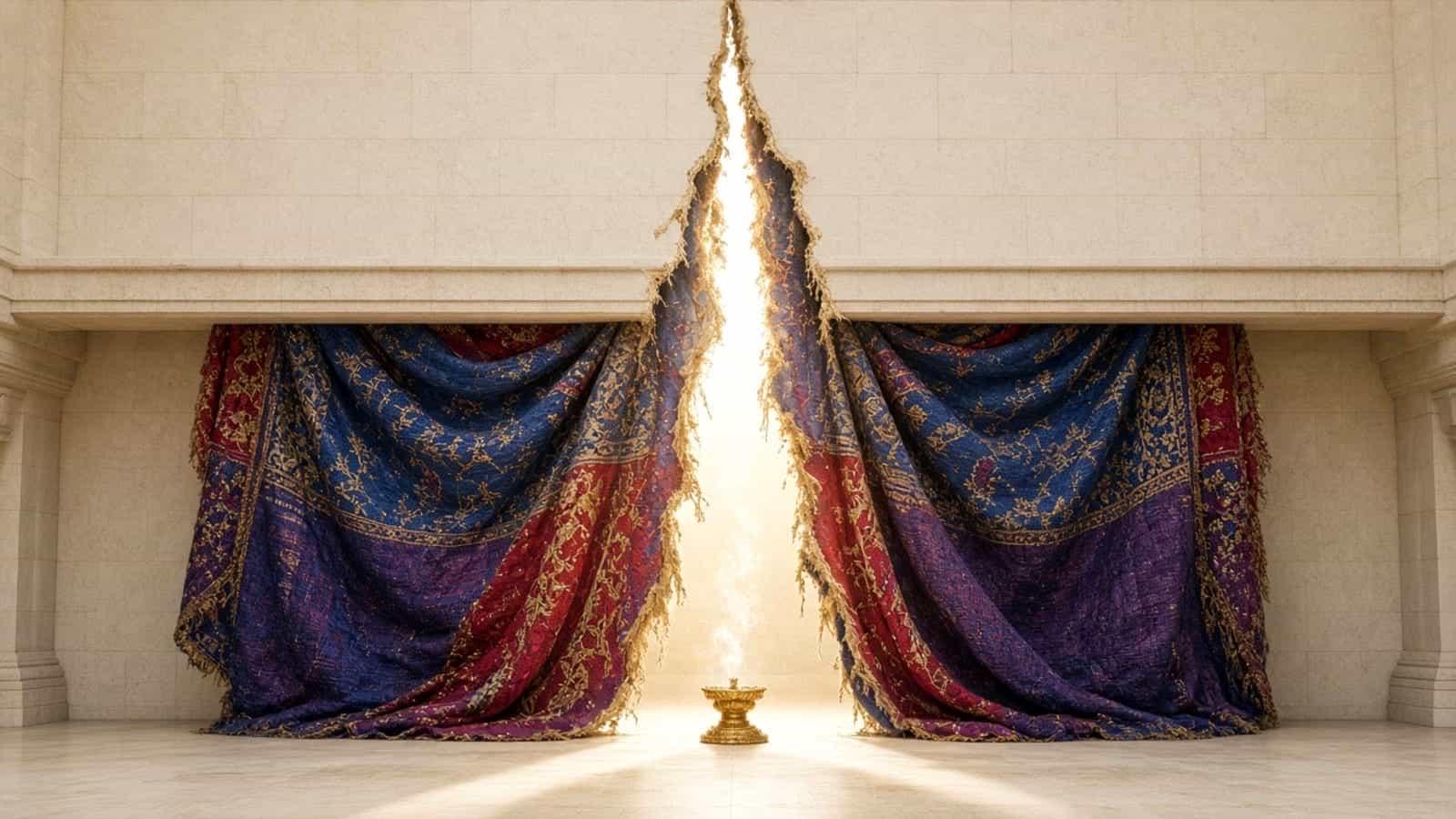
It is significant that when Jesus was crucified, we read that this veil in the temple was torn from the top to the bottom. God ripped the thing. Had man ripped it, it would have been from the bottom to the top. But God ripped the veil at the death of Jesus Christ, signifying that the way into the presence of God is now available for all man. You and I can come now into the presence of God through Jesus Christ, this glorious sacrifice for our sins. And we can enter ourselves right into the very presence of God through His work on our behalf. And so as long as the first tabernacle stood, the Holy Spirit was signifying that the way into the holiest, into the very presence of God, was not yet manifested or open to man.
Verses 9–12
Which was a figure [that is the tabernacle] for the time then present, in which were offered both gifts and sacrifices, that could not make him that did the service perfect, as pertaining to the conscience; Which stood only in meats and drinks, and in divers washings, and carnal ordinances, imposed on them until the time of [the change] the reformation [that is that was wrought by Jesus Christ]. But Christ being come a high priest of good things to come, by a greater and more perfect tabernacle, not made with hands, that is to say, not of this building; Neither by the blood of goats and calves, but by his own blood he entered in once into the holy place, having obtained eternal redemption for us (9:9-12).
The contrast is the high priest had to go in every year to offer first the offerings for his own sin, and then to offer for the sins of the people. And every year he had to do this. But Jesus once went into not the tabernacle made with hands, but entered into heaven itself, of which the earthly tabernacle was just a model. He entered into heaven itself and not with the blood of goats or of calves, but with His own blood He entered into that presence of God, having obtained eternal redemption for us. And so with His own blood He was then both the sacrifice and the sacrificer. He was both the offering and the one who offered.
Now you would bring your offering to the priest, he would offer it for you. Jesus became both; the offering itself, and the one who offered the offering unto God in entering into the presence of God with His own blood, and thus, redeemed man.
Verses 13–14
For if the blood of bulls and goats, and the ashes of a heifer sprinkling the unclean, would sanctify it to the purifying of the flesh: How much more shall the blood of Christ, who through the eternal Spirit offered himself without spot to God, purge your conscience from dead works to serve the living God? (9:13-14).
As he points out the weakness of the sacrifices made by the priests is that they could not really give us a clear conscience. They were a reminder of our sins. And the fact that they had to do it every year made us constantly conscious of our guilt. But Jesus Christ has now purified our consciences in that He has once and for all entered in to make an atonement for us with His blood, thus having offered Himself without spot.
When they brought a lamb to God, God wouldn't accept the castoffs. Here is an old cow. It's about ready to die. Let's see if we can get some good out of it. Let's give it to God. It is tragic, really, that so many times man wants to give the castoffs to God. "I can't use it anymore. I might as well give it to God. It's no good around here."
I read of a farmer one time who came in to breakfast and announced to his wife that their cow had twin calves. He said, "I'm so excited about it. I want to give one to the Lord and keep one for myself." She said, "Oh, I think that is a great idea." And so as the calves were growing up he kept announcing that when they were old enough to sell one belonged to God and one belonged to him. She said, "Well, which one's the Lord's?" He said, "It doesn't make any difference. One is the Lord's and one's mine." So he would never put the finger on one of them being the Lord's and one his. They just both were the same. But one morning he came in and said, "Terrible thing happened--God's calf died."
God wouldn't accept the castoffs. He said when you offer a lamb it has to be without spot. Now a spot was an inherent defect in the lamb. It also had to be without blemish. A blemish was an acquired defect. The lamb born with spots was a genetic thing. A lamb with blemishes that was the result of an encounter with a wolf, or falling down a cliff or some getting caught and blemished. The lamb that was offered had to be both without the inherent defects and without acquired defects; without spot and blemish. Peter said, "For we are redeemed not with corruptible things, such as silver and gold, from our empty manner of life, but with the precious blood of Jesus Christ, who was a lamb without spot and without blemish" (I Peter 1:18-19). It can really only be said of Jesus that He was without spot. He was born without the sinful nature. He had no inherent sin in Him.
It is an interesting thing that they have discovered that the gene factors that make up the blood in a child come basically from the father. Therefore, the gene factors creating the blood in Jesus Christ, coming from the Father, came directly from God and was not spotted by the inherent defectiveness in man. Jesus not only was born pure, but He remained pure. He was without blemish. And so He only could qualify as a sacrificial lamb. You see, you could never qualify as a sacrificial lamb before God. We were born with spots, but even if we weren't, we have acquired blemishes, and thus, we would not be fit to be a sacrifice for sin. But Jesus, without spot or blemish, offered Himself to God that He might cleanse your conscience from the dead works that you might serve the living God.
Now there are people who are still trying to please God with their works. They are still seeking to offer God the works of their hands. Unfortunately, that is exactly what the Jews are doing today. Yesterday, the Day of Atonement, there were no sacrifices for sins. There were no offerings. There were no lambs that were slain. There were no goats or bulls. But what they did was sit in their homes and reflect upon their lives and upon all of their good works. And they reflected also on their evil connivings. But as they reflected, they prayed that God would accept their good works and overlook their evil. And as long as their good works could overbalance their evil, they felt comfortable. Of course, many of them were racing around this past week trying to do a lot of good works so that it would be a comfortable day for them yesterday. Jesus Christ has purged us from these dead works that we might serve the living God.
Verse 15
And for this cause he is the mediator of the new covenant (9:15),
Now the high priest was the one who was the mediator in the Old Covenant, but Jesus is the mediator of the new covenant.
that by means of death, for the redemption of the transgressions that were under the first testament, they which are called might receive the promise of eternal inheritance (9:15).
So Christ has become the mediator. "This cup is the new covenant in my blood shed for the remission of sins," the New Testament. That by His death He has made the redemption for our transgressions that were committed under the first covenant, under the law. That we who have been called then might receive the promise of eternal inheritance. Now back in verse 12, we had eternal redemption, and now the eternal inheritance for those who are eternally redeemed. How glorious it is, this eternal inheritance. Peter said, "Thanks be unto God who has caused us to be born again unto a living hope by the resurrection of Jesus Christ from the dead. To an inheritance that is incorruptible, undefiled, and fades not away that is reserved in heaven for you. Who are kept by the power of God through faith" (I Peter 1:3-5). So this eternal inheritance that is ours in Christ.
Paul the apostle prayed for the Ephesians that they might know what is the hope of their calling. If you only knew the glories that God has in store for you in His eternal kingdom as you are the heirs of this eternal inheritance.
Verses 16–17
Now where a testament is [or where there is a will], there must of necessity be the death of the testator. For a testament is of force after men are dead: otherwise it is of no strength at all while the testator liveth (9:16-17).
So a person who makes out a will, the will does not come into force until they die. They've made out their last will and testament. This is what I want done with my things after I'm gone. But that will does not come into effect, it does not have any force until after the person who has made it is dead. Then it comes into force. Jesus established the covenant, but by His death the covenant came into force, so that we are now in that glorious covenant. Christ having died, the covenant now comes in force. It is something that we now benefit from because of the death of Christ.
Verses 18–22
Now neither the first covenant was dedicated without blood. For when Moses had spoken every precept to all the people according to the law, he took the blood of calves and of goats, with water, and scarlet wool, and hyssop, and he sprinkled both the book and all the people, saying, This is the blood of the testament which God has enjoined unto you. Moreover he sprinkled with blood both the tabernacle, and all the vessels of the ministry. And almost all things are by the law purged [or cleansed] with blood; and without the shedding of blood is no remission (9:18-22).
What an important declaration! When Moses established the whole thing, he killed the blood, and he killed the goats. He mixed it with water the blood, sprinkled the people, and he sprinkled the book, and he sprinkled the whole place to set it apart. "This is God's testament." It is now enforced, and enforced by the blood that has been shed, a blood covenant. It was through the blood that everything was cleansed. The Bible speaks about the blood of Jesus Christ cleansing us from all sin. So these things, the testament then being enforced, the shedding of blood, it now comes in force. He said, "For without the shedding of blood there is no remission." That is, no remission of sins.
That is where I have great difficulty with the very devout Jews of the present day. I have no doubt or question of their sincerity. I believe that they do love God and I believe that they are very sincere in their worship of God. However, I cannot agree that by their works they can atone for their sins. That is totally against the scripture. So as I view it, they have one great problem. And that's the great problem that plagues all men, the problem of sin. What do I do about my guilt? If there is no temple, if there are no sacrifices, if there is no shedding of blood, then how are their sins remitted? Or how can they be remitted if without the shedding of blood there is no remission? So that, to me, is the great problem that every Jew would have to face, because they are not keeping God's first covenant that He established with them. Of course, they reject the second covenant, but they're not keeping the first. Thus, having set aside the law of God, they teach the traditions of men for doctrine, just as they were doing in Jesus' day. He said, "And you teach for doctrine the traditions of man," and the traditions of man is that your good works should atone for your evil. Just be better than you are evil, gooder than you are bad, and you'll be all right. But that is not what the scripture says. God established the ways by which their sins could be covered, and it was through the offerings.
I think it's extremely significant that there have been no offerings for almost 2,000 years. Since shortly after the death of Christ, they ceased and have not begun again. They will apparently begin again in that seven-year period after the church has been taken out and God begins to work again with Israel. It would appear that their offerings and sacrifices will begin again, for the antichrist is going to come in the middle of that seven-year period and cause the daily oblations and sacrifices to cease. So they will establish a place of worship, and they will institute sacrifices again during that final seven-year cycle, which God has yet to accomplish on the nation of Israel. But right now they do not have a basis, scripturally, for the putting away of their sins.
Verse 23
It was therefore necessary that the patterns of things in the heavens should be purified with these; but the heavenly things themselves with better sacrifices than these (9:23).
In other words, this pattern down here, this model, it was important that it be cleansed in this manner; purified. But the heavenly things themselves with better sacrifices than that of calves or goats or lambs.
Verse 24
For Christ did not enter into the holy places that were made with hands (9:24),
He didn't enter into temple, into the Holy of Holies there.
for these are only figures [or models] of the true; but he entered into heaven itself, now to appear in the presence of God for us (9:24):
Our great High Priest there in presence of God representing us.
Verses 25–28
Nor yet that he should offer himself often, as the high priest entered into the holy place every year with blood of others; For then must he often have suffered since the foundation of the world: but now once in the end of the world hath he appeared to put away sin by the sacrifice of himself. And as it is appointed unto men once to die, but after this the judgment: So Christ was once offered to bear the sins of many; and unto them that look for him shall he appear the second time without sin unto salvation (9:25-28).
And so Jesus came and He offered Himself as a sacrifice and then He entered into heaven itself that He might appear before God for us. His sacrifice was complete. That is why it only needed to happen once; once and for all. And so it's been appointed unto man once to die after that the judgment; so Christ once offered to bear our sins.
C3000 · 1985 to 1999
Chapter introduction
Hebrews, chapter nine.
As the writer is going to be making an interesting comparison between the approach to God, through the old covenant as he contrasts it with the approach to God through the New Covenant. And how that this New Covenant that God has established is superior in its approach to God.
Now as we said, there seems to be sort of a tie between the chapters. In the eighth chapter, he began to talk about this Covenant that God promised to make with the house of Israel, in which He would put the laws in their minds and write them in their hearts. He will be to them a God. They will be His people. They will not teach every man his neighbour, and every man his brother, saying, Know the Lord: for they shall know Me, from the least to the greatest. For I will be merciful to their unrighteousness, and their sins and their iniquities will I remember no more. In that He saith, A new covenant, He hath made the first old. Now that which decayeth and waxeth old is ready to vanish away.
So now continuing the subject of the New Covenant, in contrast with the Old Covenant. The Old Covenant was the law and it was by the sacrifices and all that man had his access to God. The New Covenant, of course, is through Jesus Christ, and the access that we have to God, through Jesus Christ.
Then verily the first covenant had also ordinances of divine service, and a worldly sanctuary. There were the various sacrifices, the divine service. There was the offering of the incense on a daily basis, the daily sacrifices. You can read those in the Books of Exodus and Leviticus.
Verse 2
For there was a tabernacle made;
The tabernacle was actually forty-five feet long, fifteen wide and fifteen feet tall. It was made of boards of Acacia wood that were overlaid with gold. They had silver sockets in them. They had these staves that they would put through the silver sockets, sockets that would hold the boards up in place. The tabernacle was portable because the children of Israel were moving through the wilderness. They could dismantle it and then again, put it back up. It was so constructed that it could be moved from place to place when God signified that the time had come to move on.
Now, the tabernacle, itself, was divided into two compartments. The entrance was from the east. The first compartment that you came to, was called the Holy Place. That was thirty feet by fifteen feet. In the Holy Place, as you would enter, on the left-hand side, or the south side, there would be the Menorah, the candlestick with the arms coming out from it, much as we have up here on the communion table. And that was attended to on a daily basis by the priests. It was important that they kept it burning twenty-four hours a day. And so the priests would come in. They would trim it, the wicks. They would keep the oil supplied in the Menorah so that there was a constant light in place called the Holy Place.
As you would enter into on the left would be this Menorah, on the right hand side would be a small table with twelve loaves of bread, two rows of six. This was the table of shewbread. Each loaf of bread represented a tribe of Israel, the twelve tribes. Only every week they would replace the bread and only the priest could eat that shewbread, made of fine flour.
Then in the front would be the altar of incense, where the priests would take and offer this incense, which was representative of the worship of God’s people. It was a sweet smelling savor, the prayers of God's people actually in heaven. They bring the little golden vials full of odors, which are the prayers of the saints. So it’s the worship, the prayers of the saints, presented to God in a figurative form in the incense because our prayers come up to God as a sweet smelling savor.
Then there was this curtain that divided the room into two compartments. Within the curtain or the veil, and known as the veil of the temple. It was known as the veil of tabernacle. Within it there was the Holy of Holies or the Holiest of All.
And the Holy of Holies was a fifteen foot cube. It was fifteen feet wide, fifteen long and fifteen feet high. There in the center of it was the Ark of the Covenant. The Ark of the Covenant was a box. Within the box were the two tables of stone, upon which God inscribed the Ten Commandments. There was also a jar of manna. There was also the rod of Aaron that budded.
When an argument came up over Aaron’s qualifications and all, for the priest hood. There were others who felt that they had a right to be priest also in offering the atonement, they brought the priest and each one laid it out before Lord one night. In the morning when they came in, Aaron’s stick had blossomed and budded. It had almonds on it. Thus, it was signified that Aaron was the chosen high priest of God. So that rod was also in this box called the Ark of the Covenant. Again, it was made of Acacia wood, overlaid with gold.
On top of the box was lid, called the mercy seat. It was also covered with gold. And then atop the mercy seat, there were these solid gold cherubim. This inner part of the tabernacle, the Holy of Holies, had no external light, but it was lit by just the light of God's presence, called the Shekinah.
And into the outer part of the tabernacle, only a priest could come. Outside of the tabernacle itself, there was this courtyard. In the courtyard, there was a basin where the priests would wash. There was also the altar upon which the sacrifices would be burned or roasted. So a person could come into this, what was known at the outer court. It was an area that was sort of fenced in by curtains that were seven and a half feet, which surrounded the tabernacle. And you could come in there with your sacrifice. The priests, then would take your sacrifice and offer it up before the Lord.
There were different types of sacrifices. There was the sin offering, which you would bring an animal as a sin offering. You would lay your hands on the head of the animal. You would confess your sins, transfer the sin over onto the animal. It would be slain and the blood would be taken and sprinkled there upon the altar. It would be burned and roasted and given unto the Lord as a sacrifice for your sin.
There was also what was known as the burnt offering. The burnt offering was an offering of consecration, indicating your desire to really just consecrate your life fully to God. You would bring a burnt offering.
And then they had what they called the peace offering. That was the offering of communion. With the peace offering, you would bring your sacrifice. The priest would take a part of it and burn it, the fat of the animal would be burned in the fire. The smoke would ascend up and of course, it would be like, you know, the smoke when your neighbor is barbecuing and it smells so good, you know, when it comes wafting over into your yard. You think, oh man! You need to find out what he is cooking over there. The fat would be burned and that sweet smell of that fat being burned, offered to God.
The priest would take a portion of it for himself, but the rest would be roasted. You and your family would sit down and eat it together. The idea was, we are eating with God! We are fellowshipping with God. It was the peace offering, which was the offering of communion, which was indicating our fellowship with God, as we sort of eat with God.
We have mentioned in the past, how that eating with someone in the Jewish culture was so very important because when ate with someone, it was in their mind, becoming one with that person. Because we take the bread. We break it. We give it to you. You eat. I take the same loaf of bread. I pull off a piece and I eat it. We are both eating from the same loaf of bread. So that bread that is nourishing you now is also nourishing me. As you eat it, it will be assimilated and become a part of you, a part of your body. As I eat it, I assimilate it. It becomes a part of my body. So in a mystical sense, we’re being united together because we are both being nourished by the same bread, the same bread that is becoming a part of me, is becoming a part of you. And as they would have the cups of soup and all, out in the middle of the table. You would dip your bread in the soup and eat it. I would dip my bread in the soup and eat it. It was just the idea. That’s becoming a part of you, it’s becoming a part of me, and thus, in a mystical way, we’re becoming a part of each other.
That is why a Jew would never eat with a Gentile. It was forbidden for a Jew to eat with a Gentile because he did not want to become one with a Gentile. That is why the religious Jews did not want to eat with sinners. And one of the faults that they found with Jesus, one of the accusations that they made against Jesus is that He ate with sinners. And that, to them, was a very terrible thing because it meant He was becoming one with sinners. He was identifying with sinners, eating with sinners.
Now, the idea then, if in the peace offering, I am eating a part of this lamb and I’ve offered a part of it to God. We’re sitting down together, sort of eating together, it means that I’m becoming one with God. It was a very beautiful thing in the symbolism of it, as you are eating there and you have that consciousness, I am becoming a part of God because I have offered a part of the lamb to Him. I’m eating a part of it and thus becoming united with God in this peace offering.
Now the regular priests would go daily. You wouldn’t be allowed to go beyond that outer court. The priest would go into the Holy Place. They would go in daily as they would take care of candle stick, to make sure there was oil, the light was burning as they would change the bread on the table of shewbread and as they would offer daily the incense within this Holy Place. But the Holy of Holies, that innermost cubicle, was entered only one day out of the year by the high priest. No one else would go in. In Leviticus chapter 16, it tells us a little bit about the entry of the high priest on that day.
On the Day of Atonement the high priest did all of the sacrifices by himself. Thus there were somewhere around sixteen different sacrifices that he had to do. But it was the duty of the high priest only. He could not have the help of the other priests.
So in Numbers 29:7, Then he removed his gorgeous robes, cleansed himself again in water, dressed himself in the simple purity of the white linen. There was brought to him a bullock that he had bought with his own resources. He placed his hands on the head and standing there in the full sight of the people, he confessed his own sin and the sin of his family. He would say, oh Lord God, I have committed iniquity. I have transgressed. I have sinned, I and my house. Oh Lord, I intrigue Thee, cover over or atone for the iniquities, the transgressions and the sins which I have committed. There is the word atonement. It’s the Hebrew word, kophar. It’s to make a covering. Lord, cover over it. I and my house have sinned, even as it is written in the Law of Moses, thy servant, for in the day he will cover over and atone for you to make you clean from all of your transgressions. Before the Lord, you shall be cleansed.
And for the moment the bullock was left before the altar, then followed one of the unique ceremonies of the Day of the Atonement. Two goats were standing by. Beside the goats was an urn, a little bowl with two lots in it. And they would cast the lot. One lot was marked for Jehovah and the second lot was marked for Azazel, which in the King James is translated, scapegoat. The lots were drawn and laid one on the head of each animal or goat. And a tongued shaped piece of scarlet was tied to the horn of the scapegoat. And for the moment the goats were left. Then the high priest turned to the bullock, which was beside the altar, that is the bullock that he offered for his own sin. Then he killed it. Its throat was slit. The blood was caught by a priest in the basin. The basin was kept in motion so that the blood would not coagulate, for soon it was to be used. Then came first of the great moments. The high priest took the coals from the altar and put them in a sensor. He took the incense and put it in a special dish. Then he walked into the Holy of Holies to burn the incense in the very presence of God! It was laid down that he must not stay too long unless the people of Israel become terrified. The people literally watched with baited breath! When he came out of the presence of God, still alive, there was a great sigh of relief.
And when the high priest came out from the Holy of Holies, he took the basin of the bullock’s blood. He went back into the Holy of Holies and sprinkled it seven times up, and seven times down. Then he came out and killed the goat that was marked for Jehovah. And with its blood, he re-entered the Holy of Holies and sprinkled again. Then he came out and mingled together the blood of the bullock and the goat, and seven times sprinkled the horns of the altar, the incense and the altar itself. And what remained of the blood, was laid at the foot of the altar of the burnt offering and thus the Holy of Holies and the altar were cleansed by the blood from any defilements that might be on them.
Then came the most vivid ceremony of all! The scapegoat was brought forward. The high priest laid his hands upon it. He confessed his own sin and the sins of the people. The goat was set forth there into the desert. There in the desert the goat was released. The priest who led it out there would watch until the goat had disappeared over the hillside.
Now at each high point there was a priest positioned. And when the goat finally disappeared, the priest who had taken the goat there would signal to the priest on the first high point, who would turn and signal to the priest on the second high point because they were all in view of each other. That priest would signal to the next priest, who would signal to the next priest, who would signal to the priest who was on the Mount of Olives, who would then signal to the high priest who was standing at the entrance of the tabernacle. And the signal would come and he would announce to the people, your sins are forgiven and they are departed from you! The scapegoat is a symbol of the separation of your sins. How that God not only forgives, but He separates you from the past, from the sins.
And so the people then would all break forth in singing the Hallel Psalms of praise. Their sins have been atoned for, for another year. And that was a ceremony that took place on an annual basis there in the tabernacle. And every year it would be repeated, year after year.
Verse 3
So, as we go back to our text in Hebrews, For there was a tabernacle made, the first, wherein was (as we mentioned) the candlestick, and the table, and the shewbread; which is called the sanctuary.
And after the second veil, the tabernacle which is called the Holiest of all;
The candlestick, the table of shewbread, which is called the sanctuary or the Holy Place.
Verse 4
Then behind the veil, the tabernacle, which is called the Holy of Holies,
Which had the golden censer, and the ark of the covenant overlaid round about with gold, wherein was the golden pot that had manna, and Aaron's rod that budded, and the tables of the covenant;
The two tables of stone—the covenant.
Verses 5–7
And over it the cherubims of glory shadowing the mercyseat; of which we cannot now speak particularly.
Now when these things were thus ordained, the priests went always into the first tabernacle, accomplishing the service of God.
But into the second went the high priest alone once every year, not without blood, which he offered for himself, and for the errors of the people:
So we have gone through that part with you.
Verse 8
The Holy Ghost (Spirit) this signifying, that the way into the holiest of all was not yet made manifest, while as the first tabernacle was yet standing:
As long as that tabernacle stood, it was just signifying that access to the presence of God was not yet available for everyone, only for the high priest, only after the many offerings and sacrifices, did he enter in.
And when he entered in, he had this robe on with pomegranates and bells around the hem of the robe, that he wore. According to tradition, he had a chain around his foot. When he would enter in, they would wait outside and as long as he was ministering inside, they could hear these little golden bells. If the bells would cease, if there would be dead silence, they would know that God did not receive their offering, that there was some flaw within it. And the high priest who had gone in to offer it, was stricken dead in the presence of the Lord, because God did not accept the offering. Thus the chain on his foot, they wouldn’t dare go into get him. So they would pull him out by the chain on his foot. So the access to God, was just not available for anyone. It was only through the high priest that they could have access unto God. So the Holy Spirit was thus signifying that the access, the presence of God, the Holiest, was not yet available to man as long as the tabernacle was standing.
Verse 9
Which was a figure for the time then present, in which were offered both gifts and sacrifices, that could not make him that did the service perfect (or complete), as pertaining to the conscience;
It wasn’t complete. It couldn’t completely rid your conscience of the sense of guilt.
Now it is interesting that it is recognized that a guilty conscience will often lead a person into abnormal behavioral patterns because somehow when we have a guilty conscience, we have a need to be punished. I know I have done wrong and I cannot be relieved from that sense of guilt until I feel that I have been punished for the guilt.
Growing up as a kid, there would be times when my dad would tell me not to do certain things. But under the pressure of friends or otherwise, I often did what dad told me not to do. And oftentimes my dad would discover that I had done what he had told me not to do.
Now when I would do something that I knew I was instructed not to do, I felt guilty over it. I felt rather alienated from the family, especially when my dad found out. And quite often there at the dinner table, my dad would say, son, we’ll take care of this after dinner. Those were the hardest dinners to eat! My brother knew that I was guilty, too. And he sort of delighted in the consequences that I was going to receive.
But I had a hard time looking at the rest of the family. I would have my head down because I knew I was guilty and I really didn’t feel a part of the family. I felt alienated. But after dinner, dad would take me into the bedroom. He would ask me, invariably that question, son, why did you do that, when I told you not to? Oh, I hate that question! You know you don’t dare say, I just wanted to. So you say, I don’t know, dad. I don’t know, you know. I did know. I wanted to do it. But I don’t dare tell him that.
But then, he would, well, this was the day before we knew anything about child abuse. He would take off his belt and give me some applied psychology. But you know there was sort of a cleansing with that because I was no longer guilty. I felt a relief from that sense of guilt. I could now go out and listen to the radio with the rest of the family. I could now go out and play monopoly or anything else. I was part of the family again because my guilt had been punished. You know it’s a healthy thing to have that feeling of guilt, gone.
Now one of the things that these sacrifices couldn’t quite do, is that they couldn’t completely remove the sense of guilt. That animal had to be killed because of my sin. It was a sacrifice and it was bearing my sin. It died in my place. Yet, it didn’t, because you had to do it over and over again, there wasn’t the complete sense of forgiveness from the guilt. So these sacrifices of the tabernacle were a figure for the time then present in the which were offered both the gifts and the sacrifices, that could not make him that did the service perfect, as pertaining to the conscience;
Verse 10
Which stood only in meats and drinks, and divers washings, and carnal ordinances, imposed on them until the time of reformation
(the New Covenant, the New Covenant that God established through Jesus).
Verses 11–12
But (Jesus) Christ being come an high priest of good things to come, by a greater and more perfect tabernacle, not made with hands, that is to say, not of this building;
Neither by the blood of goats and calves, but by his own blood he entered in once into the holy place, having obtained eternal redemption for us.
So, here is your contrast now. Yearly, the high priest would have to enter in with many washings, many sacrifices and all of this, which could not make him completely free from the sense of guilt.
But Christ, and he entered into the earthly tabernacle which was only a model of heaven. When we get to Revelation chapter four and we see the throne of God, the cherubim are about the throne of God, crying holy, holy, holy Lord, God, Almighty, which we sang tonight. And that’s the cherubim in the presence of God in heaven.
So here in the earthly model, this room of gold, with the golden cherubim and the mercy seat and the Ark of the Covenant was a type of the very presence of God in heaven, where the cherubim surround the throne of God.
Jesus didn’t enter into the model with the blood of calves or goats or bulls. He entered into heaven itself with His own blood, once and for all! There is no need of any further sacrifice for sin. All of the sacrifices of the Old Testament were only foreshadowing the complete sacrifice of Jesus Christ. So neither by the blood of goats or calves, but by His own blood, He entered once into the Holiest Place. And that is the very presence of God, having obtained eternal redemption for us!
Verses 13–14
For if the blood of bulls and of goats, and the ashes of an heifer sprinkling the unclean, sanctifieth to the purifying of the flesh:
How much more shall the blood of Christ, who through the eternal Spirit offered himself without spot to God, purge your conscience from dead works to serve the living God?
Now, he introduced here now also the ashes of a heifer. You have heard a lot lately about the red heifer. And how that when Moses had made the tabernacle and all of the instruments to be used in this offering to God in making a covering for the people’s sin, when it was all finished they took a red heifer and they burned the red heifer. They took the ashes and mingled it with water. They went around and sprinkled everything. And thus there was the cleansing of all the instruments, the cleansing of the tabernacle so that it could be sanctified unto God or set apart, exclusively for God.
In the desire that the Jews have today of rebuilding the temple and re-instituting the services of the temple, the sacrifices and all, the Temple Institute in Israel has already made the trumpets. It has made the basins. It’s made the bowls and the various things for the sacrifices. They are working now on the candelabra. But they know that when they make it, they are going to have to find a red heifer. It will have to be burned according to the law, the ashes mingled the water and all and the sprinkling to set these vessels apart. You couldn’t just use them right now. They would have to first of all be cleansed through this process of the ashes of the red heifer. They of course feel maybe they have found one. And of course the rabbis are arguing over it. Someone said they found a white hair on it and thus it’s disqualified, but you’ll never get them to agree on everything.
How much is that, if that goat, he said, could cleanse things? How much more the blood of Jesus Christ, who through the Eternal Spirit offered Himself without spot to God, purge your conscience from dead works to serve the living God?
Our works can never justify us or bring us cleansing from our sins. Our works, according to God, are as a filthy rag in His sight! Thus, to try to offer to God our works, for an atonement of our sins is ludicrous. God has made provision through Jesus Christ that we no longer by dead works try to serve the living God.
Verse 15
And for this cause he (that is Jesus) is the mediator of the new testament (New Covenant), that by means of death, for the redemption of the transgressions that were under the first testament, they which are called might receive the promise of eternal inheritance.
So Jesus becomes this Mediator of this New Covenant. He said this is a New Covenant in my blood, shed for the remission of sin. For the redemption of the transgressions that they who were under the first covenant, they which are called might receive the promise of the eternal inheritance. Now that Jesus has come, once and for all, the eternal inheritance that we have in Him, not repeated annul sacrifices.
But then he sort of changes and shifts gears here. Because we have been talking about the covenants, but now he talks about the will. He is talking about wills, making out a will. So the testament is a will.
Verses 16–17
For where a testament is, there must also of necessity be the death of the testator.
For a testament is of force after men are dead: otherwise it is of no strength at all while the testator liveth.
Now, we’ve made out a will and we have left what might be there to family and all, and yet, you see, until we die, they don’t get it. The will is not in effect as long as Kay and I are still alive. And so the kids have to wait until we die before they can be the beneficiaries of the will that we have made. And so there is of necessity the death of the testator before the will can be put into force.
Verse 18
Whereupon neither the first testament was dedicated without blood.
There was death, the death of the animal. And thus, by the sprinkling of the blood, the sanctifying of things, the testament or the covenant was established.
Now of course with our New Covenant, it was established through the death of Jesus.
Verse 19
For when Moses had spoken every precept to all the people according to the law, he took the blood of calves and of goats, with water, and scarlet wool, and hyssop, and sprinkled both the book, and all the people, He sprinkled them all. You are God's people. You are set apart! And the covenant is now in effect, because of the death of the animal.
Verses 20–21
Saying, This is the blood of the testament (covenant) which God hath enjoined unto you.
Moreover he sprinkled with blood both the tabernacle, and all the vessels of the
ministry(in the tabernacle).
Verse 22
And almost all things are by the law purged (cleansed) with blood; and without shedding of blood is no remission.
Now, this is where a Jew today, has a difficult time, because God established a covenant with them whereby their sins could be covered. It was by offering the blood of an animal in sacrifice. And by the annual Day of Atonement, when the priest would go in with the blood of a goat, first of all the blood of the bullock for his own sins and the blood of the goat for the sins of the people, thus atonement was made. But without the shedding of blood, there is no remission. So the Jew today, who has substituted his works for sacrifice, does not have a remission of sins or a covering for his sin because our works can never cover! Without the shedding of blood, there is no remission.
I had a Jewish guide ask me one time, what about my father, Chuck? He is a very religious man. He goes to temple every Sabbath. He does his daily prayers. He is a good man. He follows the law. You mean God will not allow him in heaven because He doesn’t believe in Jesus Christ? And I said to him, that’s a real problem in my own mind. When I see the devotion of the Jews, when I see them at the Western Wall, when I see them bobbing and praying, when I see them reading the prayer book and I observe their devotions and their dedication. But I said, the problem is, what about the sin? How is he getting rid of the guilt of sin? For without the shedding of blood, there is no remission. And so the whole issue is the sin issue. You say your father keeps the law. He doesn’t keep the law! The law required that he brings a sacrifice. And the sacrifice be made for his sins—the sin offering. And thus he is not keeping the law. And thus it is a difficult thing, but without the shedding of blood, there is no remission.
Verse 23
It was therefore necessary that the patterns of things in the heavens
(Now the earthly tabernacle, you remember, is a pattern of the things in heaven. When Moses was given the instructions to make the tabernacle, the Lord said, be careful. You make it exactly like it was given to you! And God even anointed men with the Holy Spirit, gifted them, as artisans in order that they might make it according to the pattern. They were patterns of the things in the heavens.
Verse 24
But it was necessary that they should be purified with these; but the heavenly things themselves with better sacrifices than these.
For Christ is not entered into the holy places made with hands, which are the figures of the true; but into heaven itself, now to appear in the presence of God for us:
So our great High Priest did not enter into the Holy of Holies, here on earth. The Holy of Holies here on earth was only a model of that which is in heaven. He entered into the true, of which the earthly tabernacle and temple were only figures of the true.
Verses 25–26
Nor yet that he should offer himself often, as the high priest (once a year, had to offer for the sins of the people. As he) entereth into the holy place every year with blood of others;
For then must he often have suffered since the foundation of the world: but now once in the end of the world (or the end of the age) hath he appeared to put away sin by the sacrifice of himself.
Not the covering, not the kophar, but actually a putting away of our sins by the sacrifice of Himself.
Verses 27–28
And as it is appointed unto men once to die, but after this the judgment:
So Christ was once offered to bear the sins of many; and unto them that look for him shall he appear the second time without sin unto salvation.
It’s appointed unto us, once to die. But death is not the end. After that the judgment. It is appointed unto once to die, not twice, not five times, fifteen times, twenty times. As some people believe in re-incarnation. And I understand Dave Rolph was talking to a lady recently about her beliefs. It seemed that she did believe in re-incarnation. So I forget just exactly how the story goes, but there was some mention of her grandfather and he said, maybe I’m him! But the, once to die, but after that, not re-incarnated, but after that the judgment. For we must all appear, the Scripture said, before the judgment seat of Christ.
So Christ was once offered to bear the sins of many. Christ died for the sins of the world. He died to bear our sin. God laid on Him the iniquities of us all. All we like sheep had gone astray, we turned everyone to our own way, but God laid on Him the iniquities of us all. So Christ was once offered to bear the sins of many; and unto them that look for him, shall He appear the second time without sin unto salvation. The question is, are you looking for Him to appear? There seems to be here, at least an indication of the importance of looking for Him. Jesus, over and over said to His disciples in regards to the coming for His church, the Rapture, He said, watch ye therefore, and be ready. You know not when the Son of Man is coming. He was talking about some of the conditions that would take place in the last days. He said, when you see these things begin to come to pass, look up, lift up your heads, for your redemption is drawing nigh. Unto them that look for Him, shall He appear the second time apart from sin, unto salvation.
That’s a glorious day when Christ, who is our life shall appear, then shall we appear with Him in glory! And we look forward to that day.
Now, going into chapter ten. And we said there is a crossover between each chapter. And as we enter into chapter ten, he’s going to continue to make these comparisons between the first covenant and the second covenant. The New Covenant that we have in Jesus, again showing the superiority of the this New Covenant over the old covenant.
Father, we thank You for this New Covenant that was made for us and for the cleansing and the putting away of our sins, once and for all. And Lord, how grateful we are that we can enter into this New Covenant through our Lord Jesus Christ, who has entered into heaven for us. And so Lord, as we go through and as we look at these comparisons, give us a better, clearer understanding of the approach to You. Because Lord, it is our desire to come before You, to fellowship with You and to be close to You. And thank You, Lord, that the way has been made for us to approach through Jesus Christ. No longer the veil separating the common person from God, but that at the death of Jesus, the veil being rent, signifying that the way into the Holiest of all is now available to us, who will come through Jesus Christ to You. Lord, we come tonight, thanking You for this wonderful privilege, thanking You for Your Son who brought this New Covenant and made it all possible. Enrich us, Lord, in our walk. And may we truly live after the Spirit. In Jesus' name we pray. Amen.
Now, may the Lord watch over you and keep you in His love, fill you with His Spirit and cause you to always abound in the grace of God and in the work of the Lord, in Jesus' name. Amen. God bless you!