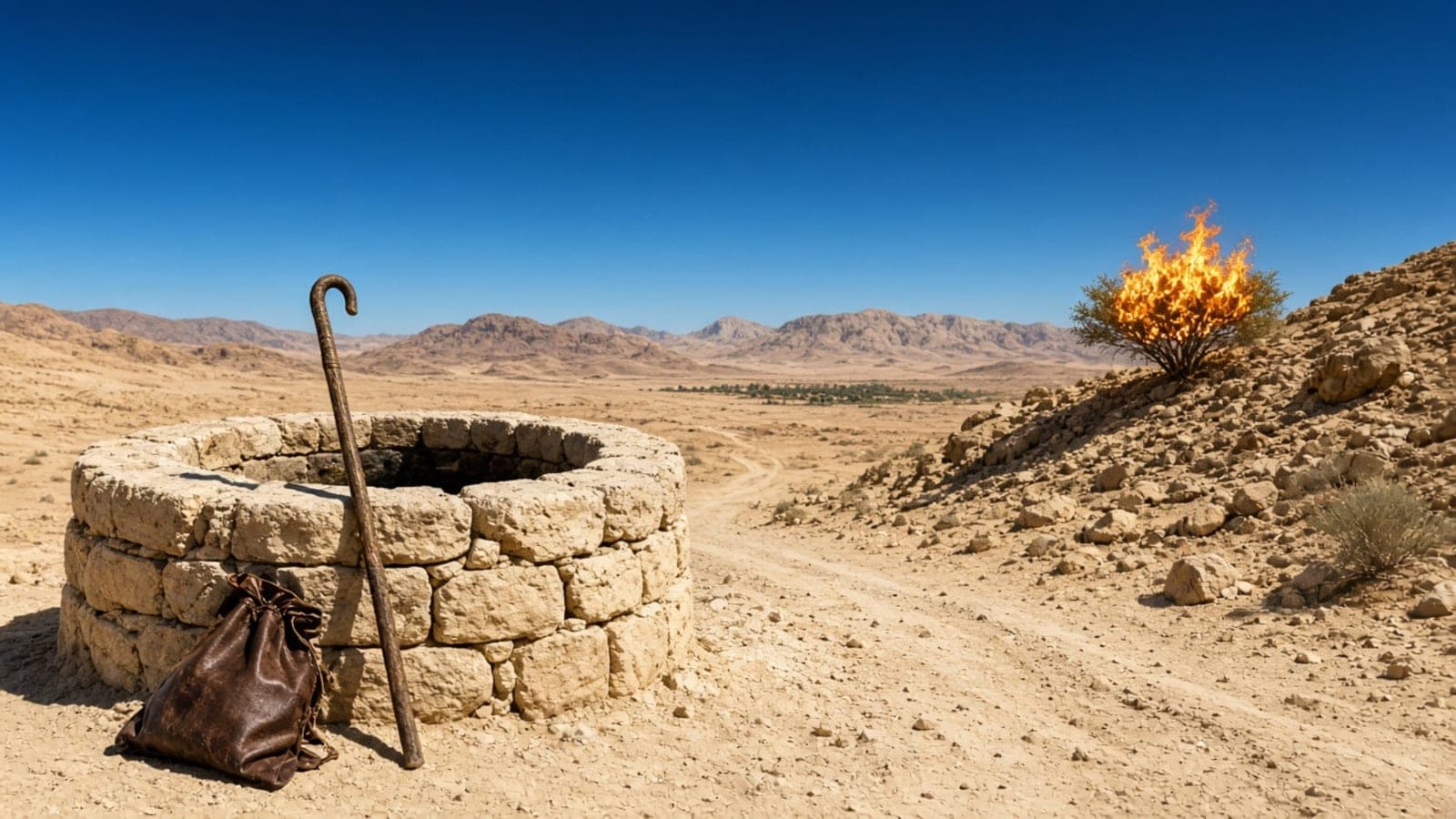
Moses was eighty years old and finished. Forty years earlier he had been a prince of Egypt; now he was on the back side of a desert keeping another man's sheep, a fugitive with a price on his head and nothing left of the future he had imagined. And it is exactly there, to a burned-out man tending livestock that were not his, that God shows up in a bush that burns without being consumed.
Moses asks the obvious question. If I go to Egypt and say the God of your fathers sent me, they will ask His name. What do I tell them?
And God gives him the answer that has never stopped echoing. Ehyeh asher ehyeh. I AM THAT I AM. Tell them I AM has sent you.
Sit with how strange that is as a name. Not “the Almighty,” though He is. Not “the Eternal,” though He is that too. When the Maker of everything is asked who He is, He answers with the barest possible form of the verb to be. I am. He names Himself with existence itself.
What the Name Actually Says
The Hebrew is ehyeh, the first-person form of the verb hayah, to be. And here is the thing worth slowing down for: Biblical Hebrew does not have tenses the way English does. It has aspect, completed or incomplete, which means ehyeh legitimately carries “I am,” “I will be,” and “I go on being,” all at once. That is why your translations disagree. Some say “I AM THAT I AM.” Some say “I WILL BE WHAT I WILL BE.” Both are honest attempts at a verb that refuses to sit still in time.
The name is tied directly to the four letters behind the word LORD in your Old Testament, YHWH, the name so holy that Jewish scribes would not pronounce it. Ehyeh, “I am,” is a wordplay on Yahweh, “He is.” When God speaks His own name it is first-person, I AM. When you speak it, it becomes third-person, He is. Either way it says the same thing: this One simply is, underived, uncaused, dependent on nothing, the only being in the universe who exists by nature of what He is rather than because something else made Him.
There is a real debate worth naming here. The older translation “I am the Existing One” comes through the Greek Old Testament, and some scholars think it leans harder on abstract philosophy than the Hebrew itself does. They point to two verses earlier, where God tells Moses ehyeh immakh, “I will be with you,” the same verb, and read the name less as a lecture on self-existence and more as a promise of presence: I will be there, for you, as whatever the moment requires.
It is not either/or. The One who exists by His own nature is also the One who bends down to a fugitive and says I will be with you. Self-existence and covenant presence in a single word. He is the ground of all being, and He is coming to Egypt with you. The philosophers and the shepherds are both right, and the name holds them together.
The Reaching Starts Here
Notice what the I AM is doing when He gives the name. He is not on a mountain being admired. He has come down.
“I have surely seen the affliction of my people which are in Egypt... and I am come down to deliver them” (Exodus 3:7–8). That is the reaching God, the thread that runs the whole length of Scripture, and here it wears the divine name like a badge. The One who simply is, who needs nothing and no one, has noticed a group of slaves making bricks in a foreign country, and He has descended to get them out. The name is not introduced in the abstract. It is introduced in the middle of a rescue.
This is the pattern you find everywhere once you have seen it. The self-sufficient God is the reaching God. He does not need Israel and He comes for Israel anyway. He did not need Moses and He lit a bush for Moses anyway. Existence itself walked into a desert to find one broken man and hand him a staff.
The Name That Carried a Nation
From that bush, the I AM becomes the engine of the entire Exodus, and the Exodus is one of the great hinges of the whole biblical story. Before it, God deals with a family, a scattered clan of patriarchs. After it, He deals with a nation under a covenant of law, forged in a furnace and marched out through a split sea. The burning bush is the doorway between two whole eras of God's dealings with humanity, and the name I AM is what holds the door.
Watch it work. The plagues are the I AM dismantling the gods of Egypt one by one. The Passover is the I AM teaching His people that judgment passes over wherever the blood is applied. The sea opening is the I AM making a road through the impossible. Every act of that deliverance is the signature of the God who named Himself existence, proving in history that He is exactly what He said, present, active, and utterly beyond every so-called god Egypt could field against Him.
Then the Name Walked into the Temple
Now come forward fifteen hundred years, into a temple courtyard in Jerusalem, where a Galilean carpenter is in an argument with the religious leaders about Abraham.
Through the Gospel of John, this man has been doing something remarkable with two small Greek words, egō eimi, “I am.” I am the bread of life. I am the light of the world. I am the door of the sheep. I am the good shepherd. I am the resurrection and the life. I am the way, the truth, and the life. I am the true vine. Seven times He fills in the blank, and every one of them is an offer of shelter, of food, of light, of life, held out to anyone who will come.
And then, in John 8, He stops filling in the blank.
They challenge Him: You are not yet fifty years old, and you have seen Abraham? And Jesus answers: “Verily, verily, I say unto you, Before Abraham was, egō eimi” (John 8:58).
Not “before Abraham was, I was.” That would only claim He is very old. He says “before Abraham was, I am.” The grammar breaks on purpose. He reaches back across fifteen centuries, past Abraham, and picks up the exact name spoken at the burning bush, and He puts it on His own lips in the present tense, because the One who spoke it has no past tense. Divinity is always now.
The scholarship has a caveat worth stating: some argue the connection runs through the “I am he” of Isaiah rather than straight back to Exodus 3:14. It changes nothing, because in Isaiah “I am he” is God distinguishing Himself from every idol, another divine self-identification. Every road leads to the same place. And there is one witness whose testimony settles it beyond argument: the people standing there.
Because the very next verse says, “Then took they up stones to cast at him.”
They knew. Nobody picks up rocks over a grammar lesson. In that culture there was exactly one crime that got you stoned on the spot, and it was blasphemy, a man making himself God. They understood precisely what He had claimed. He had taken the unspeakable name, the name from the bush, the name that split the sea, and He had said it about Himself. They were not confused. They were either going to worship or kill, and they chose the stones.
Where You Can Hide
Go back to those seven sayings for a moment, because they are not just theology. They are an address.
When the great I AM finally speaks His name in flesh, look at what He attaches it to. I am the door. You go in through Me and you are safe. I am the good shepherd, and the good shepherd lays down His life for the sheep. I am the bread; you will not starve. I am the light; you will not walk in darkness. I am the vine; abide in Me and you will not wither. The self-existent God does not just announce that He is. He announces that He is a shelter, and He names Himself the place where you can hide.
This is the answer to the oldest problem in the book. The story opened with two people hiding from God, crouched in the trees, exposed and afraid. And here is God in the flesh saying: stop hiding from Me and hide in Me. I am the door. Come inside.
So Come to the One Who Is
The God who exists by His own nature, who needs nothing, who named Himself I AM at a bush that would not burn up, took that name into a human throat and then let human hands nail Him to a cross. Think about what that costs. Existence itself chose to die. The One whose name has no past tense entered time, took on a body that could bleed, and spent it. The great I AM said “it is finished” and stopped breathing, so that people who are hiding in the trees could come out and live.
And then, because He is the I AM and the grave has no claim on the One who simply is, He walked out of it. Death cannot hold existence. The tomb could not keep the God whose name is I AM, and He came out on the third day still bearing it, still holding the door open.
So here is what you do with this, and it is not complicated. You stop trying to be your own foundation. Every one of us spends years quietly acting as our own I AM, the self-made center of our own small universe, the one thing we are sure exists and can depend on. And it never holds, because you are not self-existent. You are a creature. You began. You will end. You need. There is only one I AM, and the staggering news of this whole book is that He is not your rival. He is your rescue. He came down to a fugitive at a bush, He came down to slaves in Egypt, He came down to a world in the flesh, and He is reaching for you right now with the same hand that lit the bush.
The seven doors are still open. The name still stands. And the invitation that the great I AM held out with His own voice has never once been withdrawn: whosoever comes to Me will never hunger, whosoever comes to Me I will in no wise cast out.
You do not have to be the one who is anymore. You never could carry it. Come and hide in the One who can, the One who was reaching for you before Abraham was, the One who is reaching still.
He is the I AM. And He wants you to come home.
Exodus 3: the chapter behind this essay
Open the burning bush in the Bible reader with verse-by-verse commentary from Whosoever Will, Chuck Smith, and Matthew Henry beside the text.
This essay is original to Whosoever Will (2026). A reading of Exodus 3 and John 8 on the name I AM. All rights reserved. Platform use under Revelation 22:17, free to all who come.