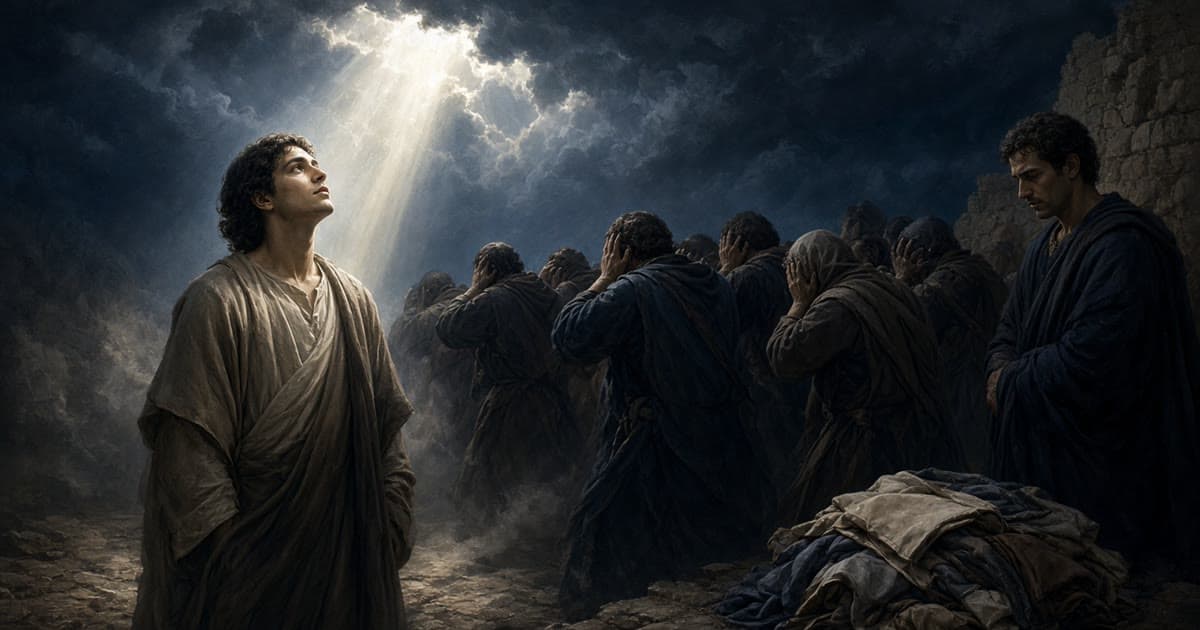
Before Stephen said a word in his own defense, God gave the room a sign.
Luke tells it plainly. The council had hauled in false witnesses, stacked the charges, and fixed their eyes on the accused, and “all that sat in the council, looking stedfastly on him, saw his face as it had been the face of an angel” (Acts 6:15). His face was shining. Radiant. Lit from somewhere that was not the room.
Every man on that council knew exactly what that meant, because every man on that council had built his life on the books that told the one other story like it. Moses came down from the mountain, from forty days in the presence of God, and his face shone so brightly the people were afraid to come near him, and he had to put a veil over it (Exodus 34:29-30). The shining face was the signature of a man who had been standing in the presence of God. And here was Stephen, accused of blaspheming Moses, wearing the exact mark of Moses on his face while they judged him.
It was God's own verdict, handed to the court before the trial began. This man is not a blasphemer. This man has been with Me. Read the face.
They would not read it.
The Question the Shining Face Forces
Stop here, because this opening image raises a question that runs to the bottom of everything this platform is about.
Why would God bother?
If these men were fixed, if their verdict was settled before the world began, if they were simply going to do what they were always going to do with no possibility of doing otherwise, then the shining face is a strange and pointless gesture. You do not hold up a sign to a wall. You do not hand a verdict to a jury that cannot read. A sign given to people who cannot respond to it is not mercy and it is not justice; it is a cruelty dressed as a courtesy, and God does not deal in that.
The shining face only makes sense if the men looking at it could have gone either way. God lit Stephen's face because the choice in that room was real, and He was loading the scales toward life the way He always does, giving them one more reason, one more sign, one more chance to see. The sign is the proof that the response matters. God does not argue with stones. He argued with these men, in light, on the face of the one they were about to kill, because they were not stones. They were men who could still turn.
They saw the sign. And then they gave Stephen the floor, and he told them the whole story of their nation, and every beat of it said the same thing the shining face had said, and they would not read that either.
The Story Underneath the Story
Ask Stephen a simple yes-or-no question, are you against Moses and the temple, and he answers with the entire history of Israel, from Abraham to Solomon, in one breath. It looks like a stall. It is actually the sharpest indictment in the New Testament, and it moves on a single rail.
Watch what he chooses to emphasize. Abraham, called by a God who appeared to him in Mesopotamia, in Haran, out in the pagan world, long before there was a temple or a holy land to stand on. Joseph, sold by his own brothers, rejected by the very family he would later save, exalted in a foreign country and then made their deliverer. Moses, refused by his own people the first time he came (“who made thee a ruler and a judge over us?”), driven into the desert, and sent back by God as the ruler they had rejected, to save the people who had pushed him away. The prophets, every one of them, persecuted and killed by the fathers of the men now sitting in judgment, though every one of them pointed forward to the coming of the Righteous One.
There is a pattern here, and Stephen is drawing it in the air so that only a blind man could miss it. God sends a deliverer. The people reject him. God exalts him anyway and saves them through the very one they refused. It happened with Joseph. It happened with Moses. It happened with the prophets. And it has just happened, one final and infinite time, with Jesus, the Righteous One the prophets promised, rejected and murdered by the very people who were built to recognize Him. The council is not judging a man who broke with their history. The council is repeating their history, live, in the room, as Stephen speaks.
And underneath even that runs the deeper thread, the one that gives the whole speech its spine. God has never been contained. He met Abraham in Mesopotamia, Joseph in Egypt, Moses in a burning bush in Midian, the whole nation in a wilderness with no temple in sight. “The most High dwelleth not in temples made with hands” (Acts 7:48). Their whole confidence was a building. Stephen's whole point is that the God they had locked inside that building had been walking the earth reaching for people the entire time, in every foreign and unlikely place, and was standing in their own council chamber at that moment with a shining face, and they could not see Him because they were looking at the architecture.
The Word That Breaks the System
Then Stephen stops telling the story and turns to face them, and in three verses he says the thing that gets him killed, and one word in it quietly demolishes an entire theology.
“Ye stiffnecked and uncircumcised in heart and ears, ye do always resist the Holy Ghost: as your fathers did, so do ye” (Acts 7:51).
Take the words apart, because every one is doing work. Stiffnecked is a farming word, an ox that will not bend its neck to take the yoke, that locks its whole body against the plow. Uncircumcised in heart and ears is the sharpest thing a Jew could say to a Jew. Circumcision was the sign of the covenant, the mark cut into the flesh that said I belong to God. To be uncircumcised in heart is to wear the sign on the body and have nothing behind it, the covenant mark with an unchanged life underneath, the ears that will not hear and the heart that will not yield while the outward badge of belonging stays perfectly in place. They had the sign. They had refused the substance the sign was about.
And then the word. Resist. “Ye do always resist the Holy Ghost.”
Sit with what it means that a man being murdered says this to his murderers. The Greek word means to fall against, to push back, to actively set yourself in opposition to a force that is pressing on you. And Stephen does not say they resisted once, in a weak moment. He says they always resist, that their fathers did it, that it is the family trade, a whole history of a God pressing in and a people pushing back. The Holy Spirit came, and came, and came, in Joseph and Moses and the prophets and the Righteous One and the shining face in that very room, and every time, the answer was the same. No.
Now hold that word up against the idea that the grace of God, when it comes to a person, cannot be refused. That when the Spirit moves to save, the movement is irresistible, the outcome fixed, the human being carried along with no real power to say no. Set that idea next to Stephen's dying sentence and watch it fall apart, because you cannot resist an irresistible force. The words cannot both be true. If the Spirit's work on a heart cannot be turned away, then Stephen's central accusation is not merely false, it is incoherent, a charge of doing the one thing that on that theory can never be done. But Stephen is not incoherent. He is a Spirit-filled man, in his last minutes, seeing heaven open, and the Holy Spirit Himself is putting this word in his mouth: you always resist Me. The verdict of heaven on that room is that the Spirit had genuinely come to them and they had genuinely refused Him, and that the refusing was real enough to damn.
This is the thing the deterministic reading of Scripture cannot absorb, and it is not hiding in some obscure corner. It is the climax of the first Christian martyr's final sermon. The whole tragedy of the scene depends on the resistance being real. God really reached. They really refused. And the refusing was theirs.
They Kept the Law and Broke It
Stephen has one more blade, and it is aimed at the exact center of their confidence.
“Who have received the law by the disposition of angels, and have not kept it” (Acts 7:53).
The Jews held that the Law had been given at Sinai through the mediation of angels, handed down with the highest possible pedigree, delivered by the shining ones of heaven into the hands of Moses. It was the crown of their identity. And these men in particular, the council, the scholars, the rulers, were the most scrupulous law-keepers alive. They tithed their spices. They counted their steps on the Sabbath. They had built fences around the Law and fences around the fences.
And Stephen says: you did not keep it.
How can that be? They kept it more carefully than anyone. And that is precisely the point, and it is the same point the whole New Testament keeps making. You can keep the entire external apparatus of the Law, every rule, every ritual, every fast, and break the Law at its root, because the Law was never finally about the spices. It was about the God who gave it and the Righteous One it pointed to, and men who murder the Righteous One while tithing their mint have not kept the Law, they have missed the entire thing it existed to say. They had the sign in their flesh and did not have God in their hearts. They had the Law in their hands and did not have it in their lives. They had every external mark of belonging to God, delivered by angels, and they used the very righteousness those marks were supposed to produce to kill the Son of God when He stood in front of them.
The most religious men in the room were the ones resisting the Spirit hardest, because their religion had become the veil. It let them look at a shining face and see a blasphemer. It let them hold the Law of God while breaking it in the worst way it has ever been broken. Keeping the form is not keeping the faith. It never was.
The Door Held Open With Stones in the Air
Here is where the scene should end in pure judgment, and instead it ends in something that will not fit any system that makes God cold.
They could not bear it. They stopped their ears, the ears Stephen had just called uncircumcised, physically covering them so the word could not get in, and they rushed him and dragged him out and picked up stones. And Stephen, with the rocks already in the air, looked up, saw heaven opened and Jesus standing to receive him, and prayed two prayers. “Lord Jesus, receive my spirit.” And then, on his knees, with a loud voice, for the men who were killing him: “Lord, lay not this sin to their charge” (Acts 7:59-60).
He asked God to forgive them. The resisters. The ones who had just refused every sign and murdered him for the message. With his last breath, the reaching God reached through Stephen one more time, toward the very men with blood on their hands, holding the door open even then.
And do not miss who was standing there holding the coats. A young man named Saul, consenting to the death, guarding the garments of the executioners, resisting the Holy Ghost as hard as any man in that crowd. If ever there was a heart the determinist would write off as vessel of wrath, fitted for destruction, it was Saul of Tarsus with Stephen's blood on his conscience. And you know what happened to him on the road to Damascus. The man resisting hardest at Stephen's stoning became the greatest preacher of the grace he had resisted. Stephen's dying prayer for his murderers was answered in the most spectacular conversion in history, and it started with a resister who finally stopped resisting.
That is who God is. He lights a face in a hostile room because the choice is real. He tells the whole story one more time to men He knows may kill the teller, because the reaching is real. He lets His martyr pray for the murderers, because the door is real and it is open. And He takes the worst resister in the crowd and makes him the apostle to the world, because no resistance is so hard that grace cannot finally win a willing yes out of it, if the man will only, at last, stop pushing back.
You are not a stone. God has never treated you like one. Every sign in your life, every word that found you, every strange mercy and unearned reaching, is Him loading the scales toward life on a face you were meant to read. The tragedy of that council was not that they were fixed. It was that they were free, and they used it to stop their ears. The glory of Saul was not that he was overpowered. It was that the same reaching that he had resisted for years finally met a man who quit resisting.
Read the face. Do not stop your ears. The Spirit who came to that room is still not willing that any should perish, still pressing, still reaching, and the one thing you can do about it is the one thing those men did: always resist. But you do not have to. The door Stephen died with open is open still.
And whosoever will, let him take the water of life freely. Even a man holding the coats. Even you.
Acts 7: the chapter behind this essay
Open Stephen's speech in the Bible reader with verse-by-verse commentary from Whosoever Will, Chuck Smith, and Matthew Henry beside the text.
This essay is original to The Whosoever Study Bible. A reading of Acts 7 on Stephen's speech and the word that undoes irresistible grace. All rights reserved. Platform use under Revelation 22:17, free to all who come.