
What this will do for you
You have heard that God decides who is in and who is out before anyone is born. That He hardens some and softens others by a hidden choice, and nothing you do touches it.
I am going to show you a different God, and I am going to show Him to you from the text, not from a system.
Here is the claim. Every time God deals with a man in Scripture, the text tells you what came first. When God shows grace, the man had humbled himself. When God brings judgment, the man had refused. And when God Himself brings a man low, Scripture names the reason every single time, and the reason is never “because I chose to.”
By the end you will have a rule you can check in any Bible. God answers what a man does with Him. He does not sort men before they move.
One rule, before we start
One rule runs through everything below. Never read a verse alone. Read the verses around it, and when the argument is big, read the whole book.
Most of what people believe about God choosing comes from one verse with the three around it left out. So we are going to read the three around it, every time.
Exhibit one: humble yourself, and God answers
Start with the men who humbled themselves. Watch what follows, and watch for the little word that ties the two together.
“If my people, which are called by my name, shall humble themselves, and pray... then will I hear from heaven.”
If, then. The hearing follows the humbling, and the text says so with an if.
“Because thine heart was tender, and thou hast humbled thyself before the LORD... I also have heard thee, saith the LORD.”
Because. Josiah humbled himself, and God says the hearing is because of it.
“And when he humbled himself, the wrath of the LORD turned from him.”
When. Rehoboam humbled himself, and the wrath turned.
“Because... thou didst humble thyself before God... I have even heard thee also, saith the LORD.”
When Manasseh was in affliction, he “humbled himself greatly before the God of his fathers” (33:12), prayed, “and he was intreated of him” (33:13).
Read them together. If, because, when, when. Every one is a connecting word, and it sits in the text, not in my argument. The man humbles himself, and the response follows, and Scripture ties them with a word you can point to.
I counted every place a man humbles himself and the surrounding verse states what followed. Ten of them carry a connector like these. Ten out of ten, the response is favour. Hearing, wrath turned, judgment deferred, covenant remembered. There is no verse where a man humbles himself before God and gets nothing.
Exhibit two: refuse, and judgment follows
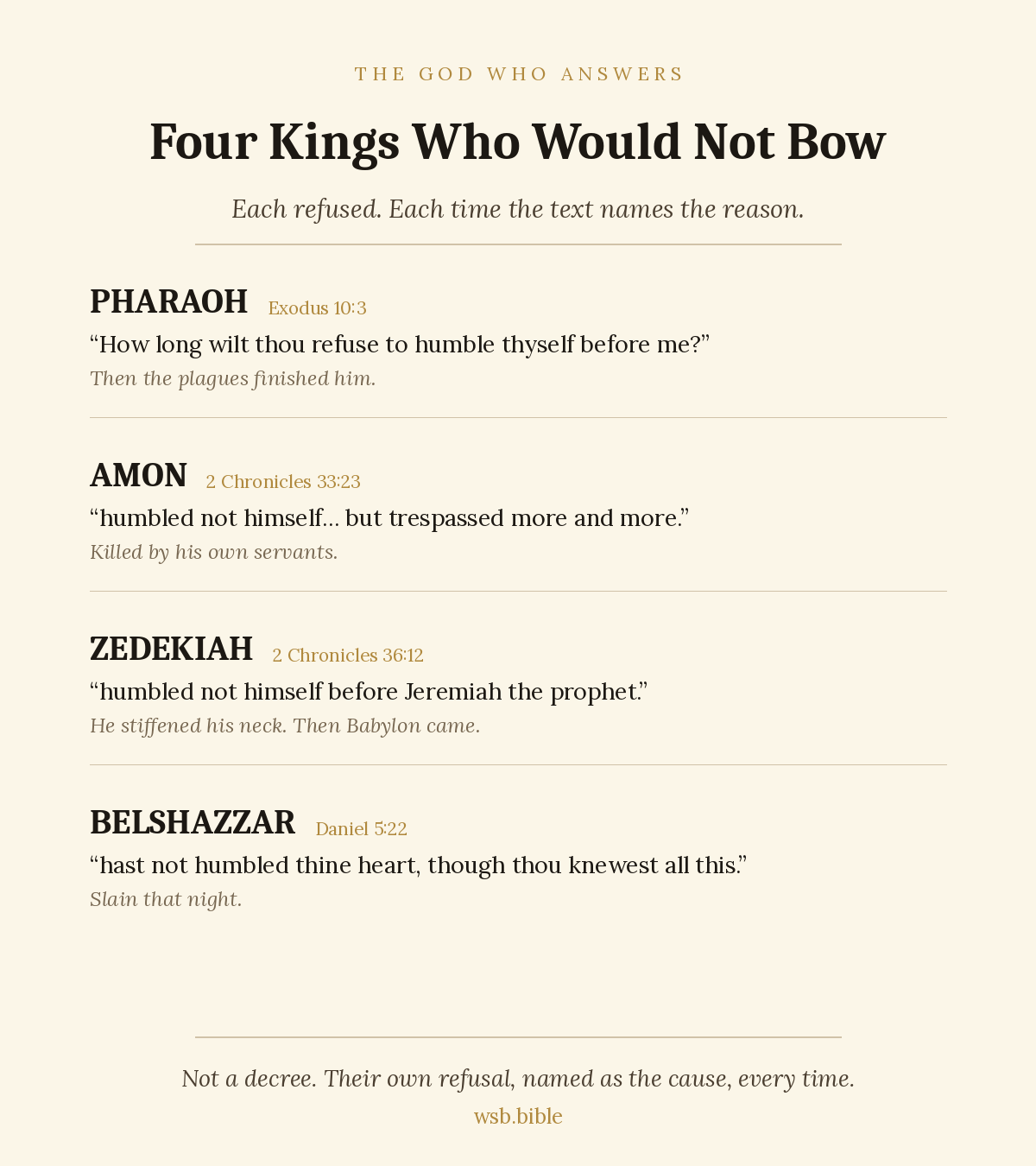
Now the other half, because the Bible gives both. Four kings refused to humble themselves. Read what the text names as the cause each time.
“How long wilt thou refuse to humble thyself before me?” (Exodus 10:3) God asked Pharaoh that, in the middle of the plagues. Then the plagues finished him.
“And humbled not himself before the LORD, as Manasseh his father had humbled himself; but Amon trespassed more and more.” (2 Chronicles 33:23) His own servants killed him.
“and humbled not himself before Jeremiah the prophet.” (2 Chronicles 36:12) He stiffened his neck and hardened his heart, and the word therefore follows, and Babylon comes.
“And thou his son, O Belshazzar, hast not humbled thine heart, though thou knewest all this.” (Daniel 5:22) He was slain that night.
Four kings. Four refusals. And every time the refusal is named as the reason. Not a decree. Not a choice made before they were born. Their own refusal, written on the page, given as the cause.
This is the mirror of exhibit one, and it is exact. Humble yourself and grace follows. Refuse and judgment follows. Both hang on what the man did, and both times the text names what the man did as the cause.
Exhibit three: even when God brings a man low, He tells you why
This is where they push back. They will say, but God humbles people. God brings men low. Is that not God sorting?
So I read every verse where God is the one doing the humbling. Every single one. And every single one gives a reason, right there in the text.
Sometimes the reason is to teach His own people.
“that he might humble thee, and that he might prove thee, to do thee good at thy latter end.” (Deuteronomy 8:16) That is God humbling Israel in the wilderness, and the verse is purpose from end to end. Every clause is a that-he-might. Why did He humble them? To prove them, and to do them good in the end. The reason is the whole verse. And He says what kind of act it is: “as a man chasteneth his son, so the LORD thy God chasteneth thee.” (Deuteronomy 8:5) A father with a son he already has. Not a judge sorting strangers.
Sometimes the reason is the man's own pride, named in the text.
“those that walk in pride he is able to abase.” (Daniel 4:37) That is Nebuchadnezzar, the clearest case in all Scripture of God bringing a pagan king low. And the cause sits one verse before the humbling, in the king's own mouth: “Is not this great Babylon, that I have built by the might of my power?” (Daniel 4:30) He boasted, and while the word was still in his mouth, God brought him down.
And watch how it finishes, because this is what ends the argument. “mine understanding returned unto me, and I blessed the most High... and excellent majesty was added unto me.” (Daniel 4:34-36) God humbled him, and then restored him, and added to him. That is not reprobation. Reprobation ends in nothing. This ends in a man restored and praising God.
I found no verse, anywhere, where God brings a man low for no reason stated in the man. Not one. Every time, the cause is on the page: to teach His own, or to answer a pride the text names.
And Scripture says it outright, so you do not have to infer it. “For he doth not afflict willingly nor grieve the children of men.” (Lamentations 3:33) He does not do it from pleasure. He does not do it from a bare will. He answers what is there.
The one hard case, and I will not hide it
There is one verse where a man humbles himself and nothing follows.
Psalm 10:10 describes the wicked man who “croucheth, and humbleth himself” so that the poor may fall into his claws. That is not a man humbling himself before God. It is a predator feigning humility to trap someone. No divine response, because it was never aimed at God.
It is the exception that shows the rule. Real humbling before God gets an answer every time. Faked humbling aimed at a victim gets nothing, because God is not its object.
What the evidence shows
Put it together.
Fifteen men humble themselves before God. Where the text supplies a connector, the answer is favour, ten for ten.
Four kings refuse to humble themselves. Judgment follows, and the refusal is named as the cause, four for four.
And every time God Himself brings a man low, the text states the reason, and the reason is always to teach His own or to answer pride. Never a bare decree. Twice it ends in the man restored.
There is no verse in Scripture where God deals with a man apart from what is in the man. None.
The verdict
So here is the God the text actually shows you.
Not a God who sorted you before you drew breath. A God who answers what you do with Him.
Humble yourself, and He hears. That is the pattern, written with an if and a because and a when, in book after book.
He asked Pharaoh how long he would refuse. You do not ask that of a man who cannot answer.
He is not waiting behind a decree. He is waiting for you to do what those kings would not.
“Humble yourselves in the sight of the Lord, and he shall lift you up.”
Your part first. Then His.
Scripture quoted from the King James Version. Every quotation verified against the tagged Masoretic text and the King James text (STEPBible TAHOT, CC BY 4.0).
This essay is original to The Whosoever Study Bible. The word counts, the grammatical readings, and the Seven Threads reading are original scholarship. All rights reserved. Platform use under Revelation 22:17, free to all who come.