John opens the chapter at a wedding in Cana, a small town in Galilee. The mother of Jesus is there, and Jesus and His disciples have been invited. Nothing about the setting is grand. The one whom chapter 1 called the Word made flesh comes to a family celebration as a guest, and it is here, not in the temple or before the rulers, that He will first show His glory (2:11).
The first sign is set at an ordinary village wedding, with Jesus and His disciples present as invited guests.
see John 1:14 · John 2:11 · John 4:46
The wine runs out, a failure that would shame the host, and the mother of Jesus brings the lack to Him: "They have no wine." His answer sounds harsh in English and is not. "Woman" (gynai) is a respectful address. He uses it again from the cross: "Woman, behold thy son" (19:26). "What have I to do with thee" (ti emoi kai soi) is a Hebrew idiom, close to "why bring this to me?" It marks that what He does next is not done at her direction. The reason follows: "mine hour is not yet come." This is the first mention of His "hour" (hōra) in John, and through the rest of the book that hour is the cross and His glorifying (7:30; 8:20; 12:23; 13:1; 17:1). The first sign is given with the cross already in view. His mother does not argue. She turns to the servants and says, "Whatsoever he saith unto you, do it." These are her last recorded words in Scripture, and they point away from herself to Him. Obedience to His word is the response the whole book asks for.
Jesus acts on the Father's timing, and His mother's last recorded words direct the servants to obey Him.
Woman (gynai): woman; here a respectful form of address, used again at 19:26 · hour (hōra): hour; in John, the appointed time of the cross and glorification
threads t3 · see John 19:26 · John 7:30 · John 8:20 · John 12:23 · John 13:1 · John 17:1
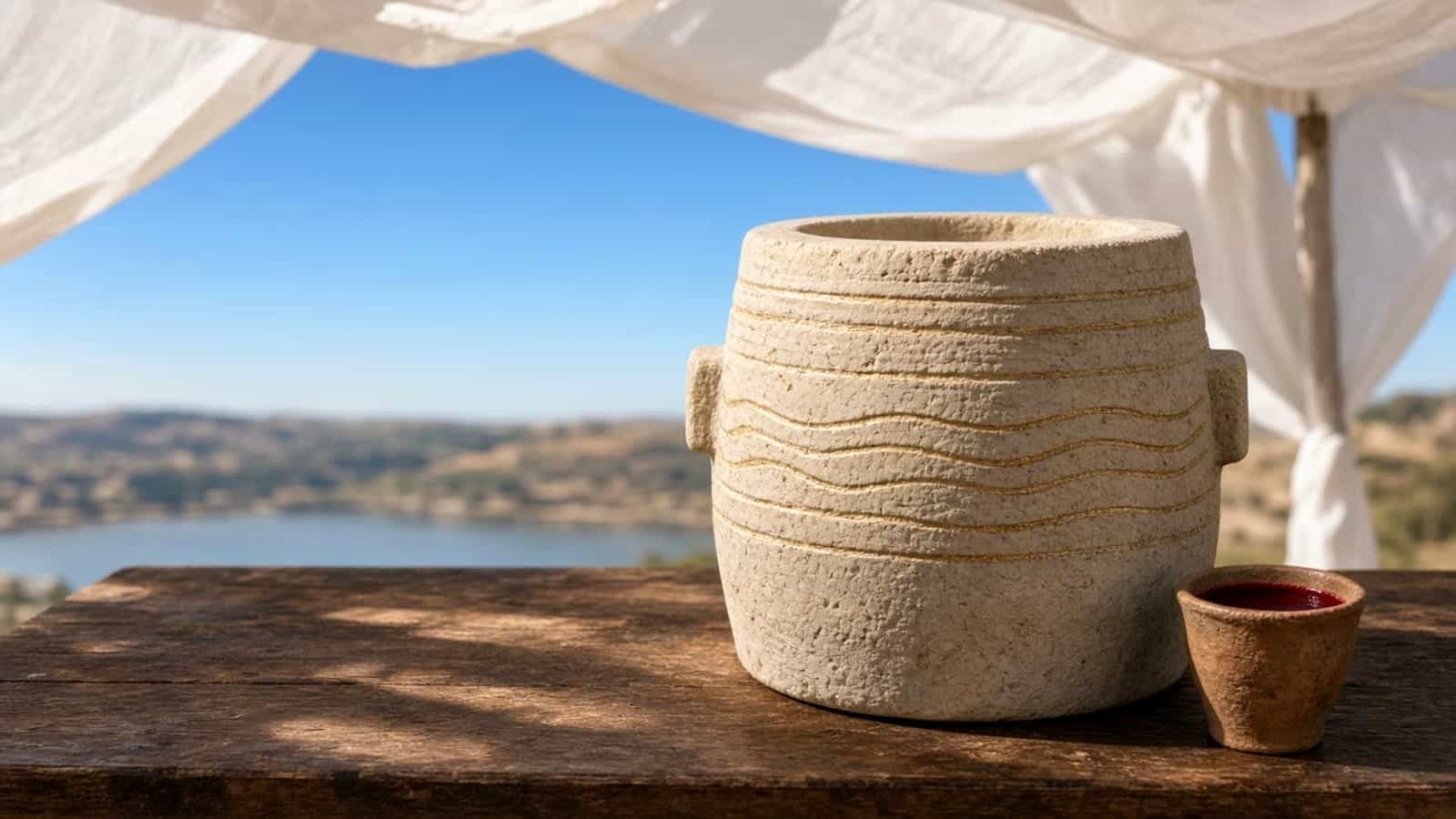
John records what kind of vessels these were: six stone waterpots "after the manner of the purifying of the Jews." They held water for ceremonial washing. The detail is there for a reason. Jesus does not call for wineskins. He has the purification pots filled "up to the brim" and then tells the servants to draw from them. The vessels of the old ritual are about to hold something new. John has already said it in a sentence: "the law was given by Moses, but grace and truth came by Jesus Christ" (1:17). Here it is shown at a wedding. The servants do what His mother told them to do. They fill, they draw, they carry, and the sign happens in the course of their obedience.
Jesus takes the vessels of the old ceremonial washing and fills them for a new purpose.
threads t5 · see John 1:17 · John 2:5 · Mark 7:3-4
The ruler of the feast tastes the wine without knowing where it came from. The servants know. He calls the bridegroom and says what any host would recognize: the good wine is served first and the poorer wine later, "but thou hast kept the good wine until now." John lets an unwitting witness give the verdict. What Jesus supplies is not a patch on a shortage. It is better than what the feast began with, and there is a great deal of it. The bridegroom did nothing to earn it and did not know to ask. It was given.
The wine Jesus gives is abundant and better than what came before, and it is given freely to an ordinary household.
threads t7 · see John 1:16 · Isaiah 55:1
John's word for "miracles" here is sēmeia, signs. "This beginning of miracles" is archē tōn sēmeiōn, the beginning of the signs. A sign points past itself. The wine is not the point. Who made it is the point. This first sign "manifested forth his glory" (doxa), the same glory the opening of the book said "we beheld" (1:14). Then comes the result: "his disciples believed on him" (episteusan eis auton; pisteuō). The order matters. He reveals, and they believe. The sign shows them who He is, and they answer it with faith. That is the purpose John gives for writing down the signs at all: "that ye might believe that Jesus is the Christ, the Son of God" (20:31). Revelation, then response, is the pattern this Gospel repeats from here on.
The first sign reveals the glory of Jesus, and His disciples respond to that revelation by believing on Him.
miracles (sēmeion): sign; a work that points beyond itself to who Jesus is · glory (doxa): glory, splendor; the revealed majesty of God · believed (pisteuō): to believe, to trust, to entrust
threads t3 · t5 · see John 1:14 · John 20:30-31 · John 4:54
John moves Jesus from Cana down to Capernaum with his mother, his brethren, and his disciples, and notes that the stay was brief. The verse is a hinge. The quiet scene in Galilee is over, and the next verse takes Him up to Jerusalem for His first public act there.
A short stay in Capernaum with His family and disciples joins the sign at Cana to the Passover in Jerusalem.
see Matthew 4:13 · John 7:3-5
At Passover Jesus goes up to Jerusalem. What He finds in the temple is commerce: sellers of oxen, sheep, and doves, and money-changers at their tables. The animals were for sacrifice and the coin exchange served the temple tax, so the trade had a religious excuse. But it had taken over the court of the house of God. The place set apart for worship had become a place of business.
Jesus comes to Jerusalem at Passover and finds the temple court turned into a market.
threads t3 · see Exodus 12:14 · Deuteronomy 16:16 · John 2:16
He makes a scourge of small cords and drives them out, sellers and animals together. He pours out the coins and overturns the tables. To the dove sellers He gives a command: "Take these things hence; make not my Father's house an house of merchandise." The weight is in two words, "my Father's." He does not say "our Father's house" or "God's house." He speaks as the Son, with a son's right to set his father's house in order. No one had appointed Him to police the temple. He acts on an authority that is His own. And the result of the act is that the house is cleared for what it was for: a place where people come to God, not a place where access is bought and sold.
Jesus cleanses the temple with a Son's authority over His Father's house.
threads t1 · t3 · see Luke 2:49 · Malachi 3:1 · Matthew 21:12-13 · Mark 11:15-17
The disciples later connected what they saw to what was written. The line is from Psalm 69:9. That psalm is quoted again as John's Gospel approaches the cross: "They hated me without a cause" (15:25) and the vinegar given Him to drink (19:28-29). So the zeal that clears the temple and the suffering that ends at Calvary come out of the same psalm. The cleansing is not an outburst. It is the Messiah doing what Scripture said He would do, and it sets Him on the road to the hour He spoke of in verse 4.
The zeal of Jesus for His Father's house fulfills Psalm 69:9.
zeal (zēlos): zeal, burning devotion
threads t3 · see Psalm 69:9 · John 15:25 · John 19:28-29 · Psalm 69:4 · Psalm 69:21
The rulers do not dispute that the market was wrong. They ask by what right He acted: "What sign shewest thou unto us?" His answer is a riddle they will not solve: "Destroy this temple, and in three days I will raise it up." The sign of His authority is His resurrection. Notice who does the raising. "I will raise it up" (egerō, from egeirō) is active. He speaks of raising Himself from death, which is a claim only God could make. He says the same thing openly later: "I have power to lay it down, and I have power to take it again" (10:18).
Asked for a sign of His authority, Jesus gives His own death and resurrection, and says He Himself will do the raising.
raise up (egeirō): to raise, to rouse, to raise from the dead
threads t3 · t6 · see John 10:17-18 · Matthew 12:38-40 · Matthew 26:61 · Mark 14:58
They hear Him speak of the stone building, forty-six years in construction, and the claim sounds absurd. John gives the reader the key they lacked: "he spake of the temple of his body." The temple was where God's presence dwelt with His people. John has already said that the Word "was made flesh, and dwelt among us" (1:14), where "dwelt" is eskēnōsen, He pitched His tent, He tabernacled. Now Jesus says it of Himself. God's dwelling with man is no longer a building in Jerusalem. It is a person. To destroy this temple is to put Him to death, and to raise it in three days is His resurrection. (The word for temple in these verses, naos, the sanctuary where God dwells, is not the word used of the temple courts in 2:14, hieron.)
The body of Jesus is the true temple, the place where God dwells among men.
dwelt (1:14) (skēnoō): to pitch a tent, to tabernacle, to dwell
threads t6 · see John 1:14 · Colossians 2:9 · John 4:21-24 · Revelation 21:22
John tells us when the disciples understood: after He rose. They did not grasp the saying when they heard it. The event made it clear, and then they "believed the scripture, and the word which Jesus had said." Two things are set side by side as the object of their faith, the written Scripture and the spoken word of Jesus, and John gives them equal weight. Their faith rested on what God had said, confirmed by what God then did.
The resurrection confirmed the saying, and the disciples believed both the Scripture and the word of Jesus.
see John 12:16 · Luke 24:6-8 · Luke 24:44-45 · Psalm 16:10
Many in Jerusalem "believed in his name, when they saw the miracles which he did." Then John adds a hard sentence: "But Jesus did not commit himself unto them." The two verbs are the same word in Greek. They believed (episteusan) in Him, and He did not entrust (episteuen) Himself to them; both are forms of pisteuō. They trusted Him after a fashion. He did not trust them. John gives the reason: "he knew what was in man." He did not need a report on anyone. John does not say their belief was no belief. He says it was a belief drawn out by spectacle, and that kind of faith has further to go. The chapter began with a sign that led the disciples to believe on Him (2:11). It ends with signs that produced a belief He would not rest Himself on. The next chapter opens with a man who comes on those terms, "no man can do these miracles that thou doest, except God be with him" (3:2), and Jesus answers him, "Ye must be born again" (3:7).
Faith that rests only on signs is real belief that has not yet received Jesus as He is, and He knows the difference in every heart.
believed / commit (pisteuō): to believe, to trust; in 2:24, to entrust oneself
see John 2:11 · John 3:2 · John 3:7 · John 6:26 · John 8:30-31 · 1 Samuel 16:7