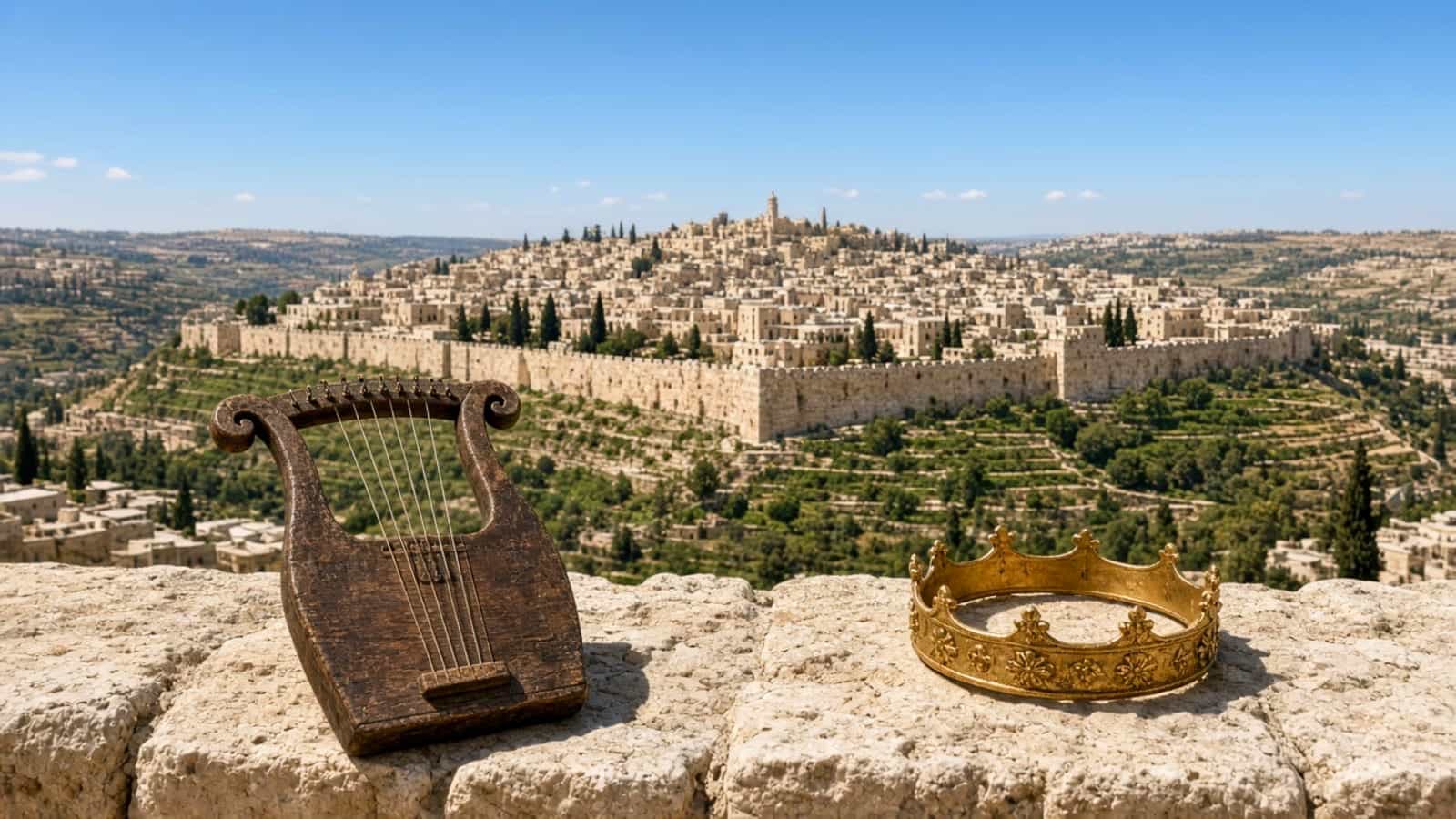
The closing sections of 2 Samuel bracket the Davidic kingship with poetry and reflection. Chapter 22 is David's great song of thanksgiving (the same text as Psalm 18) rehearsing the whole arc of his life from the earliest days of Saul's persecution through the establishment of his kingdom. The LORD is my rock, my fortress, my deliverer, my shield, my stronghold, my refuge, my savior.
The song is the longest sustained piece of personal theological reflection in the historical books. David is not doing systematic theology. He is narrating his life through the lens of who God has been to him. In distress I called upon the LORD; to my God I cried. He heard my voice. The earth trembled and shook. He reached down from on high and drew me out of many waters.
The last oracle of David (2 Samuel 23:1-7) is called the last words of David, son of Jesse, the sweet psalmist of Israel. He asks: when one rules justly over men, ruling in the fear of God, he dawns on them like the morning light, like the sun shining forth on a cloudless morning, like rain that makes grass sprout from the earth. Is not my house so with God? For he has made with me an everlasting covenant, ordered in all things and secure.
Thread 3 is in meshicho (the anointed one and his seed forever) and in the everlasting covenant that David celebrates as the ground of his security. The Davidic covenant is not abstract theology to David. It is personal assurance spoken from the inside of a life that has been through everything. Thread 1 is the whole song: the God who reaches, rescues, draws from many waters, delivers from enemies. This is the God David has known personally across sixty years.
The LORD is my rock and my fortress and my deliverer: David's great song of thanksgiving is the personal Psalm 18, the voice of the man after God's own heart from the other side of all the pursuing and the hiding and the waiting and the ruling.
מְגִדִּיל יְשׁוּעוֹת מַלְכּוֹ וְעֹשֶׂה חֶסֶד לִמְשִׁיחוֹ לְדָוִד וּלְזַרְעוֹ עַד עוֹלָם (megiddil yeshuot malko ve-oseh chesed li-meshicho le-David u-le-zar'o ad-olam): he is the tower of salvation for his king and shows chesed to his anointed to David and to his seed for ever: li-meshicho (to his anointed, mashiach; David is the anointed one and his song closes with the recognition that the chesed extends beyond him to his seed; ad-olam in the mouth of David himself, celebrating the covenant he has been given; the anointed and his seed forever is the Davidic covenant celebrated from the inside)
threads t1 · t3 · see 2 Samuel 23:1-5 · Psalm 18:1-50 · Luke 1:69
The closing sections of 2 Samuel bracket the Davidic kingship with poetry and reflection. Chapter 22 is David's great song of thanksgiving (the same text as Psalm 18) rehearsing the whole arc of his life from the earliest days of Saul's persecution through the establishment of his kingdom. The LORD is my rock, my fortress, my deliverer, my shield, my stronghold, my refuge, my savior.
The song is the longest sustained piece of personal theological reflection in the historical books. David is not doing systematic theology. He is narrating his life through the lens of who God has been to him. In distress I called upon the LORD; to my God I cried. He heard my voice. The earth trembled and shook. He reached down from on high and drew me out of many waters.
The last oracle of David (2 Samuel 23:1-7) is called the last words of David, son of Jesse, the sweet psalmist of Israel. He asks: when one rules justly over men, ruling in the fear of God, he dawns on them like the morning light, like the sun shining forth on a cloudless morning, like rain that makes grass sprout from the earth. Is not my house so with God? For he has made with me an everlasting covenant, ordered in all things and secure.
Thread 3 is in meshicho (the anointed one and his seed forever) and in the everlasting covenant that David celebrates as the ground of his security. The Davidic covenant is not abstract theology to David. It is personal assurance spoken from the inside of a life that has been through everything. Thread 1 is the whole song: the God who reaches, rescues, draws from many waters, delivers from enemies. This is the God David has known personally across sixty years.
The LORD is my rock and my fortress and my deliverer: David's great song of thanksgiving is the personal Psalm 18, the voice of the man after God's own heart from the other side of all the pursuing and the hiding and the waiting and the ruling.
מְגִדִּיל יְשׁוּעוֹת מַלְכּוֹ וְעֹשֶׂה חֶסֶד לִמְשִׁיחוֹ לְדָוִד וּלְזַרְעוֹ עַד עוֹלָם (megiddil yeshuot malko ve-oseh chesed li-meshicho le-David u-le-zar'o ad-olam): he is the tower of salvation for his king and shows chesed to his anointed to David and to his seed for ever: li-meshicho (to his anointed, mashiach; David is the anointed one and his song closes with the recognition that the chesed extends beyond him to his seed; ad-olam in the mouth of David himself, celebrating the covenant he has been given; the anointed and his seed forever is the Davidic covenant celebrated from the inside)
threads t1 · t3 · see 2 Samuel 23:1-5 · Psalm 18:1-50 · Luke 1:69
The closing sections of 2 Samuel bracket the Davidic kingship with poetry and reflection. Chapter 22 is David's great song of thanksgiving (the same text as Psalm 18) rehearsing the whole arc of his life from the earliest days of Saul's persecution through the establishment of his kingdom. The LORD is my rock, my fortress, my deliverer, my shield, my stronghold, my refuge, my savior.
The song is the longest sustained piece of personal theological reflection in the historical books. David is not doing systematic theology. He is narrating his life through the lens of who God has been to him. In distress I called upon the LORD; to my God I cried. He heard my voice. The earth trembled and shook. He reached down from on high and drew me out of many waters.
The last oracle of David (2 Samuel 23:1-7) is called the last words of David, son of Jesse, the sweet psalmist of Israel. He asks: when one rules justly over men, ruling in the fear of God, he dawns on them like the morning light, like the sun shining forth on a cloudless morning, like rain that makes grass sprout from the earth. Is not my house so with God? For he has made with me an everlasting covenant, ordered in all things and secure.
Thread 3 is in meshicho (the anointed one and his seed forever) and in the everlasting covenant that David celebrates as the ground of his security. The Davidic covenant is not abstract theology to David. It is personal assurance spoken from the inside of a life that has been through everything. Thread 1 is the whole song: the God who reaches, rescues, draws from many waters, delivers from enemies. This is the God David has known personally across sixty years.
The LORD is my rock and my fortress and my deliverer: David's great song of thanksgiving is the personal Psalm 18, the voice of the man after God's own heart from the other side of all the pursuing and the hiding and the waiting and the ruling.
מְגִדִּיל יְשׁוּעוֹת מַלְכּוֹ וְעֹשֶׂה חֶסֶד לִמְשִׁיחוֹ לְדָוִד וּלְזַרְעוֹ עַד עוֹלָם (megiddil yeshuot malko ve-oseh chesed li-meshicho le-David u-le-zar'o ad-olam): he is the tower of salvation for his king and shows chesed to his anointed to David and to his seed for ever: li-meshicho (to his anointed, mashiach; David is the anointed one and his song closes with the recognition that the chesed extends beyond him to his seed; ad-olam in the mouth of David himself, celebrating the covenant he has been given; the anointed and his seed forever is the Davidic covenant celebrated from the inside)
threads t1 · t3 · see 2 Samuel 23:1-5 · Psalm 18:1-50 · Luke 1:69
The closing sections of 2 Samuel bracket the Davidic kingship with poetry and reflection. Chapter 22 is David's great song of thanksgiving (the same text as Psalm 18) rehearsing the whole arc of his life from the earliest days of Saul's persecution through the establishment of his kingdom. The LORD is my rock, my fortress, my deliverer, my shield, my stronghold, my refuge, my savior.
The song is the longest sustained piece of personal theological reflection in the historical books. David is not doing systematic theology. He is narrating his life through the lens of who God has been to him. In distress I called upon the LORD; to my God I cried. He heard my voice. The earth trembled and shook. He reached down from on high and drew me out of many waters.
The last oracle of David (2 Samuel 23:1-7) is called the last words of David, son of Jesse, the sweet psalmist of Israel. He asks: when one rules justly over men, ruling in the fear of God, he dawns on them like the morning light, like the sun shining forth on a cloudless morning, like rain that makes grass sprout from the earth. Is not my house so with God? For he has made with me an everlasting covenant, ordered in all things and secure.
Thread 3 is in meshicho (the anointed one and his seed forever) and in the everlasting covenant that David celebrates as the ground of his security. The Davidic covenant is not abstract theology to David. It is personal assurance spoken from the inside of a life that has been through everything. Thread 1 is the whole song: the God who reaches, rescues, draws from many waters, delivers from enemies. This is the God David has known personally across sixty years.
The LORD is my rock and my fortress and my deliverer: David's great song of thanksgiving is the personal Psalm 18, the voice of the man after God's own heart from the other side of all the pursuing and the hiding and the waiting and the ruling.
מְגִדִּיל יְשׁוּעוֹת מַלְכּוֹ וְעֹשֶׂה חֶסֶד לִמְשִׁיחוֹ לְדָוִד וּלְזַרְעוֹ עַד עוֹלָם (megiddil yeshuot malko ve-oseh chesed li-meshicho le-David u-le-zar'o ad-olam): he is the tower of salvation for his king and shows chesed to his anointed to David and to his seed for ever: li-meshicho (to his anointed, mashiach; David is the anointed one and his song closes with the recognition that the chesed extends beyond him to his seed; ad-olam in the mouth of David himself, celebrating the covenant he has been given; the anointed and his seed forever is the Davidic covenant celebrated from the inside)
threads t1 · t3 · see 2 Samuel 23:1-5 · Psalm 18:1-50 · Luke 1:69
The closing sections of 2 Samuel bracket the Davidic kingship with poetry and reflection. Chapter 22 is David's great song of thanksgiving (the same text as Psalm 18) rehearsing the whole arc of his life from the earliest days of Saul's persecution through the establishment of his kingdom. The LORD is my rock, my fortress, my deliverer, my shield, my stronghold, my refuge, my savior.
The song is the longest sustained piece of personal theological reflection in the historical books. David is not doing systematic theology. He is narrating his life through the lens of who God has been to him. In distress I called upon the LORD; to my God I cried. He heard my voice. The earth trembled and shook. He reached down from on high and drew me out of many waters.
The last oracle of David (2 Samuel 23:1-7) is called the last words of David, son of Jesse, the sweet psalmist of Israel. He asks: when one rules justly over men, ruling in the fear of God, he dawns on them like the morning light, like the sun shining forth on a cloudless morning, like rain that makes grass sprout from the earth. Is not my house so with God? For he has made with me an everlasting covenant, ordered in all things and secure.
Thread 3 is in meshicho (the anointed one and his seed forever) and in the everlasting covenant that David celebrates as the ground of his security. The Davidic covenant is not abstract theology to David. It is personal assurance spoken from the inside of a life that has been through everything. Thread 1 is the whole song: the God who reaches, rescues, draws from many waters, delivers from enemies. This is the God David has known personally across sixty years.
The LORD is my rock and my fortress and my deliverer: David's great song of thanksgiving is the personal Psalm 18, the voice of the man after God's own heart from the other side of all the pursuing and the hiding and the waiting and the ruling.
מְגִדִּיל יְשׁוּעוֹת מַלְכּוֹ וְעֹשֶׂה חֶסֶד לִמְשִׁיחוֹ לְדָוִד וּלְזַרְעוֹ עַד עוֹלָם (megiddil yeshuot malko ve-oseh chesed li-meshicho le-David u-le-zar'o ad-olam): he is the tower of salvation for his king and shows chesed to his anointed to David and to his seed for ever: li-meshicho (to his anointed, mashiach; David is the anointed one and his song closes with the recognition that the chesed extends beyond him to his seed; ad-olam in the mouth of David himself, celebrating the covenant he has been given; the anointed and his seed forever is the Davidic covenant celebrated from the inside)
threads t1 · t3 · see 2 Samuel 23:1-5 · Psalm 18:1-50 · Luke 1:69
The closing sections of 2 Samuel bracket the Davidic kingship with poetry and reflection. Chapter 22 is David's great song of thanksgiving (the same text as Psalm 18) rehearsing the whole arc of his life from the earliest days of Saul's persecution through the establishment of his kingdom. The LORD is my rock, my fortress, my deliverer, my shield, my stronghold, my refuge, my savior.
The song is the longest sustained piece of personal theological reflection in the historical books. David is not doing systematic theology. He is narrating his life through the lens of who God has been to him. In distress I called upon the LORD; to my God I cried. He heard my voice. The earth trembled and shook. He reached down from on high and drew me out of many waters.
The last oracle of David (2 Samuel 23:1-7) is called the last words of David, son of Jesse, the sweet psalmist of Israel. He asks: when one rules justly over men, ruling in the fear of God, he dawns on them like the morning light, like the sun shining forth on a cloudless morning, like rain that makes grass sprout from the earth. Is not my house so with God? For he has made with me an everlasting covenant, ordered in all things and secure.
Thread 3 is in meshicho (the anointed one and his seed forever) and in the everlasting covenant that David celebrates as the ground of his security. The Davidic covenant is not abstract theology to David. It is personal assurance spoken from the inside of a life that has been through everything. Thread 1 is the whole song: the God who reaches, rescues, draws from many waters, delivers from enemies. This is the God David has known personally across sixty years.
The LORD is my rock and my fortress and my deliverer: David's great song of thanksgiving is the personal Psalm 18, the voice of the man after God's own heart from the other side of all the pursuing and the hiding and the waiting and the ruling.
מְגִדִּיל יְשׁוּעוֹת מַלְכּוֹ וְעֹשֶׂה חֶסֶד לִמְשִׁיחוֹ לְדָוִד וּלְזַרְעוֹ עַד עוֹלָם (megiddil yeshuot malko ve-oseh chesed li-meshicho le-David u-le-zar'o ad-olam): he is the tower of salvation for his king and shows chesed to his anointed to David and to his seed for ever: li-meshicho (to his anointed, mashiach; David is the anointed one and his song closes with the recognition that the chesed extends beyond him to his seed; ad-olam in the mouth of David himself, celebrating the covenant he has been given; the anointed and his seed forever is the Davidic covenant celebrated from the inside)
threads t1 · t3 · see 2 Samuel 23:1-5 · Psalm 18:1-50 · Luke 1:69
The closing sections of 2 Samuel bracket the Davidic kingship with poetry and reflection. Chapter 22 is David's great song of thanksgiving (the same text as Psalm 18) rehearsing the whole arc of his life from the earliest days of Saul's persecution through the establishment of his kingdom. The LORD is my rock, my fortress, my deliverer, my shield, my stronghold, my refuge, my savior.
The song is the longest sustained piece of personal theological reflection in the historical books. David is not doing systematic theology. He is narrating his life through the lens of who God has been to him. In distress I called upon the LORD; to my God I cried. He heard my voice. The earth trembled and shook. He reached down from on high and drew me out of many waters.
The last oracle of David (2 Samuel 23:1-7) is called the last words of David, son of Jesse, the sweet psalmist of Israel. He asks: when one rules justly over men, ruling in the fear of God, he dawns on them like the morning light, like the sun shining forth on a cloudless morning, like rain that makes grass sprout from the earth. Is not my house so with God? For he has made with me an everlasting covenant, ordered in all things and secure.
Thread 3 is in meshicho (the anointed one and his seed forever) and in the everlasting covenant that David celebrates as the ground of his security. The Davidic covenant is not abstract theology to David. It is personal assurance spoken from the inside of a life that has been through everything. Thread 1 is the whole song: the God who reaches, rescues, draws from many waters, delivers from enemies. This is the God David has known personally across sixty years.
The LORD is my rock and my fortress and my deliverer: David's great song of thanksgiving is the personal Psalm 18, the voice of the man after God's own heart from the other side of all the pursuing and the hiding and the waiting and the ruling.
מְגִדִּיל יְשׁוּעוֹת מַלְכּוֹ וְעֹשֶׂה חֶסֶד לִמְשִׁיחוֹ לְדָוִד וּלְזַרְעוֹ עַד עוֹלָם (megiddil yeshuot malko ve-oseh chesed li-meshicho le-David u-le-zar'o ad-olam): he is the tower of salvation for his king and shows chesed to his anointed to David and to his seed for ever: li-meshicho (to his anointed, mashiach; David is the anointed one and his song closes with the recognition that the chesed extends beyond him to his seed; ad-olam in the mouth of David himself, celebrating the covenant he has been given; the anointed and his seed forever is the Davidic covenant celebrated from the inside)
threads t1 · t3 · see 2 Samuel 23:1-5 · Psalm 18:1-50 · Luke 1:69
The closing sections of 2 Samuel bracket the Davidic kingship with poetry and reflection. Chapter 22 is David's great song of thanksgiving (the same text as Psalm 18) rehearsing the whole arc of his life from the earliest days of Saul's persecution through the establishment of his kingdom. The LORD is my rock, my fortress, my deliverer, my shield, my stronghold, my refuge, my savior.
The song is the longest sustained piece of personal theological reflection in the historical books. David is not doing systematic theology. He is narrating his life through the lens of who God has been to him. In distress I called upon the LORD; to my God I cried. He heard my voice. The earth trembled and shook. He reached down from on high and drew me out of many waters.
The last oracle of David (2 Samuel 23:1-7) is called the last words of David, son of Jesse, the sweet psalmist of Israel. He asks: when one rules justly over men, ruling in the fear of God, he dawns on them like the morning light, like the sun shining forth on a cloudless morning, like rain that makes grass sprout from the earth. Is not my house so with God? For he has made with me an everlasting covenant, ordered in all things and secure.
Thread 3 is in meshicho (the anointed one and his seed forever) and in the everlasting covenant that David celebrates as the ground of his security. The Davidic covenant is not abstract theology to David. It is personal assurance spoken from the inside of a life that has been through everything. Thread 1 is the whole song: the God who reaches, rescues, draws from many waters, delivers from enemies. This is the God David has known personally across sixty years.
The LORD is my rock and my fortress and my deliverer: David's great song of thanksgiving is the personal Psalm 18, the voice of the man after God's own heart from the other side of all the pursuing and the hiding and the waiting and the ruling.
מְגִדִּיל יְשׁוּעוֹת מַלְכּוֹ וְעֹשֶׂה חֶסֶד לִמְשִׁיחוֹ לְדָוִד וּלְזַרְעוֹ עַד עוֹלָם (megiddil yeshuot malko ve-oseh chesed li-meshicho le-David u-le-zar'o ad-olam): he is the tower of salvation for his king and shows chesed to his anointed to David and to his seed for ever: li-meshicho (to his anointed, mashiach; David is the anointed one and his song closes with the recognition that the chesed extends beyond him to his seed; ad-olam in the mouth of David himself, celebrating the covenant he has been given; the anointed and his seed forever is the Davidic covenant celebrated from the inside)
threads t1 · t3 · see 2 Samuel 23:1-5 · Psalm 18:1-50 · Luke 1:69
The closing sections of 2 Samuel bracket the Davidic kingship with poetry and reflection. Chapter 22 is David's great song of thanksgiving (the same text as Psalm 18) rehearsing the whole arc of his life from the earliest days of Saul's persecution through the establishment of his kingdom. The LORD is my rock, my fortress, my deliverer, my shield, my stronghold, my refuge, my savior.
The song is the longest sustained piece of personal theological reflection in the historical books. David is not doing systematic theology. He is narrating his life through the lens of who God has been to him. In distress I called upon the LORD; to my God I cried. He heard my voice. The earth trembled and shook. He reached down from on high and drew me out of many waters.
The last oracle of David (2 Samuel 23:1-7) is called the last words of David, son of Jesse, the sweet psalmist of Israel. He asks: when one rules justly over men, ruling in the fear of God, he dawns on them like the morning light, like the sun shining forth on a cloudless morning, like rain that makes grass sprout from the earth. Is not my house so with God? For he has made with me an everlasting covenant, ordered in all things and secure.
Thread 3 is in meshicho (the anointed one and his seed forever) and in the everlasting covenant that David celebrates as the ground of his security. The Davidic covenant is not abstract theology to David. It is personal assurance spoken from the inside of a life that has been through everything. Thread 1 is the whole song: the God who reaches, rescues, draws from many waters, delivers from enemies. This is the God David has known personally across sixty years.
The LORD is my rock and my fortress and my deliverer: David's great song of thanksgiving is the personal Psalm 18, the voice of the man after God's own heart from the other side of all the pursuing and the hiding and the waiting and the ruling.
מְגִדִּיל יְשׁוּעוֹת מַלְכּוֹ וְעֹשֶׂה חֶסֶד לִמְשִׁיחוֹ לְדָוִד וּלְזַרְעוֹ עַד עוֹלָם (megiddil yeshuot malko ve-oseh chesed li-meshicho le-David u-le-zar'o ad-olam): he is the tower of salvation for his king and shows chesed to his anointed to David and to his seed for ever: li-meshicho (to his anointed, mashiach; David is the anointed one and his song closes with the recognition that the chesed extends beyond him to his seed; ad-olam in the mouth of David himself, celebrating the covenant he has been given; the anointed and his seed forever is the Davidic covenant celebrated from the inside)
threads t1 · t3 · see 2 Samuel 23:1-5 · Psalm 18:1-50 · Luke 1:69
The closing sections of 2 Samuel bracket the Davidic kingship with poetry and reflection. Chapter 22 is David's great song of thanksgiving (the same text as Psalm 18) rehearsing the whole arc of his life from the earliest days of Saul's persecution through the establishment of his kingdom. The LORD is my rock, my fortress, my deliverer, my shield, my stronghold, my refuge, my savior.
The song is the longest sustained piece of personal theological reflection in the historical books. David is not doing systematic theology. He is narrating his life through the lens of who God has been to him. In distress I called upon the LORD; to my God I cried. He heard my voice. The earth trembled and shook. He reached down from on high and drew me out of many waters.
The last oracle of David (2 Samuel 23:1-7) is called the last words of David, son of Jesse, the sweet psalmist of Israel. He asks: when one rules justly over men, ruling in the fear of God, he dawns on them like the morning light, like the sun shining forth on a cloudless morning, like rain that makes grass sprout from the earth. Is not my house so with God? For he has made with me an everlasting covenant, ordered in all things and secure.
Thread 3 is in meshicho (the anointed one and his seed forever) and in the everlasting covenant that David celebrates as the ground of his security. The Davidic covenant is not abstract theology to David. It is personal assurance spoken from the inside of a life that has been through everything. Thread 1 is the whole song: the God who reaches, rescues, draws from many waters, delivers from enemies. This is the God David has known personally across sixty years.
The LORD is my rock and my fortress and my deliverer: David's great song of thanksgiving is the personal Psalm 18, the voice of the man after God's own heart from the other side of all the pursuing and the hiding and the waiting and the ruling.
מְגִדִּיל יְשׁוּעוֹת מַלְכּוֹ וְעֹשֶׂה חֶסֶד לִמְשִׁיחוֹ לְדָוִד וּלְזַרְעוֹ עַד עוֹלָם (megiddil yeshuot malko ve-oseh chesed li-meshicho le-David u-le-zar'o ad-olam): he is the tower of salvation for his king and shows chesed to his anointed to David and to his seed for ever: li-meshicho (to his anointed, mashiach; David is the anointed one and his song closes with the recognition that the chesed extends beyond him to his seed; ad-olam in the mouth of David himself, celebrating the covenant he has been given; the anointed and his seed forever is the Davidic covenant celebrated from the inside)
threads t1 · t3 · see 2 Samuel 23:1-5 · Psalm 18:1-50 · Luke 1:69
The closing sections of 2 Samuel bracket the Davidic kingship with poetry and reflection. Chapter 22 is David's great song of thanksgiving (the same text as Psalm 18) rehearsing the whole arc of his life from the earliest days of Saul's persecution through the establishment of his kingdom. The LORD is my rock, my fortress, my deliverer, my shield, my stronghold, my refuge, my savior.
The song is the longest sustained piece of personal theological reflection in the historical books. David is not doing systematic theology. He is narrating his life through the lens of who God has been to him. In distress I called upon the LORD; to my God I cried. He heard my voice. The earth trembled and shook. He reached down from on high and drew me out of many waters.
The last oracle of David (2 Samuel 23:1-7) is called the last words of David, son of Jesse, the sweet psalmist of Israel. He asks: when one rules justly over men, ruling in the fear of God, he dawns on them like the morning light, like the sun shining forth on a cloudless morning, like rain that makes grass sprout from the earth. Is not my house so with God? For he has made with me an everlasting covenant, ordered in all things and secure.
Thread 3 is in meshicho (the anointed one and his seed forever) and in the everlasting covenant that David celebrates as the ground of his security. The Davidic covenant is not abstract theology to David. It is personal assurance spoken from the inside of a life that has been through everything. Thread 1 is the whole song: the God who reaches, rescues, draws from many waters, delivers from enemies. This is the God David has known personally across sixty years.
The LORD is my rock and my fortress and my deliverer: David's great song of thanksgiving is the personal Psalm 18, the voice of the man after God's own heart from the other side of all the pursuing and the hiding and the waiting and the ruling.
מְגִדִּיל יְשׁוּעוֹת מַלְכּוֹ וְעֹשֶׂה חֶסֶד לִמְשִׁיחוֹ לְדָוִד וּלְזַרְעוֹ עַד עוֹלָם (megiddil yeshuot malko ve-oseh chesed li-meshicho le-David u-le-zar'o ad-olam): he is the tower of salvation for his king and shows chesed to his anointed to David and to his seed for ever: li-meshicho (to his anointed, mashiach; David is the anointed one and his song closes with the recognition that the chesed extends beyond him to his seed; ad-olam in the mouth of David himself, celebrating the covenant he has been given; the anointed and his seed forever is the Davidic covenant celebrated from the inside)
threads t1 · t3 · see 2 Samuel 23:1-5 · Psalm 18:1-50 · Luke 1:69
The closing sections of 2 Samuel bracket the Davidic kingship with poetry and reflection. Chapter 22 is David's great song of thanksgiving (the same text as Psalm 18) rehearsing the whole arc of his life from the earliest days of Saul's persecution through the establishment of his kingdom. The LORD is my rock, my fortress, my deliverer, my shield, my stronghold, my refuge, my savior.
The song is the longest sustained piece of personal theological reflection in the historical books. David is not doing systematic theology. He is narrating his life through the lens of who God has been to him. In distress I called upon the LORD; to my God I cried. He heard my voice. The earth trembled and shook. He reached down from on high and drew me out of many waters.
The last oracle of David (2 Samuel 23:1-7) is called the last words of David, son of Jesse, the sweet psalmist of Israel. He asks: when one rules justly over men, ruling in the fear of God, he dawns on them like the morning light, like the sun shining forth on a cloudless morning, like rain that makes grass sprout from the earth. Is not my house so with God? For he has made with me an everlasting covenant, ordered in all things and secure.
Thread 3 is in meshicho (the anointed one and his seed forever) and in the everlasting covenant that David celebrates as the ground of his security. The Davidic covenant is not abstract theology to David. It is personal assurance spoken from the inside of a life that has been through everything. Thread 1 is the whole song: the God who reaches, rescues, draws from many waters, delivers from enemies. This is the God David has known personally across sixty years.
The LORD is my rock and my fortress and my deliverer: David's great song of thanksgiving is the personal Psalm 18, the voice of the man after God's own heart from the other side of all the pursuing and the hiding and the waiting and the ruling.
מְגִדִּיל יְשׁוּעוֹת מַלְכּוֹ וְעֹשֶׂה חֶסֶד לִמְשִׁיחוֹ לְדָוִד וּלְזַרְעוֹ עַד עוֹלָם (megiddil yeshuot malko ve-oseh chesed li-meshicho le-David u-le-zar'o ad-olam): he is the tower of salvation for his king and shows chesed to his anointed to David and to his seed for ever: li-meshicho (to his anointed, mashiach; David is the anointed one and his song closes with the recognition that the chesed extends beyond him to his seed; ad-olam in the mouth of David himself, celebrating the covenant he has been given; the anointed and his seed forever is the Davidic covenant celebrated from the inside)
threads t1 · t3 · see 2 Samuel 23:1-5 · Psalm 18:1-50 · Luke 1:69
The closing sections of 2 Samuel bracket the Davidic kingship with poetry and reflection. Chapter 22 is David's great song of thanksgiving (the same text as Psalm 18) rehearsing the whole arc of his life from the earliest days of Saul's persecution through the establishment of his kingdom. The LORD is my rock, my fortress, my deliverer, my shield, my stronghold, my refuge, my savior.
The song is the longest sustained piece of personal theological reflection in the historical books. David is not doing systematic theology. He is narrating his life through the lens of who God has been to him. In distress I called upon the LORD; to my God I cried. He heard my voice. The earth trembled and shook. He reached down from on high and drew me out of many waters.
The last oracle of David (2 Samuel 23:1-7) is called the last words of David, son of Jesse, the sweet psalmist of Israel. He asks: when one rules justly over men, ruling in the fear of God, he dawns on them like the morning light, like the sun shining forth on a cloudless morning, like rain that makes grass sprout from the earth. Is not my house so with God? For he has made with me an everlasting covenant, ordered in all things and secure.
Thread 3 is in meshicho (the anointed one and his seed forever) and in the everlasting covenant that David celebrates as the ground of his security. The Davidic covenant is not abstract theology to David. It is personal assurance spoken from the inside of a life that has been through everything. Thread 1 is the whole song: the God who reaches, rescues, draws from many waters, delivers from enemies. This is the God David has known personally across sixty years.
The LORD is my rock and my fortress and my deliverer: David's great song of thanksgiving is the personal Psalm 18, the voice of the man after God's own heart from the other side of all the pursuing and the hiding and the waiting and the ruling.
מְגִדִּיל יְשׁוּעוֹת מַלְכּוֹ וְעֹשֶׂה חֶסֶד לִמְשִׁיחוֹ לְדָוִד וּלְזַרְעוֹ עַד עוֹלָם (megiddil yeshuot malko ve-oseh chesed li-meshicho le-David u-le-zar'o ad-olam): he is the tower of salvation for his king and shows chesed to his anointed to David and to his seed for ever: li-meshicho (to his anointed, mashiach; David is the anointed one and his song closes with the recognition that the chesed extends beyond him to his seed; ad-olam in the mouth of David himself, celebrating the covenant he has been given; the anointed and his seed forever is the Davidic covenant celebrated from the inside)
threads t1 · t3 · see 2 Samuel 23:1-5 · Psalm 18:1-50 · Luke 1:69
The closing sections of 2 Samuel bracket the Davidic kingship with poetry and reflection. Chapter 22 is David's great song of thanksgiving (the same text as Psalm 18) rehearsing the whole arc of his life from the earliest days of Saul's persecution through the establishment of his kingdom. The LORD is my rock, my fortress, my deliverer, my shield, my stronghold, my refuge, my savior.
The song is the longest sustained piece of personal theological reflection in the historical books. David is not doing systematic theology. He is narrating his life through the lens of who God has been to him. In distress I called upon the LORD; to my God I cried. He heard my voice. The earth trembled and shook. He reached down from on high and drew me out of many waters.
The last oracle of David (2 Samuel 23:1-7) is called the last words of David, son of Jesse, the sweet psalmist of Israel. He asks: when one rules justly over men, ruling in the fear of God, he dawns on them like the morning light, like the sun shining forth on a cloudless morning, like rain that makes grass sprout from the earth. Is not my house so with God? For he has made with me an everlasting covenant, ordered in all things and secure.
Thread 3 is in meshicho (the anointed one and his seed forever) and in the everlasting covenant that David celebrates as the ground of his security. The Davidic covenant is not abstract theology to David. It is personal assurance spoken from the inside of a life that has been through everything. Thread 1 is the whole song: the God who reaches, rescues, draws from many waters, delivers from enemies. This is the God David has known personally across sixty years.
The LORD is my rock and my fortress and my deliverer: David's great song of thanksgiving is the personal Psalm 18, the voice of the man after God's own heart from the other side of all the pursuing and the hiding and the waiting and the ruling.
מְגִדִּיל יְשׁוּעוֹת מַלְכּוֹ וְעֹשֶׂה חֶסֶד לִמְשִׁיחוֹ לְדָוִד וּלְזַרְעוֹ עַד עוֹלָם (megiddil yeshuot malko ve-oseh chesed li-meshicho le-David u-le-zar'o ad-olam): he is the tower of salvation for his king and shows chesed to his anointed to David and to his seed for ever: li-meshicho (to his anointed, mashiach; David is the anointed one and his song closes with the recognition that the chesed extends beyond him to his seed; ad-olam in the mouth of David himself, celebrating the covenant he has been given; the anointed and his seed forever is the Davidic covenant celebrated from the inside)
threads t1 · t3 · see 2 Samuel 23:1-5 · Psalm 18:1-50 · Luke 1:69
The closing sections of 2 Samuel bracket the Davidic kingship with poetry and reflection. Chapter 22 is David's great song of thanksgiving (the same text as Psalm 18) rehearsing the whole arc of his life from the earliest days of Saul's persecution through the establishment of his kingdom. The LORD is my rock, my fortress, my deliverer, my shield, my stronghold, my refuge, my savior.
The song is the longest sustained piece of personal theological reflection in the historical books. David is not doing systematic theology. He is narrating his life through the lens of who God has been to him. In distress I called upon the LORD; to my God I cried. He heard my voice. The earth trembled and shook. He reached down from on high and drew me out of many waters.
The last oracle of David (2 Samuel 23:1-7) is called the last words of David, son of Jesse, the sweet psalmist of Israel. He asks: when one rules justly over men, ruling in the fear of God, he dawns on them like the morning light, like the sun shining forth on a cloudless morning, like rain that makes grass sprout from the earth. Is not my house so with God? For he has made with me an everlasting covenant, ordered in all things and secure.
Thread 3 is in meshicho (the anointed one and his seed forever) and in the everlasting covenant that David celebrates as the ground of his security. The Davidic covenant is not abstract theology to David. It is personal assurance spoken from the inside of a life that has been through everything. Thread 1 is the whole song: the God who reaches, rescues, draws from many waters, delivers from enemies. This is the God David has known personally across sixty years.
The LORD is my rock and my fortress and my deliverer: David's great song of thanksgiving is the personal Psalm 18, the voice of the man after God's own heart from the other side of all the pursuing and the hiding and the waiting and the ruling.
מְגִדִּיל יְשׁוּעוֹת מַלְכּוֹ וְעֹשֶׂה חֶסֶד לִמְשִׁיחוֹ לְדָוִד וּלְזַרְעוֹ עַד עוֹלָם (megiddil yeshuot malko ve-oseh chesed li-meshicho le-David u-le-zar'o ad-olam): he is the tower of salvation for his king and shows chesed to his anointed to David and to his seed for ever: li-meshicho (to his anointed, mashiach; David is the anointed one and his song closes with the recognition that the chesed extends beyond him to his seed; ad-olam in the mouth of David himself, celebrating the covenant he has been given; the anointed and his seed forever is the Davidic covenant celebrated from the inside)
threads t1 · t3 · see 2 Samuel 23:1-5 · Psalm 18:1-50 · Luke 1:69
The closing sections of 2 Samuel bracket the Davidic kingship with poetry and reflection. Chapter 22 is David's great song of thanksgiving (the same text as Psalm 18) rehearsing the whole arc of his life from the earliest days of Saul's persecution through the establishment of his kingdom. The LORD is my rock, my fortress, my deliverer, my shield, my stronghold, my refuge, my savior.
The song is the longest sustained piece of personal theological reflection in the historical books. David is not doing systematic theology. He is narrating his life through the lens of who God has been to him. In distress I called upon the LORD; to my God I cried. He heard my voice. The earth trembled and shook. He reached down from on high and drew me out of many waters.
The last oracle of David (2 Samuel 23:1-7) is called the last words of David, son of Jesse, the sweet psalmist of Israel. He asks: when one rules justly over men, ruling in the fear of God, he dawns on them like the morning light, like the sun shining forth on a cloudless morning, like rain that makes grass sprout from the earth. Is not my house so with God? For he has made with me an everlasting covenant, ordered in all things and secure.
Thread 3 is in meshicho (the anointed one and his seed forever) and in the everlasting covenant that David celebrates as the ground of his security. The Davidic covenant is not abstract theology to David. It is personal assurance spoken from the inside of a life that has been through everything. Thread 1 is the whole song: the God who reaches, rescues, draws from many waters, delivers from enemies. This is the God David has known personally across sixty years.
The LORD is my rock and my fortress and my deliverer: David's great song of thanksgiving is the personal Psalm 18, the voice of the man after God's own heart from the other side of all the pursuing and the hiding and the waiting and the ruling.
מְגִדִּיל יְשׁוּעוֹת מַלְכּוֹ וְעֹשֶׂה חֶסֶד לִמְשִׁיחוֹ לְדָוִד וּלְזַרְעוֹ עַד עוֹלָם (megiddil yeshuot malko ve-oseh chesed li-meshicho le-David u-le-zar'o ad-olam): he is the tower of salvation for his king and shows chesed to his anointed to David and to his seed for ever: li-meshicho (to his anointed, mashiach; David is the anointed one and his song closes with the recognition that the chesed extends beyond him to his seed; ad-olam in the mouth of David himself, celebrating the covenant he has been given; the anointed and his seed forever is the Davidic covenant celebrated from the inside)
threads t1 · t3 · see 2 Samuel 23:1-5 · Psalm 18:1-50 · Luke 1:69
The closing sections of 2 Samuel bracket the Davidic kingship with poetry and reflection. Chapter 22 is David's great song of thanksgiving (the same text as Psalm 18) rehearsing the whole arc of his life from the earliest days of Saul's persecution through the establishment of his kingdom. The LORD is my rock, my fortress, my deliverer, my shield, my stronghold, my refuge, my savior.
The song is the longest sustained piece of personal theological reflection in the historical books. David is not doing systematic theology. He is narrating his life through the lens of who God has been to him. In distress I called upon the LORD; to my God I cried. He heard my voice. The earth trembled and shook. He reached down from on high and drew me out of many waters.
The last oracle of David (2 Samuel 23:1-7) is called the last words of David, son of Jesse, the sweet psalmist of Israel. He asks: when one rules justly over men, ruling in the fear of God, he dawns on them like the morning light, like the sun shining forth on a cloudless morning, like rain that makes grass sprout from the earth. Is not my house so with God? For he has made with me an everlasting covenant, ordered in all things and secure.
Thread 3 is in meshicho (the anointed one and his seed forever) and in the everlasting covenant that David celebrates as the ground of his security. The Davidic covenant is not abstract theology to David. It is personal assurance spoken from the inside of a life that has been through everything. Thread 1 is the whole song: the God who reaches, rescues, draws from many waters, delivers from enemies. This is the God David has known personally across sixty years.
The LORD is my rock and my fortress and my deliverer: David's great song of thanksgiving is the personal Psalm 18, the voice of the man after God's own heart from the other side of all the pursuing and the hiding and the waiting and the ruling.
מְגִדִּיל יְשׁוּעוֹת מַלְכּוֹ וְעֹשֶׂה חֶסֶד לִמְשִׁיחוֹ לְדָוִד וּלְזַרְעוֹ עַד עוֹלָם (megiddil yeshuot malko ve-oseh chesed li-meshicho le-David u-le-zar'o ad-olam): he is the tower of salvation for his king and shows chesed to his anointed to David and to his seed for ever: li-meshicho (to his anointed, mashiach; David is the anointed one and his song closes with the recognition that the chesed extends beyond him to his seed; ad-olam in the mouth of David himself, celebrating the covenant he has been given; the anointed and his seed forever is the Davidic covenant celebrated from the inside)
threads t1 · t3 · see 2 Samuel 23:1-5 · Psalm 18:1-50 · Luke 1:69
The closing sections of 2 Samuel bracket the Davidic kingship with poetry and reflection. Chapter 22 is David's great song of thanksgiving (the same text as Psalm 18) rehearsing the whole arc of his life from the earliest days of Saul's persecution through the establishment of his kingdom. The LORD is my rock, my fortress, my deliverer, my shield, my stronghold, my refuge, my savior.
The song is the longest sustained piece of personal theological reflection in the historical books. David is not doing systematic theology. He is narrating his life through the lens of who God has been to him. In distress I called upon the LORD; to my God I cried. He heard my voice. The earth trembled and shook. He reached down from on high and drew me out of many waters.
The last oracle of David (2 Samuel 23:1-7) is called the last words of David, son of Jesse, the sweet psalmist of Israel. He asks: when one rules justly over men, ruling in the fear of God, he dawns on them like the morning light, like the sun shining forth on a cloudless morning, like rain that makes grass sprout from the earth. Is not my house so with God? For he has made with me an everlasting covenant, ordered in all things and secure.
Thread 3 is in meshicho (the anointed one and his seed forever) and in the everlasting covenant that David celebrates as the ground of his security. The Davidic covenant is not abstract theology to David. It is personal assurance spoken from the inside of a life that has been through everything. Thread 1 is the whole song: the God who reaches, rescues, draws from many waters, delivers from enemies. This is the God David has known personally across sixty years.
The LORD is my rock and my fortress and my deliverer: David's great song of thanksgiving is the personal Psalm 18, the voice of the man after God's own heart from the other side of all the pursuing and the hiding and the waiting and the ruling.
מְגִדִּיל יְשׁוּעוֹת מַלְכּוֹ וְעֹשֶׂה חֶסֶד לִמְשִׁיחוֹ לְדָוִד וּלְזַרְעוֹ עַד עוֹלָם (megiddil yeshuot malko ve-oseh chesed li-meshicho le-David u-le-zar'o ad-olam): he is the tower of salvation for his king and shows chesed to his anointed to David and to his seed for ever: li-meshicho (to his anointed, mashiach; David is the anointed one and his song closes with the recognition that the chesed extends beyond him to his seed; ad-olam in the mouth of David himself, celebrating the covenant he has been given; the anointed and his seed forever is the Davidic covenant celebrated from the inside)
threads t1 · t3 · see 2 Samuel 23:1-5 · Psalm 18:1-50 · Luke 1:69
The closing sections of 2 Samuel bracket the Davidic kingship with poetry and reflection. Chapter 22 is David's great song of thanksgiving (the same text as Psalm 18) rehearsing the whole arc of his life from the earliest days of Saul's persecution through the establishment of his kingdom. The LORD is my rock, my fortress, my deliverer, my shield, my stronghold, my refuge, my savior.
The song is the longest sustained piece of personal theological reflection in the historical books. David is not doing systematic theology. He is narrating his life through the lens of who God has been to him. In distress I called upon the LORD; to my God I cried. He heard my voice. The earth trembled and shook. He reached down from on high and drew me out of many waters.
The last oracle of David (2 Samuel 23:1-7) is called the last words of David, son of Jesse, the sweet psalmist of Israel. He asks: when one rules justly over men, ruling in the fear of God, he dawns on them like the morning light, like the sun shining forth on a cloudless morning, like rain that makes grass sprout from the earth. Is not my house so with God? For he has made with me an everlasting covenant, ordered in all things and secure.
Thread 3 is in meshicho (the anointed one and his seed forever) and in the everlasting covenant that David celebrates as the ground of his security. The Davidic covenant is not abstract theology to David. It is personal assurance spoken from the inside of a life that has been through everything. Thread 1 is the whole song: the God who reaches, rescues, draws from many waters, delivers from enemies. This is the God David has known personally across sixty years.
The LORD is my rock and my fortress and my deliverer: David's great song of thanksgiving is the personal Psalm 18, the voice of the man after God's own heart from the other side of all the pursuing and the hiding and the waiting and the ruling.
מְגִדִּיל יְשׁוּעוֹת מַלְכּוֹ וְעֹשֶׂה חֶסֶד לִמְשִׁיחוֹ לְדָוִד וּלְזַרְעוֹ עַד עוֹלָם (megiddil yeshuot malko ve-oseh chesed li-meshicho le-David u-le-zar'o ad-olam): he is the tower of salvation for his king and shows chesed to his anointed to David and to his seed for ever: li-meshicho (to his anointed, mashiach; David is the anointed one and his song closes with the recognition that the chesed extends beyond him to his seed; ad-olam in the mouth of David himself, celebrating the covenant he has been given; the anointed and his seed forever is the Davidic covenant celebrated from the inside)
threads t1 · t3 · see 2 Samuel 23:1-5 · Psalm 18:1-50 · Luke 1:69
The closing sections of 2 Samuel bracket the Davidic kingship with poetry and reflection. Chapter 22 is David's great song of thanksgiving (the same text as Psalm 18) rehearsing the whole arc of his life from the earliest days of Saul's persecution through the establishment of his kingdom. The LORD is my rock, my fortress, my deliverer, my shield, my stronghold, my refuge, my savior.
The song is the longest sustained piece of personal theological reflection in the historical books. David is not doing systematic theology. He is narrating his life through the lens of who God has been to him. In distress I called upon the LORD; to my God I cried. He heard my voice. The earth trembled and shook. He reached down from on high and drew me out of many waters.
The last oracle of David (2 Samuel 23:1-7) is called the last words of David, son of Jesse, the sweet psalmist of Israel. He asks: when one rules justly over men, ruling in the fear of God, he dawns on them like the morning light, like the sun shining forth on a cloudless morning, like rain that makes grass sprout from the earth. Is not my house so with God? For he has made with me an everlasting covenant, ordered in all things and secure.
Thread 3 is in meshicho (the anointed one and his seed forever) and in the everlasting covenant that David celebrates as the ground of his security. The Davidic covenant is not abstract theology to David. It is personal assurance spoken from the inside of a life that has been through everything. Thread 1 is the whole song: the God who reaches, rescues, draws from many waters, delivers from enemies. This is the God David has known personally across sixty years.
The LORD is my rock and my fortress and my deliverer: David's great song of thanksgiving is the personal Psalm 18, the voice of the man after God's own heart from the other side of all the pursuing and the hiding and the waiting and the ruling.
מְגִדִּיל יְשׁוּעוֹת מַלְכּוֹ וְעֹשֶׂה חֶסֶד לִמְשִׁיחוֹ לְדָוִד וּלְזַרְעוֹ עַד עוֹלָם (megiddil yeshuot malko ve-oseh chesed li-meshicho le-David u-le-zar'o ad-olam): he is the tower of salvation for his king and shows chesed to his anointed to David and to his seed for ever: li-meshicho (to his anointed, mashiach; David is the anointed one and his song closes with the recognition that the chesed extends beyond him to his seed; ad-olam in the mouth of David himself, celebrating the covenant he has been given; the anointed and his seed forever is the Davidic covenant celebrated from the inside)
threads t1 · t3 · see 2 Samuel 23:1-5 · Psalm 18:1-50 · Luke 1:69
The closing sections of 2 Samuel bracket the Davidic kingship with poetry and reflection. Chapter 22 is David's great song of thanksgiving (the same text as Psalm 18) rehearsing the whole arc of his life from the earliest days of Saul's persecution through the establishment of his kingdom. The LORD is my rock, my fortress, my deliverer, my shield, my stronghold, my refuge, my savior.
The song is the longest sustained piece of personal theological reflection in the historical books. David is not doing systematic theology. He is narrating his life through the lens of who God has been to him. In distress I called upon the LORD; to my God I cried. He heard my voice. The earth trembled and shook. He reached down from on high and drew me out of many waters.
The last oracle of David (2 Samuel 23:1-7) is called the last words of David, son of Jesse, the sweet psalmist of Israel. He asks: when one rules justly over men, ruling in the fear of God, he dawns on them like the morning light, like the sun shining forth on a cloudless morning, like rain that makes grass sprout from the earth. Is not my house so with God? For he has made with me an everlasting covenant, ordered in all things and secure.
Thread 3 is in meshicho (the anointed one and his seed forever) and in the everlasting covenant that David celebrates as the ground of his security. The Davidic covenant is not abstract theology to David. It is personal assurance spoken from the inside of a life that has been through everything. Thread 1 is the whole song: the God who reaches, rescues, draws from many waters, delivers from enemies. This is the God David has known personally across sixty years.
The LORD is my rock and my fortress and my deliverer: David's great song of thanksgiving is the personal Psalm 18, the voice of the man after God's own heart from the other side of all the pursuing and the hiding and the waiting and the ruling.
מְגִדִּיל יְשׁוּעוֹת מַלְכּוֹ וְעֹשֶׂה חֶסֶד לִמְשִׁיחוֹ לְדָוִד וּלְזַרְעוֹ עַד עוֹלָם (megiddil yeshuot malko ve-oseh chesed li-meshicho le-David u-le-zar'o ad-olam): he is the tower of salvation for his king and shows chesed to his anointed to David and to his seed for ever: li-meshicho (to his anointed, mashiach; David is the anointed one and his song closes with the recognition that the chesed extends beyond him to his seed; ad-olam in the mouth of David himself, celebrating the covenant he has been given; the anointed and his seed forever is the Davidic covenant celebrated from the inside)
threads t1 · t3 · see 2 Samuel 23:1-5 · Psalm 18:1-50 · Luke 1:69
The closing sections of 2 Samuel bracket the Davidic kingship with poetry and reflection. Chapter 22 is David's great song of thanksgiving (the same text as Psalm 18) rehearsing the whole arc of his life from the earliest days of Saul's persecution through the establishment of his kingdom. The LORD is my rock, my fortress, my deliverer, my shield, my stronghold, my refuge, my savior.
The song is the longest sustained piece of personal theological reflection in the historical books. David is not doing systematic theology. He is narrating his life through the lens of who God has been to him. In distress I called upon the LORD; to my God I cried. He heard my voice. The earth trembled and shook. He reached down from on high and drew me out of many waters.
The last oracle of David (2 Samuel 23:1-7) is called the last words of David, son of Jesse, the sweet psalmist of Israel. He asks: when one rules justly over men, ruling in the fear of God, he dawns on them like the morning light, like the sun shining forth on a cloudless morning, like rain that makes grass sprout from the earth. Is not my house so with God? For he has made with me an everlasting covenant, ordered in all things and secure.
Thread 3 is in meshicho (the anointed one and his seed forever) and in the everlasting covenant that David celebrates as the ground of his security. The Davidic covenant is not abstract theology to David. It is personal assurance spoken from the inside of a life that has been through everything. Thread 1 is the whole song: the God who reaches, rescues, draws from many waters, delivers from enemies. This is the God David has known personally across sixty years.
The LORD is my rock and my fortress and my deliverer: David's great song of thanksgiving is the personal Psalm 18, the voice of the man after God's own heart from the other side of all the pursuing and the hiding and the waiting and the ruling.
מְגִדִּיל יְשׁוּעוֹת מַלְכּוֹ וְעֹשֶׂה חֶסֶד לִמְשִׁיחוֹ לְדָוִד וּלְזַרְעוֹ עַד עוֹלָם (megiddil yeshuot malko ve-oseh chesed li-meshicho le-David u-le-zar'o ad-olam): he is the tower of salvation for his king and shows chesed to his anointed to David and to his seed for ever: li-meshicho (to his anointed, mashiach; David is the anointed one and his song closes with the recognition that the chesed extends beyond him to his seed; ad-olam in the mouth of David himself, celebrating the covenant he has been given; the anointed and his seed forever is the Davidic covenant celebrated from the inside)
threads t1 · t3 · see 2 Samuel 23:1-5 · Psalm 18:1-50 · Luke 1:69